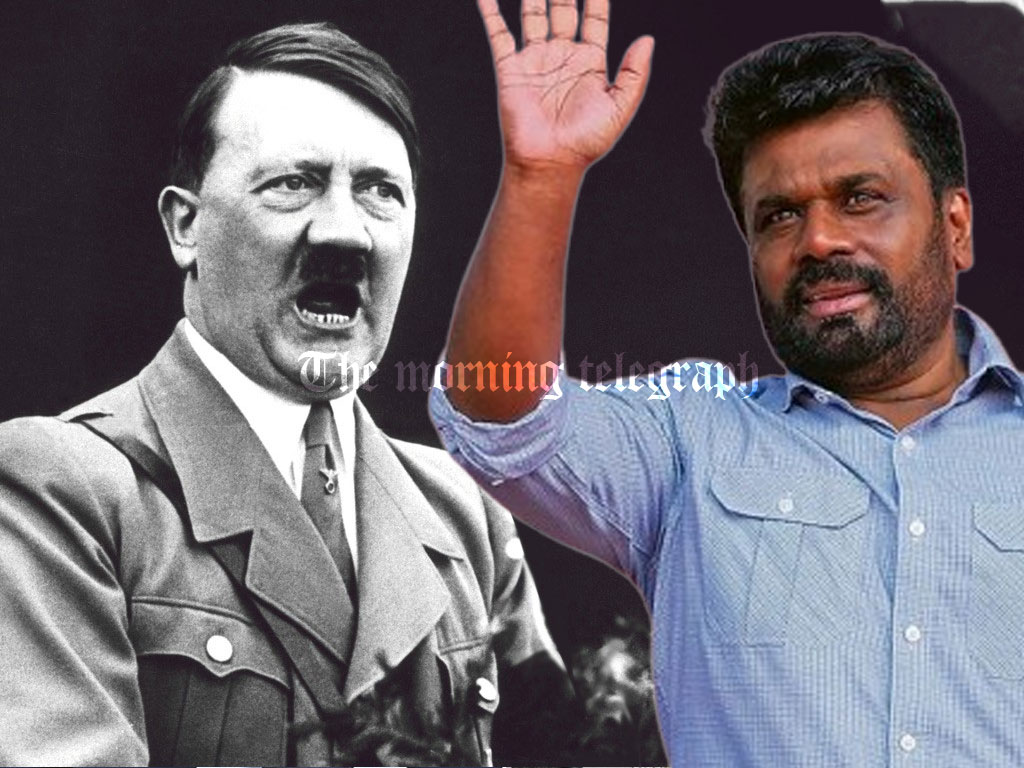
In a blistering critique, MP Udaya Gammanpila retracts an apology only to deliver a devastating political broadside, comparing the President’s rule to Hitler’s early reign and branding his budget promises as “fairy tales” designed to lull a nation to sleep.
The political atmosphere in Sri Lanka was jolted by a severe and meticulously articulated condemnation from Udaya Gammanpila, the leader and legal luminary of the Pivithuru Hela Urumaya. During a media conference that was as theatrical as it was substantive, Gammanpila unleashed a multi-pronged attack on the President, weaving together personal rebuke, historical analogy, and a forensic dismantling of the government’s economic credibility. His address began not with a direct assault, but with a sarcastic reflection on the President’s attention. Gammanpila quipped that the head of state remembers him every day he is absent from Parliament, a level of devotion he wryly noted his own wife, working abroad, probably does not match. This opening salvo, while delivered with a touch of humor, set a tone of deep personal and political friction. He immediately grounded this friction in a recent event, recalling how the President had criticized him for defending Admiral Ulugetenne, only for a High Court judge to later echo Gammanpila’s exact arguments in the order releasing the Admiral. This served as a potent preamble, establishing his narrative as one of vindication against presidential disapproval.

The core of Gammanpila’s argument then took a dramatically serious turn. He addressed a previous, seemingly controversial comparison he had made between the President and Adolf Hitler. In a masterful rhetorical pivot, he declared, “I made a mistake about comparing the President to Hitler.” He immediately clarified that his error was not in making the comparison, but in perhaps its presentation or timing. He directly challenged the President, urging him to listen to the full content of his speech. It was there, he insisted, that the “seven wonderful similarities” between the President and the Nazi dictator would be laid bare. He further elaborated that there were “many wonderful similarities” between the President’s last year in office and the first three years of Hitler’s rule, a period often studied for its gradual erosion of democratic norms. Gammanpila concluded this chilling segment with a stark, almost prophetic warning: “If you realize that Hitler, who slept in 1990, is now waking up inside you, you will feel afraid for yourself.” This was not merely an insult; it was a constructed argument, an invitation to self-reflection framed as a dire caution for the nation’s democratic health.
Having set this ominous stage, Gammanpila seamlessly transitioned into a detailed and scornful critique of the government’s economic management, which he framed as a deliberate deception of the public. He targeted the President’s budget speeches, branding them as works of fiction. With heavy sarcasm, he observed that since children do not frequent the parliamentary library, there is no fairy tale section. However, he proposed a solution: the election manifesto of the compass and the last two budget speeches, he declared, unequivocally belong to that category. He formally suggested to the parliamentary librarian that a dedicated bookshelf be established under the label “Fairy Tales” to house the President’s past, present, and future budget speeches. He bolstered this analogy by noting that fairy tales are designed to lull small children to sleep, a effect he claimed was proven by the sight of Members of Parliament dozing off during the President’s budget delivery. The true measure of this “impractical fairy tale,” he argued, could only be grasped by a rigorous examination of the implementation rates of the previous year’s budget promises.
This is where Gammanpila shifted from rhetoric to a data-driven indictment. He presented a devastating figure: a colossal 1,300 billion rupees had been allocated in the 2025 budget for capital expenditure, encompassing critical infrastructure projects like the construction of roads, irrigation tanks, and public buildings. However, as of September 30th, a mere 25% of these allocated funds had actually been utilized. He projected that even with a year-end surge, capital expenditure would, at its absolute maximum, only reach 50% of the budgeted amount. “Simply put,” he concluded, “only 50% of the budget proposals presented in the last budget have been fulfilled. Half of them are just false promises.” He stated that the full, granular details of what was done, what was not done, and what was only half-done would only become public knowledge with the release of the 2025 Central Bank report, a document he implied would serve as a official record of the administration’s failures.
To prevent his argument from being dismissed as generalities, Gammanpila embarked on an exhaustive recitation of specific, verifiable promises that were confirmed to have been broken. He strategically stated he would “recall only 25 promises,” implying the list was even longer. A central example was the commitment to enter into free trade agreements with strategic partner countries. This promise, made with fanfare in the 2025 budget, was not acted upon. Yet, in a move Gammanpila described as “shameless,” the exact same promise was reiterated in the 2026 budget speech. This, he emphasized, was not an isolated incident but part of a pattern. Other significant legislative and policy reforms that remained entirely unfulfilled included the passing of a new customs bill, for which not even a draft had been presented to Parliament; the formulation of laws to create a One Stop Shop for investors, a key promise for improving the ease of doing business; the passing of a new bill on public-private partnership, crucial for attracting investment; and the creation of an administration company to manage state enterprises. Even a direct commitment to improve workers’ livelihoods, a promise to increase the daily wage to 1,700 rupees, was broken, though a new, higher promise of 1,750 rupees was made in the subsequent budget, a tactic Gammanpila highlighted to showcase a cycle of promise and failure.
The litany of failed initiatives extended deep into the economic and social fabric of the nation. Gammanpila listed promises that had “disappeared without being fulfilled,” painting a picture of a government strong on vision but cripplingly weak on execution. This list was comprehensive and damning. It included international commitments like signing double taxation avoidance agreements and entering the Madrid Protocol for the international protection of intellectual property. It covered institutional development, such as amending the Economic Transformation Act, introducing a new bankruptcy bill, establishing a digital economy authority, and launching a new development bank. It encompassed social and agricultural pledges: establishing an innovation fund, launching public-private partnerships to develop estate hospitals, creating a model daycare center for autistic children, offering scholarships for A-level students to study abroad, maintaining a safe government stock of paddy worth 5,000 million rupees, establishing a shrimp breeding center, and providing dry food at subsidized prices during the Avurudu season. It even included specific promises regarding state-owned enterprises, like ensuring Sri Lankan Airlines reported an operating profit, and creating an industrial colony for assembling automobiles and manufacturing rubber goods. Perhaps most vividly, he pointed to the unfulfilled promise to end the human-elephant conflict through the construction of a 5,611-kilometer electric fence, a critical issue affecting rural lives and the national ecology. The sheer breadth of this list led Gammanpila to a stark conclusion: the President has made it “very clear to the country that when he wants to tell a lie, he will come to Parliament and make a speech.” Therefore, he argued with biting sarcasm, the President cannot be blamed for the 2025 budget speech being “full of lies.” The true objects of pity, he suggested, were the “159 who applauded it” and the government’s supporters, the “Dobi Brigade,” who wrote poems and songs celebrating these hollow proposals.
Gammanpila then crystallized his allegations of deception with a specific, high-profile example involving international diplomacy. He recounted that in April 2025, during a visit by Indian Prime Minister Narendra Modi, the President had officially declared the Dambulla cold storage facility, a project built with an Indian grant, complete. However, by August, Gammanpila stated he had visited the site with the media and demonstrated that construction was, in fact, not finished. This act, he alleged, exposed a lie told to the Sri Lankan people and a deception perpetrated against a key international ally, Prime Minister Modi. The contradiction became painfully public when potato and onion farmers later lamented the lack of storage facilities for their harvest, leading to questions about why the supposedly completed Dambulla facility was not being used. The most damning evidence, according to Gammanpila, came in the President’s subsequent budget speech, where he allocated 250 million rupees to finally complete the work on the same cold storage facility. This admission, Gammanpila argued, was a definitive confirmation that the earlier declaration of completion was a falsehood designed for a diplomatic photo opportunity.
Finally, Gammanpila turned his focus to the government’s overarching narrative of economic recovery. He directly contested the President’s claim that the economy had been brought back to its 2019 level by 2025. He acknowledged that some economists had predicted a ten-year recovery timeline, similar to Greece’s experience, but clarified that his camp had never subscribed to such a pessimistic forecast. Instead, he reframed the entire premise. “When he took over the country,” Gammanpila stated, “the economic growth rate was 5%. Foreign reserves were six billion dollars.” From this perspective, the government’s task was not to heroically rescue a fallen economy from a deep hole, but to protect and stabilize an economy that was already on the surface and showing positive indicators. He sarcastically mused that even if government leaders were suffering from “dementia, which causes memory loss,” the memory of the Sri Lankan people remains sharp and accurate. He reinforced this point by referencing Minister Harshana Nanayakkara’s recent oversight of forgetting to properly sign his asset declaration, implying a pattern of forgetfulness regarding crucial details within the administration.
To provide an undeniable, tangible benchmark for the public, Gammanpila concluded with a powerful reminder of the economic reality at the end of 2019, a period he suggested the government now romanticizes. He listed the prices that defined everyday life back then: a liter of petrol was 137 rupees; diesel was 104 rupees; an electricity unit was 2.50 rupees; and a gas cylinder was 1,500 rupees. This simple list served as his ultimate rebuttal. He challenged the government to return the economy to those specific indicators, the ones that directly impact the cost of living and household budgets. He declared that the Sri Lankan people are not ready to accept a recovery narrative based solely on parliamentary pronouncements and macro-economic data points that are disconnected from their daily struggles. The true measure of success, he asserted, is not found in budget speeches or political applause, but in the restored purchasing power and economic stability of the common citizen. In doing so, Udaya Gammanpila’s address transcended a mere political attack; it became a comprehensive manifesto of opposition, questioning not just the government’s competence, but its very truthfulness and its commitment to democratic principles.