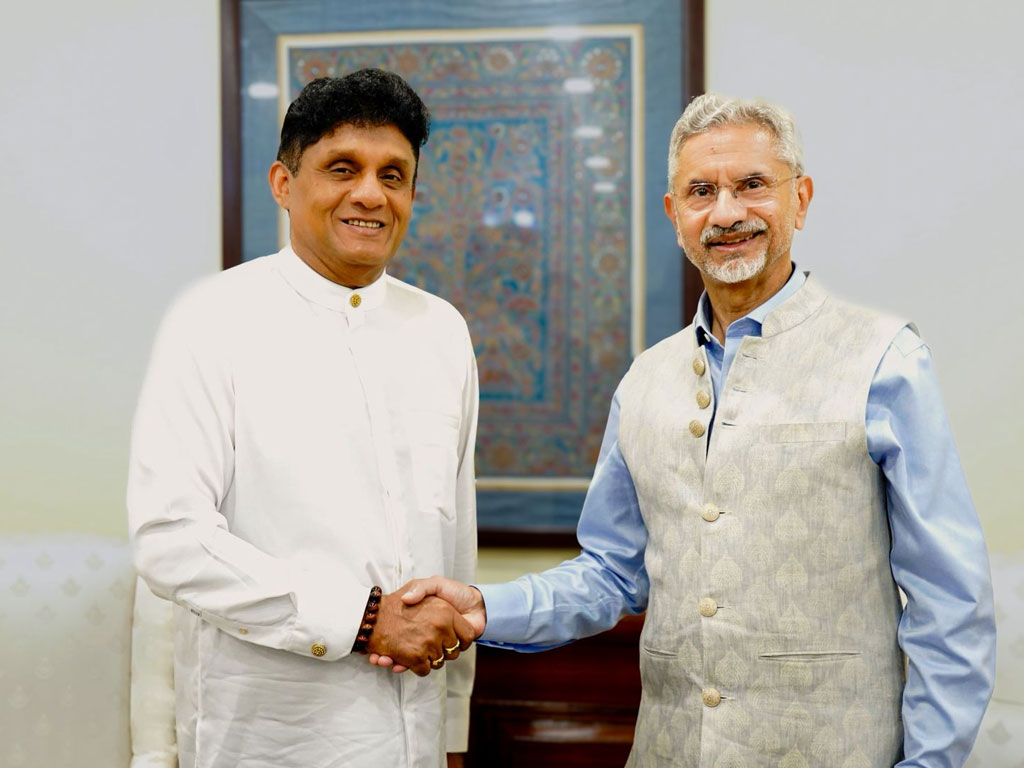
India’s quiet invitations to Sri Lankan opposition leaders long before they come to power reveal a pattern of political foresight that has shaped Colombo’s leadership for decades, from Chandrika to Anura, and now Sajith Premadasa.
India’s diplomatic theatre has never been one of loud declarations. It is a play of silence, timing, and precision. Through carefully orchestrated gestures, New Delhi has long influenced Colombo’s corridors of power without uttering a single directive. For decades, India’s quiet invitations to Sri Lankan opposition leaders have predicted political transitions before they occurred. Each visit, conducted discreetly and with deliberate timing, has revealed Delhi’s ability to read Sri Lanka’s shifting winds. The latest to walk this path is Opposition Leader Sajith Premadasa, whose recent visit to India has reignited an old question: does Delhi already know Sri Lanka’s next move?

The story does not begin with Sajith but with a small photograph buried in the third page of the Divaina newspaper in 1992. Its headline read, “Chandrika on a Tour to India.” The accompanying image showed then Indian Foreign Secretary J. N. Dixit in conversation with a young Chandrika Bandaranaike Kumaratunga. The article said she was visiting to deliver a lecture at Jawaharlal Nehru University, but the trip was no academic exercise. It had been quietly arranged by the Indian government itself, a subtle signal of recognition toward a woman who, at the time, was not even a local councillor. She had only just rejoined the Sri Lanka Freedom Party after leaving the Bahujana Peramuna, and her brother Anura Bandaranaike was fiercely contesting her re-emergence within the party.
India saw what others did not. Behind the family rivalries and political uncertainty, Delhi identified the potential of a future leader who could reshape Sri Lanka’s direction. That invitation, as history proved, was not misplaced. Within two years of her trip, Chandrika became Chief Minister of the Western Province. By 1994, she was Prime Minister, and later that same year, she was elected President. Her path to power seemed less like coincidence and more like choreography, the result of a political instinct that India had honed for decades.
The pattern did not stop there. In 2002, Mahinda Rajapaksa became Leader of the Opposition while maintaining a strained relationship with India. Yet in January 2003, Delhi invited him for an official visit. Upon returning, Mahinda told reporters that his trip had been significant, that the current political situation in Sri Lanka and the issues facing the Eastern Province had been discussed with Indian leaders. His words sounded routine, but in retrospect, the visit established a new understanding between Colombo and Delhi. Within six years, Mahinda became President, leading a government that defeated the LTTE. It was a victory that India, despite its own regional sensitivities, did not resist.
A decade later, the same script unfolded again. In August 2013, India’s attention shifted to Opposition Leader Ranil Wickremesinghe. He was invited to India for an unofficial visit and held closed-door meetings with senior Indian officials. The Rajapaksa government, sensing Delhi’s changing mood, quickly dispatched Minister G. L. Peiris to India in response. Ranil’s visit passed quietly, but by 2014 he was Prime Minister. Once again, India had sensed which way Sri Lanka’s political tide was flowing.
When the Rajapaksas were defeated in 2015, many believed their political dynasty had ended. Yet India did not close the door. After Mahinda’s victory in the 2018 local government elections and his return as Leader of the Opposition, Delhi extended fresh invitations to both Mahinda and Namal Rajapaksa. The move surprised many, given that Mahinda had previously accused India of orchestrating his 2015 defeat. But Delhi’s logic was simple. It does not play emotional politics; it plays long games. By 2019, Mahinda was Prime Minister again, Gotabaya Rajapaksa was President, and the Rajapaksa family was back in power.
Then came February 2024, the moment that revealed India’s continued mastery of timing. Delhi invited Janatha Vimukthi Peramuna leader Anura Kumara Dissanayake for an official visit. For many Sri Lankans, the invitation was astonishing. The JVP had long been a fiercely nationalist, anti-India movement that criticised Delhi’s role in South Asia. Yet Anura was photographed in Delhi meeting India’s top officials and was treated with the respect of a future statesman. At the time, he was merely an opposition MP without majority backing or strong business alliances. But India’s intelligence and diplomatic networks had read the signs. Public frustration with traditional parties was peaking, and Anura’s popularity was rapidly growing. By September 2024, he was President.
Each of these invitations, spanning three decades and multiple leaders, followed a rhythm that was deliberate and strategic. India observes, waits, and when it sees alignment between domestic frustration and opposition potential, it extends a silent gesture of recognition. The invitation serves both as a test and a signal. It is Delhi’s way of saying, “We see you. We are ready when you are.”
Now that recognition has been extended to Sajith Premadasa.
Sajith’s recent visit to India was more than a diplomatic courtesy. During his stay, he met India’s External Affairs Minister, the National Security Advisor, and several senior figures across the ruling establishment. The visit came at a delicate time when Anura Kumara Dissanayake’s presidency was beginning to show signs of strain and the next phase of Sri Lanka’s political chessboard was being carefully set. Inside Delhi’s policy circles, Sajith’s name had already emerged as the next plausible contender—a leader with national recognition, an unblemished public image, and growing acceptance among the business community and middle class.
Yet Sajith’s relationship with India carries layers of history. His father, President Ranasinghe Premadasa, remains in India’s memory as the leader who expelled the Indian Peacekeeping Force from Sri Lanka in 1990. That act redefined India’s strategic engagement in South Asia and cast a long shadow over his son’s political journey. Sajith has spent years trying to redefine that legacy.
When Indian Prime Minister Narendra Modi visited Sri Lanka in 2019, then Foreign Minister Mangala Samaraweera appointed Sajith as Minister-in-Attendance. Modi personally greeted him and expressed admiration for his housing program. Sajith went further by creating “Modi Village” in Hambantota, symbolising friendship and renewed ties. Through such gestures, he gradually replaced the image of confrontation with one of cooperation.
After Anura’s rise to the presidency, Modi met Sajith again and personally assured him of an official invitation, which India later fulfilled. For Sajith, the visit was not only about rebuilding diplomatic trust but also about reshaping his political identity. In Delhi, he was seen not as the son of a defiant president but as a pragmatic leader ready to engage with India as a regional partner.
India’s broader strategy remains unchanged. It rarely intervenes openly in Sri Lankan politics but ensures that whoever ascends to power has already passed through its doors. This anticipatory diplomacy allows India to maintain influence regardless of the party or ideology in Colombo.
Analysts in both countries now wonder if Sajith will follow the same trajectory as Chandrika, Mahinda, Ranil, and Anura, all of whom visited India shortly before rising to power. In Delhi’s playbook, timing is never accidental. Its diplomats study Sri Lanka’s political undercurrents with precision, identifying who stands next in line for leadership long before the ballots are cast.
Sajith’s visit may therefore signal more than goodwill. It could mark the beginning of another carefully managed transition in Colombo, one observed from across the Palk Strait. Whether or not he becomes president, his presence in Delhi confirms one thing: India has once again acted before the tide turns.
In Sri Lanka’s political folklore, these visits have come to carry a sense of prophecy. Chandrika’s 1992 tour preceded her presidency. Mahinda’s 2003 journey came before his victory. Ranil’s 2013 meetings were followed by power in 2014. Anura’s trip in February 2024 foreshadowed his election in September. Now Sajith has taken the same path.
India’s hand in Sri Lanka’s politics has always balanced between subtle influence and strategic restraint. Yet what remains undeniable is that no major transition in Colombo takes place without first echoing through Delhi’s diplomatic circles. Behind every handshake and every invitation lies a quiet calculation that keeps India at the heart of Sri Lanka’s political rhythm.
History, it seems, is repeating itself once again.