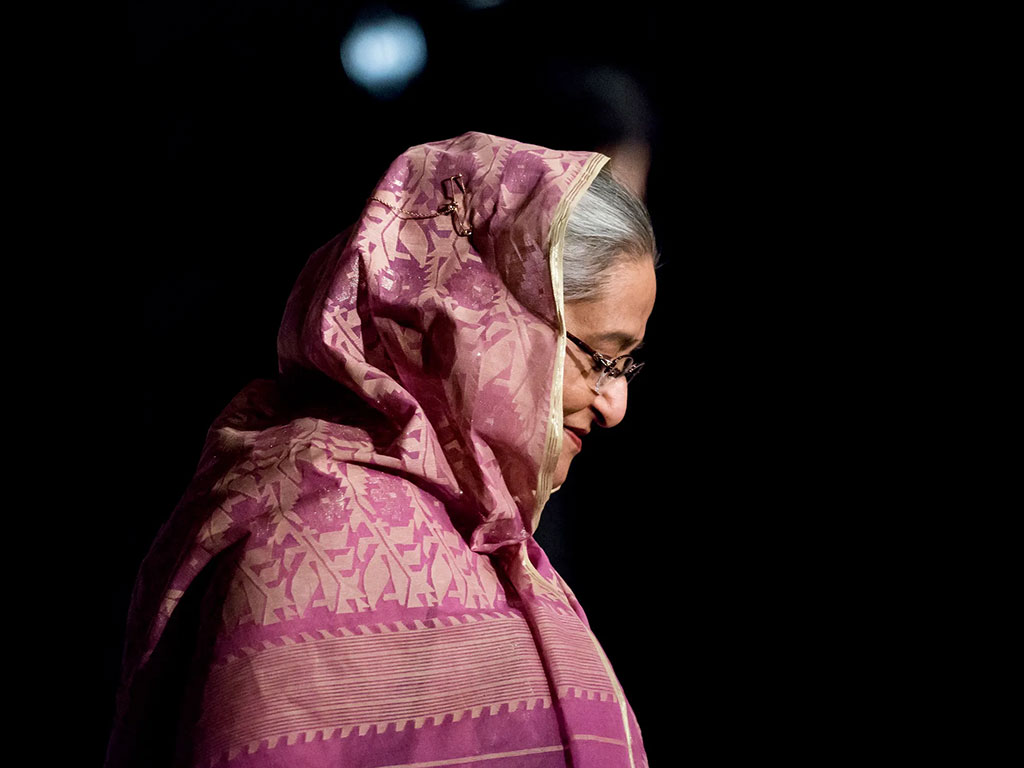
A landmark ruling next Monday will determine the fate of ousted Prime Minister Sheikh Hasina, who stands accused of overseeing deadly crackdowns on student protesters during last year’s July uprising.
Bangladesh’s International Crimes Tribunal-1 is set to deliver its long-anticipated verdict on November 17 in the case filed against former Prime Minister Sheikh Hasina and three senior officials. They are charged with crimes against humanity committed during the violent student-led uprising that shook the country last July. The tribunal, chaired by Justice Md. Golam Mortuza Majumdar alongside Justice Md. Shafiul Alam Mahmud and Judge Md. Mohitul Haque Enam Chowdhury, fixed the judgment date after concluding all trial proceedings on October 23.

The case extends beyond Hasina herself. Former Home Minister Asaduzzaman Khan Kamal and former Inspector General of Police Chowdhury Abdullah Al-Mamun are also implicated, with Al-Mamun later becoming an approver in the investigation. Chief Prosecutor Tajul Islam lodged the complaint on June 1, detailing five major counts of alleged atrocities carried out by the defendants against unarmed students and civilians.
The first count accuses Hasina and her inner circle of murder, attempted murder, torture, and other inhumane acts. The prosecution alleges that they not only failed to prevent attacks on peaceful protesters but aided and abetted violent actions perpetrated by law enforcement agencies and Awami League-linked armed groups following Hasina’s controversial July 14 media briefing. The second count alleges that Hasina ordered an extermination campaign against student demonstrators using helicopters, drones, and firearms, with directives facilitated by the former home minister and the inspector general of police.
Count three centers on the killing of student Abu Sayed near Begum Rokeya University in Rangpur on July 16. Prosecutors claim officers fired multiple rounds into Sayed’s chest under direct political orders. Count four relates to the shooting deaths of six unarmed students in Dhaka’s Chankharpul area on August 5. Count five alleges that six students in Ashulia were shot and burned the same day, with five victims confirmed dead post-mortem and one reportedly burned alive.
Prosecutors argue that collectively, the five counts constitute crimes against humanity, including systematic murder, torture, conspiracy, facilitation, and abuse of state power. They say these acts were orchestrated and enabled by Hasina and her senior officials, forming a pattern of organised violence.
The tribunal’s verdict is expected to carry enormous political and legal consequences for Bangladesh. A guilty ruling could reshape the country’s power structure and deepen divisions across an already polarised political landscape. As the nation awaits November 17, tension continues to rise, with global observers watching closely.