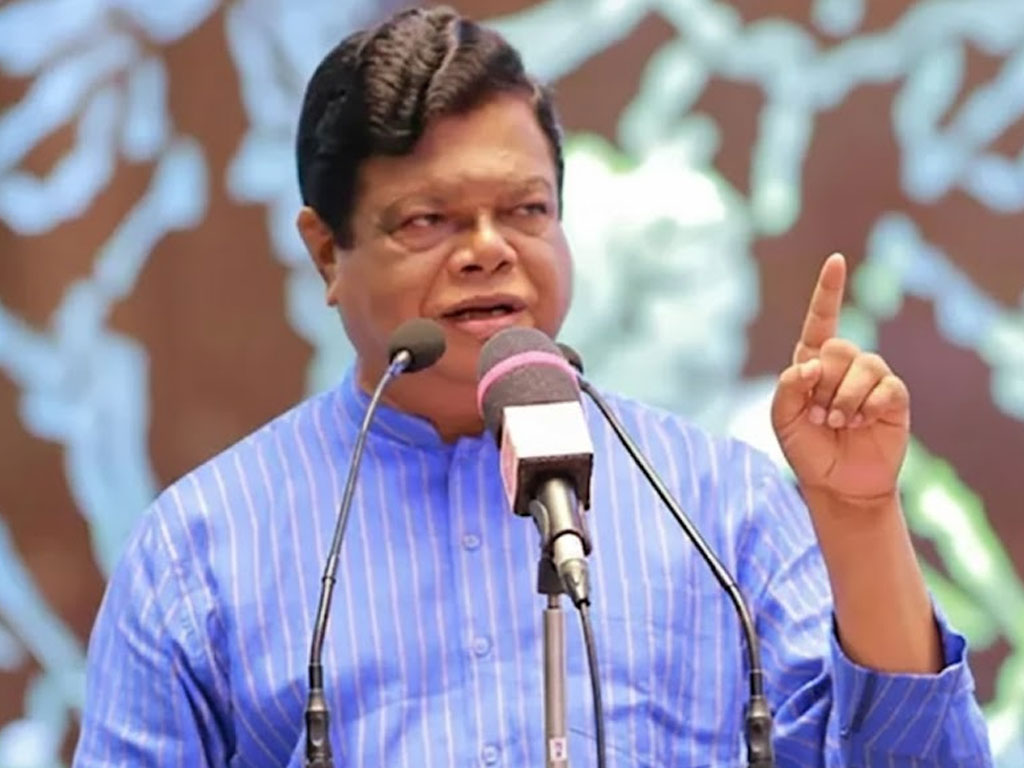
Former Minister Bandula Gunawardena has dismissed the claim of a trillion rupees in the treasury as a political fantasy, warning that Sri Lanka survives only through nonstop borrowing.
Former Minister Bandula Gunawardena stated that the story of a trillion remaining in the treasury is completely false and that according to basic economics there is no money left in the treasury of Sri Lanka. He made this statement on the thirteenth at a media conference held in Nugegoda to raise awareness about the book IMF Complex Solutions. He explained that the claim of a surplus in the treasury is an unacceptable story designed to mislead the public at a time when the country is battling one of the worst economic crises in its post independence history. Gunawardena stressed that Sri Lanka’s financial system continues to operate through heavy borrowing with no real reserves available for daily government functions.

He said that Sri Lanka faces two major national problems at present and the central issue is the lack of sufficient income to run the government on a daily basis. He referred to the long standing current account deficit in the state budget and pointed out that except for the three years of 1950, 1951 and 1977, Sri Lanka has never earned enough revenue to meet its daily operational needs. According to him this same crisis existed before the economic collapse and continues to persist even today, forcing every administration to depend on loans from domestic lenders and foreign creditors.
Gunawardena said that when the current account of the state budget shows a deficit there is nothing left in the Sri Lanka treasury. He added that regardless of who becomes president or which political group forms the government, there is no income stream that can cover daily expenses without borrowing. He emphasised that there has never been a government that survived without loans and there will never be one in the future as long as the country’s revenue base remains inadequate. In his view Sri Lanka’s economy functions by taking loans each day to cover salaries, subsidies and essential public services, and this continuous borrowing has now created a structural crisis that cannot be ignored.
He said that recent laws and financial regulations introduced under IMF influenced reforms aim to reduce the current account deficit of the state budget to five percent of the gross domestic product or less. He pointed out that there is a surplus in each targeted account when interest payments are excluded and a surplus in the primary account. Gunawardena further explained that after paying the salaries of government employees, pensions, subsidies and the purchase of goods and services required for day to day operations there is a primary surplus of two point three percent. This primary surplus reflects expenditure excluding interest payments on loans. However once interest expenses are added the surplus immediately turns into a deficit in the current account. He repeated that after paying interest on loans the government falls back into deficit and this cycle shows the depth of Sri Lanka’s financial instability.