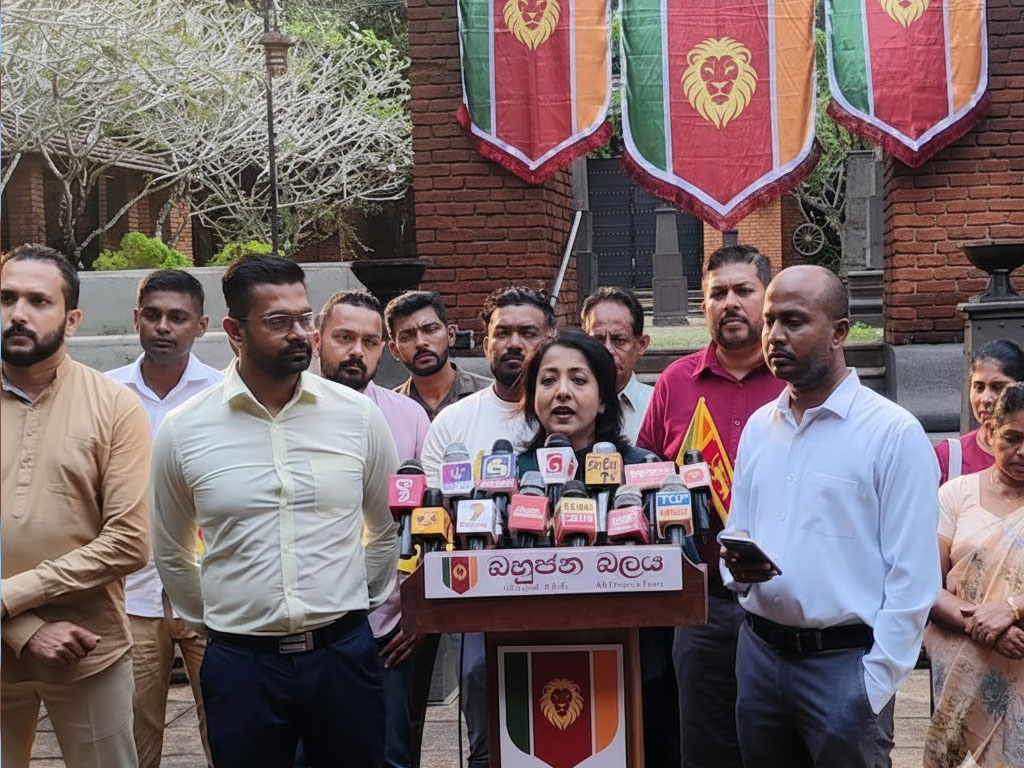
In a shocking move that has united a fractured opposition, the government is under fire for allocating a colossal 300 million rupees for a controversial “Sri Lanka Day.” As a new mass political movement, Bahujana Balaya, rises to fight it, we go inside their explosive first press conference where they labeled the celebration a “national crime” and an attempt to “erase history.”
A political earthquake is rumbling in Sri Lanka, not from a single party, but from a newly unified force. Young political leaders from across the opposition spectrum have coalesced to form Bahujana Balaya, a mass organization with a clear and urgent objective: to educate the public about what they term the short-sighted and dangerous actions of the current government and to propose effective solutions. Their first target? The government’s plan to spend 300 million rupees on a new national celebration, Sri Lanka Day. The inaugural media discussion of Bahujana Balaya, held in Battaramulla, served as a powerful launchpad for a scathing critique of the government’s priorities, highlighting a profound disconnect between the state and its struggling citizens. The event showcased a rare moment of political unity, with activists from various parties setting aside their differences to confront a common adversary on a platform of fiscal responsibility and historical preservation.

Dr. Priyankara Mahagammullage, a member of Bahujana Balaya representing the UNP, set the stage by outlining the movement’s foundational principles.
“We bring Bahujana Balaya to you today as a mass movement that can work with a common goal for all people, regardless of party color, race, caste, religion,” he declared.
He emphasized the significance of this unity, noting that while talk of such a movement was common, they had successfully transformed it into a tangible reality. The gathering, he stressed, included only the founding members, representing a majority of opposition parties, a notable feat given the frequent disagreements that plague the opposition. He explained their critical yet fair approach.
“When the budget debate is held in Parliament, we do not hesitate to criticize the mistakes made by this government and to praise it if the government takes a constructive approach.”
It was from this platform of intended constructive criticism that Dr. Mahagammullage launched into the core issue.
“Last time, during the budget, the President proposed a new day called Sri Lanka Day. It is rumored that the government will celebrate that day on December 12. Not only that, it is reported that 300 million rupees or 300 million rupees are to be spent for this.”
He questioned the very necessity of this new day, pointing to the existing national celebrations.
“When the entire nation can celebrate Independence Day on February 4 without any hassle under the Lion Flag, when there is Republic Day on May 22, and in addition, there are many cultural days, why is this another day?”
His questioning took a more pointed turn, suggesting a hidden political agenda.
“Is the government doing this stupid work to bring forward a colorful rainbow flag and concept? The government that criticized the expenses incurred when Ranil Wickremesinghe celebrated Independence Day, the government that cut expenses to reduce the solemnity of Independence Day, the government that made War Heroes Day a Soldiers’ Day, is it coming up with a new day to erase our history and create a JVP history?”
This rhetorical question framed the government’s action as a deliberate attempt to rewrite the national narrative. He concluded with a rallying cry.
“We appeal to the people of this country, the Trinitarian Mahanayake Theros, and the Cardinal Thero to be vigilant about the absurd work being done by this government. The government that is rewriting history and working hard to cover up the arias of history, wants to change the culture and civilization of the country better than the whites, but we are united and are launching this mass movement against it.”
Following him, Kumudini Bandara, another UNP member of the Bahujana Balaya, shifted the focus to the sheer impracticality and social cost of the new holiday. She began by contextualizing Sri Lanka’s place in the world.
“Our country is a country with the highest number of holidays among the countries in the world. We are in third place. Only Nepal and Iran are above us.”
She acknowledged that these holidays are rooted in a rich culture, each bearing national, religious, or cultural significance. Then came the pivotal question.
“Do we need another holiday to add to this pile of holidays?”
She painted a picture of the disruption it would cause.
“By blocking the roads of Colombo and disrupting normal life and adding a new Sri Lanka day to the calendar, this government, which came to power on the basis of classist hate politics, is trying to belittle the Independence Day that celebrates the great freedom that leaders like His Excellency DS Senanayake, FR Senanayake, Sir James Peiris, GG Ponnambalam, Chelvanayagam, TB Jaya gave to this country.”
Bandara then masterfully redirected the conversation to the human cost of this 300 million rupee expenditure, highlighting pressing social issues.
“Why can’t the money spent on such baseless celebrations be spent on creating a program that will help women from low-income families improve their livelihoods?” she asked, giving a voice to the silent struggles of countless citizens.
“How many thousands of children in this country go to school in sandals because they can’t afford a pair of shoes? Why can’t this money be spent on those children? With this allocated money, children can buy shoes worth hundreds of thousands.”
She further humanized the argument by pointing to the often-invisible workforce.
“The innocent people who clean the streets in the Colombo urban environment in the morning and evening do not have proper equipment or protective gear. The lives of those people are becoming increasingly difficult. When such a fake show is over, those people should clean these streets. Wouldn’t it be better if this money was used to uplift the lives of those people?”
She accused the government of deception, of forgetting its promises and telling fairy tales to the people. Her conclusion was laced with biting sarcasm as she speculated on the choice of date.
“Finally, can you imagine the reason why this government is using December 12 to celebrate Sri Lanka Day? To me, the only reason seems to be the most obvious. December 12 is the day that the Mayan calendar says the world will end. So how can the world end? A government formed by a party that has caused the most destruction in Sri Lanka knows only about destruction. So, it is only natural for them to celebrate a day related to destruction, which is what they are most skilled at, right?”
The tone grew even more confrontational with Charith Abeysinghe of the SJB, who began with a powerful, quotable slogan.
“Not for the dramas that suck people’s money! Don’t hide history and deceive the nation!”
He described the government’s budget speech as a fairy tale, an illusion of paradise that bears no connection to reality.
“Now, taking this illusion a step further, they are preparing to perform a brand new national drama called ‘Sri Lanka Day’.”
Abeysinghe did not mince words about the potential ulterior motives, suggesting the event was a smokescreen.
“This is a drama that is danced to suppress the drug trafficker of the day, when he emerges from the compass. They are trying to cover up the Japanese nonsense by wearing T-shirts saying ‘Clean Sri Lanka’.”
He questioned who the real beneficiaries of this “grand gamble” were, concluding it was only the government’s allied advertisers, media institutions, and contractors. In a direct challenge to the government, he demanded,
“We are directly from the government Asking: Is the blood, sweat and tears of the people of this country being squeezed into taxes, to make the cadre of the compass wear a T-shirt?”
He reminded them of their campaign promises of fiscal responsibility, asking if this was their definition of saving public money. His challenge was unequivocal.
“We challenge the government directly! If possible, recreate the history of JVP with the tax money of the people and show it!”
He drew a sharp distinction between what he implied was the dark history of the JVP and the nation’s proud milestones.
“What is that history? This country has not gained anything from those struggles. The country has only inherited a few parents who lost their children and a few children who lost their fathers. It is not like the proud freedom struggle that our old leaders won for this country without shedding a single drop of blood. It is not like the war victory that defeated terrorism and brought peace to this country through a humanitarian operation.”
Abeysinghe repeatedly returned to the sanctity of Independence Day.
“What is wrong with our National Independence Day? Leaving aside that great day that the entire nation has been celebrating with pride for decades, this newly created ‘Pacha Dina’ Why?”
He proposed a simple, cost-effective alternative.
“Why can’t you, at the same cost, with the same pride, celebrate our Independence Day with all the nations and bring them together and celebrate it more proudly? Then wouldn’t the people’s tax money be saved in crores? Or do you want to forget the history of our freedom struggle?”
He pledged to unite religious leaders, communities, and patriotic forces against this “waste of national wealth.” His final challenge was a masterstroke, putting the onus back on the government and its allies.
“We challenge you to make this ‘Sri Lanka Day’ a success! If you really want to hold these celebrations, do it with your party funds that are in the crores. Or ask the millionaire business minister Wasantha Samarasinghe to do it. We have no objection to that. But we will not allow even a single penny of the taxes of the innocent people of this country to be touched, to whitewash that dark history, or to cover up the drug trafficking that is emerging today! We will not allow that national crime at all!”
Milinda Rajapaksa of the Sri Lanka Party brought a different perspective, using metaphorical language to critique the government’s overall performance.
“The child that Ranil Wickremesinghe handed over at the last corner of the bridge is walking as if President Anura Kumara carried him the entire journey,” he said, suggesting the current administration is taking credit for economic stabilization efforts it inherited.
He stated they had no issue with this, so long as the country benefited, but warned,
“But if the child is carried incorrectly, the child will fall off the bridge.”
Rajapaksa then grounded the debate in the acute agrarian crisis gripping the nation.
“Today, farmers are taking to the streets. Not just one group, the potato farmer has taken to the streets, the onion farmer has taken to the streets, the rice farmer has taken to the streets, the corn farmer has taken to the streets, the vegetable farmer has taken to the streets. The harvest of those innocent people is rotting in their homes.”
He contrasted this dire situation with the government’s spending priorities.
“The Compass government is spending crores to add new dates to the calendar. It spent lakhs and lakhs to conduct a census. Where are the measures taken for them? Can’t the innocent farmers be given relief with the money they are spending so recklessly? Can’t they buy those people’s onions without measuring the diameter of the onion? In the end, both the farmer and the consumer are orphans!”
He also raised national security concerns, noting decreased allocations for security and reduced numbers in the security forces.
“India is already warning about the formation of new organizations against the country and the strengthening of old organizations.”
He framed this as a profound failure of governance.
“The government, which came to cut unnecessary expenses, is adding new expenses today. The government that does not spend where it needs to be spent spends on unnecessary things. This is not what the people elected this government for.”
His prediction was clear.
“The same people who were elected will soon send this government home. We request the government to do the work it came to do without wasting crores of money and challenging the culture and civilization of this country and go home.”
The conference was concluded by Iranga Mendis, the Convenor of Mahujana Balaya, who signed off “with patriotism,” solidifying the event’s tone as a nationalistic call to action against a government perceived as wasteful and historically revisionist. The formation of Bahujana Balaya and its focused attack on the 300 million rupee Sri Lanka Day expenditure signals a potent new front in Sri Lankan politics. It frames the government’s decision not just as a policy misstep, but as a fundamental betrayal of public trust, a waste of critical funds during an economic crisis, and an assault on the nation’s historical identity. The movement’s ability to maintain this unity and channel public discontent will be a critical factor to watch in the coming months, as the government proceeds with its controversial plans for a new national day.