By Roshan Jayasinghe
This piece began after I watched a TED Talk by Nick Hanauer, a billionaire investor speaking unusually plainly about inequality and bad economic ideas. What he said touched a vein that has been running through my own thinking for years: that much of what we take as “the way the world works” is in fact a set of human choices and stories. This essay is the result of sitting with his words alongside what I see in everyday life.
We live inside many stories we did not write. Some are kind. Some are cruel.
One of the loudest stories of our time is the story of capitalism. It hums underneath everything: how we work, what we buy, what we are praised for, what we are ashamed of.
The TED Talk that brought this into sharp focus was titled “The dirty secret of capitalism and a new way forward.” It was given by Nick Hanauer, a venture capitalist, an early investor in Amazon, and one of the people who has done extremely well inside this global game.

If there is such a thing as a winner in this system, he is one of them. Which is why what he said matters.
He did not stand up and tell us to work harder. He did not say the system is fair and we should stop complaining. He stood there and said, very clearly, that the way we have been taught to think about the economy is wrong, and that this wrong thinking has helped create the massive inequality and political anger we see rising around us today.
He did not blame bad people. He blamed bad ideas.
For decades we have been fed a simple economic story. Markets are natural and always know best. Rich people and large corporations are the job creators. If we make things easy for them, wealth will trickle down to everyone else. Whatever wage you get is simply the true value of your work.
Hanauer calls this out as false. Not just slightly off, but deeply untrue.
Real human beings are not cold, selfish calculators. We are cooperative, sensitive to fairness, and deeply affected by how we are treated. Prosperity does not magically descend from a small group at the top. It grows from the middle out, when ordinary people have enough money and security to participate fully in the life around them.
Hearing this from a billionaire confirmed something many people already feel in their bones. Much of our suffering comes not only from what happens to us, but from the constructs we bow to. We treat money, borders, status and ideology as if they were forces of nature. We forget that they were all invented by human beings. We let them rule us as if they were gods instead of tools.
Hanauer, in his own language, is saying the same thing about capitalism. The economy is not a god. It is a story and a structure we made up. If we made it up, we can also change it.
One of the strongest images in his talk is the picture of the economy as a jungle. This is the old picture. In a jungle, the strong eat the weak. It is brutal but “natural”. You do not argue with the lion because the lion is just being the lion.
This is how many of us have been taught to see markets. If someone is crushed, it is sad but it is just how it is. Survival of the fittest.
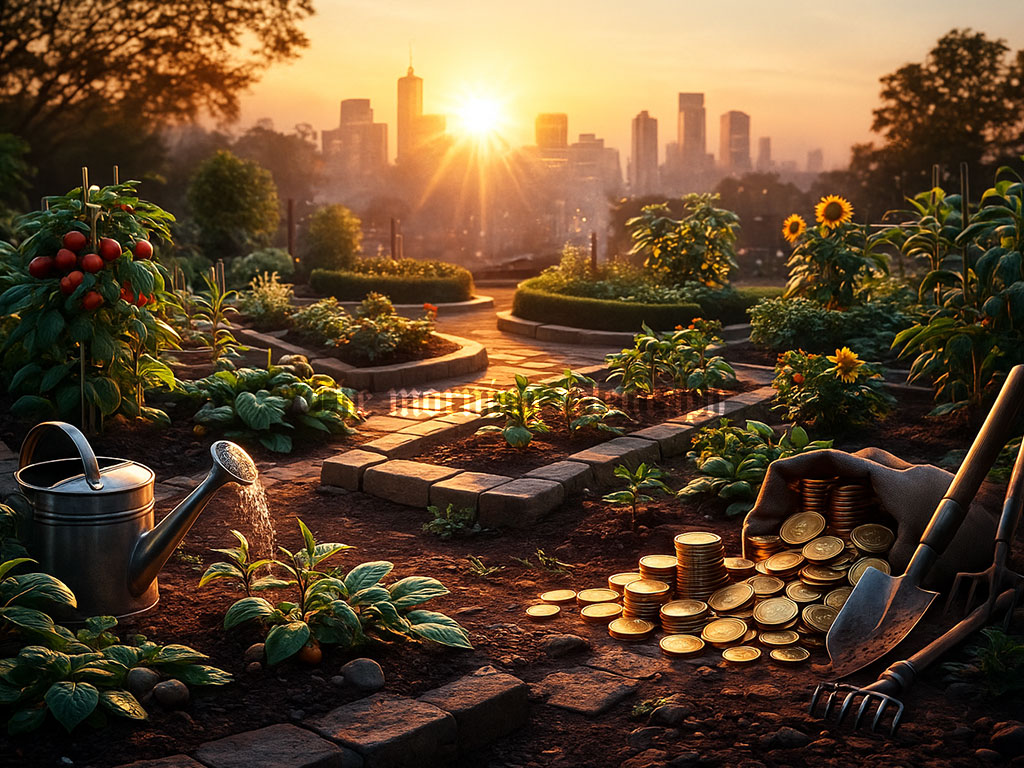
Hanauer suggests a different picture. He says the economy is not a jungle. It is a garden.
A garden is not natural in the sense of untouched. It is human made. Some plants grow fast and spread. Some are delicate and need protection. If you do nothing, a few aggressive plants take over and choke the rest.
A good garden needs tending. It needs weeding, pruning, choosing what to plant, making sure there is enough light and water for the whole. In the same way, a healthy economy needs rules, boundaries and shared values. If we leave it completely free, it does not become beautiful. It becomes wild in the worst way.
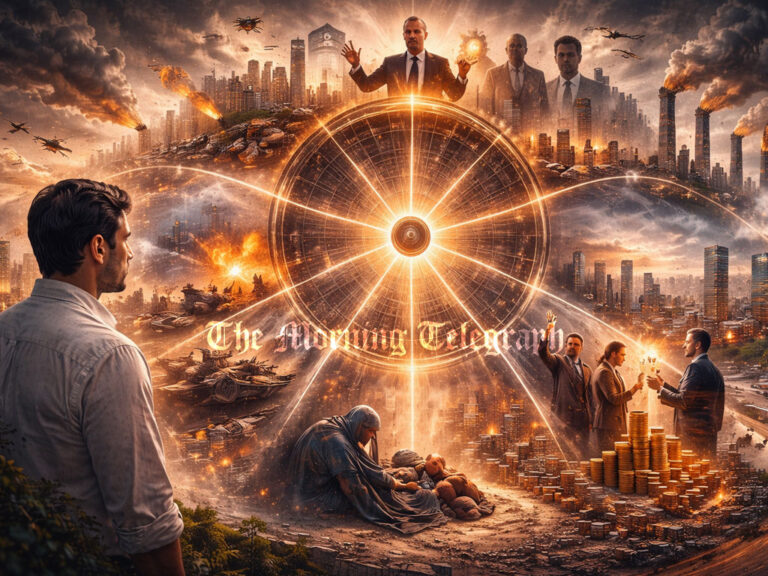
This garden image sits close to another picture I often come back to in my own thinking: the wheel.
On the outer rim of the wheel are all our roles and games. Employer, employee, consumer, citizen, creditor, debtor. The rim spins fast. Quarterly profits, elections, GDP numbers, social media outrage, daily survival.
At the centre of the wheel there is stillness. There is simply the fact that we are human. We breathe, feel, love, hurt. We want a fair chance at a decent life.
When we live only on the spinning rim, we forget that the centre exists. We begin to believe that the spin is just how it is. We forget that we built the wheel in the first place.
When we remember the centre, we see the wheel again as a tool, not a master. Something we designed, not something that designed us.
Hanauer’s garden is the same truth in another form. The economy is not an untouchable force of nature. It is a man made construct. We are allowed to tend it.
In his writing outside the TED stage, he goes further and offers a kind of new rulebook for economics. He says that markets work best when they are treated as gardens, not jungles. That inclusion is not a luxury for later, it is the engine of prosperity itself. When regular people earn decent wages and feel secure, they spend, invest and build, and that is when real growth happens.
He argues that businesses should serve everyone they touch, not only their shareholders. Workers, customers, communities and suppliers are all part of one living system. If any of those are constantly squeezed, sickness spreads.
He also says very plainly that greed is not a virtue. Acting only for yourself, all the time, is not clever or strong. It tears communities apart and eventually even harms the wealthy, because unstable societies are dangerous for everyone.
Most importantly, he reminds his audience that economics is a choice. The rules we follow today are based on beliefs from yesterday. When we realise those beliefs were wrong, we are free to choose new rules.
If you strip away the economic vocabulary, what is left is simple. It sounds like the things many of our grandparents told us. Do not be greedy. Share what you have. Look after your neighbours. Leave things better than you found them.
Sanity is often much simpler than the theories that hide it.
For me, all of this connects directly to what I think of as Transparent Trade and the idea of being custodians of the world.
When I talk about Transparent Trade, I am really talking about seeing each product as a small story of lives and landscapes, not just a price on a shelf. Take a jar of coconut butter in a shop in a foreign city. A normal label tells you the brand, the ingredients and maybe some marketing lines.
A transparent label would tell you who grew the coconut, what they were paid, how the soil and water are treated, and how much of your money actually reaches the people who did the work.
In other words, the economy is people, and we refuse to forget which people.
That is what being a custodian looks like in trade. We make people visible. We tell the truth. We refuse to hide exploitation behind clever packaging.
In a wider sense, being a custodian means remembering that none of this is truly ours in the permanent sense. Not the money, not the land, not even the companies. We are temporary caretakers. The earth was here before us and will be here after us. The systems we build are passing forms. Our responsibility is to hand things on in better condition than we found them.
Years ago, Hanauer wrote an article with a striking title: “The Pitchforks Are Coming For Us Plutocrats.” In it he warned other wealthy people that you cannot keep taking more and more while telling the majority that everything is fair. Eventually people see through the lie. When they do, anger rises. History shows that when inequality becomes extreme, societies break.
This is not about hating rich people. Most people do not hate wealth itself. What they hate is being lied to, disrespected and shut out of the possibility of a decent life.
In my own words, people do not burn from lack of luxury. They burn from lack of fairness.
When someone like Nick Hanauer stands up and says the story that justified his wealth is flawed, it matters. Not because he is more important than anyone else, but because even inside the system, the alarm bells are ringing.
In my own life and writing I have been slowly sketching what I think of as a human blueprint. A way of living that starts from honesty, simplicity and respect for life.
Hanauer’s talk supports that blueprint from another direction. He confirms that our economic order is man made, not sacred. That the human being is cooperative by nature, not a permanently broken ego. That greed and secrecy are not unavoidable, but are built into the current story and therefore can be designed out when we choose a different story.
Most of what we fight over in this world is man made. What is not man made is our shared humanity and the living earth beneath our feet.
If we remember that we are custodians, our choices begin to shift. In business we look beyond profit alone and ask whether something is fair and honest. In trade we honour the people and the land behind every product. In everyday life we stop glorifying greed and start respecting the idea of enough.
We will not redesign global capitalism from our kitchen tables. But we can keep telling the truth. We can keep choosing a little more fairness where we can. We can keep seeing through the lie that this is just how it is.
If enough of us do that, the story shifts. And when the story shifts, so do the rules.
A billionaire on a TED stage has now admitted that the old story of “this is just how capitalism works” is a man made script.
What we do with that admission, in our homes, in our work, and in our small daily choices, is up to us.
About the Author
Roshan Jayasinghe is a writer and observer of human systems. His work explores the gap between man made constructs and lived humanity, with a particular focus on how economics, trade and everyday choices intersect with questions of fairness, responsibility and inner alignment. Through essays for publications in The Morning Telegraph, he aims to remind readers that they are not passengers in a fixed machine, but active custodians of a shared world.