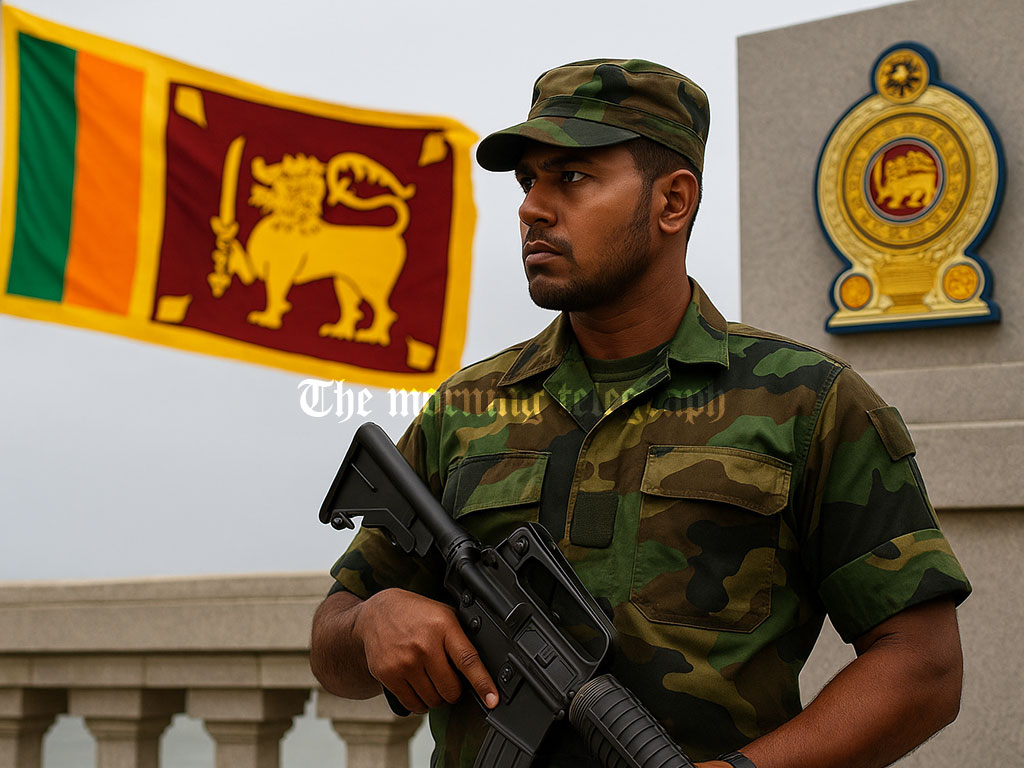
A nation’s sovereignty is not a commodity to be traded for empty promises. As Sri Lanka inks secretive agreements, it gambles its independence and its future, becoming a pawn on a geopolitical chessboard far beyond its control.
A few years ago, a delegation of senior U.S. defence officials arrived in Sri Lanka with a request that was as curious as it was disquieting. “We wish to provide the latest technology to link all immigration and emigration data flows directly to American satellite systems,” they announced, all the polished charm of a sales pitch masquerading as cooperation. Our intelligence agencies, then led by professionals steeped in operational acumen, proposed a far simpler and far safer alternative: no wireless transmissions, keep the data wired, confined within national borders, and secured at both ends. Yet the Americans, as if the very notion of safeguarding sovereignty were an obstacle to their ambitions, conveniently deferred the project. It was never about fortifying Sri Lanka or strengthening our defences; it was about reshaping our systems to suit their designs, binding our autonomy to external strategic interests. This early warning sign of foreign overreach and data sovereignty risks was a precursor to the dangerous path the nation now treads.

Today, we are confronted with an unsettling echo of that same scenario. Those at the helm appear to treat the nation’s long-term welfare with casual indifference. Agreements with foreign powers are signed, exclusive defence pacts inked, intelligence frameworks entwined, all without formal consultation with the Attorney General’s Department or judiciary. Parliament is kept in the shadows, the body entrusted with oversight, and the public only learns of these potentially epoch defining decisions long after the ink has dried. A handful of signatures around a gleaming table, and suddenly the nation is, without debate or consent, entwined in arrangements that may compromise its sovereignty. This lack of transparency in governance and absence of parliamentary scrutiny creates a democratic deficit that undermines the very foundations of the state.
For decades, Sri Lanka has prided itself on a foreign policy of non-alignment. Our foreign policy has been grounded in pragmatism and independence, enabling us to navigate turbulent global waters without being swept into the ambitions of great powers. We have cultivated durable and constructive agreements with nations worldwide, cooperation that strengthens trade, maritime security, and humanitarian readiness, without surrendering our autonomy. And yet, one must ask: why risk exclusive defence arrangements that primarily serve another nation’s strategic goals, rather than the security and dignity of our own? This shift represents a fundamental departure from a legacy of strategic independence towards a precarious future of geopolitical alignment.
Consider the U.S. State Partnership Program, where individual National Guards establish bilateral links with foreign militaries under the guise of training, disaster preparedness, and professional exchange. Beneath this polished façade lies a far more insidious truth: these programmes allow a foreign power to shape doctrines, gain operational insight, and entrench influence within our security apparatus while projecting the illusion of benign partnership. Nepal, in its wisdom, rejected such entanglements, recognising the risk to its strategic independence. Belarus followed suit. And yet, we now contemplate similar arrangements, signed with minimal transparency, while the very organs of accountability are rendered passive by expedience. This pattern of military cooperation and defence integration poses a direct threat to national security and sovereign decision making.
International law underscores the gravity of these manoeuvres. The United Nations Charter obliges states to respect the sovereignty of others; the Vienna Convention on the Law of Treaties demands transparency, parliamentary scrutiny, and proper legal procedure in entering international agreements. By sidestepping these principles, Sri Lanka risks not only political subservience but breaches of globally recognised obligations. The peril is neither theoretical nor distant; it is immediate. When our data networks, satellite communications, and defence systems fall under foreign influence, when intelligence sharing is structured to serve external priorities, the nation’s sovereignty is imperilled. The legal implications of these secret pacts are profound, placing the country in violation of its own constitutional duties and international law.
The consequences are stark. Such agreements erode our capacity to pursue an independent foreign policy, expose us to geopolitical manipulation, and create dependencies that foreign powers can exploit at will. Domestic accountability is sacrificed on the altar of expedience; decisions affecting national security are concluded without scrutiny, debate, or public awareness. Is this the path of a proud, non-aligned nation, or the trajectory of a client state cloaked in the guise of sovereignty? The erosion of sovereignty and loss of foreign policy autonomy are the ultimate costs of these clandestine deals, pushing Sri Lanka toward a future as a geopolitical pawn.
Sri Lanka already possesses a web of partnerships that safeguard its security and strategic interests without compromise. Cooperation with India on maritime safety, collaboration with Japan on humanitarian operations, and engagement with ASEAN partners in training exercises have proven effective while respecting our autonomy. None of these require alignment with foreign strategic ambitions or surrender of sensitive national systems. Why, then, gamble everything for exclusive defence agreements that chiefly serve another power’s agenda? Existing regional partnerships demonstrate that effective security cooperation is possible without sacrificing sovereign control or becoming entangled in global power rivalries.
History repeatedly warns: the lure of “cutting-edge technology” and “elite military cooperation” is rarely as altruistic as it appears. Non-aligned nations endure, and often flourish, by calibrating partnerships with care, safeguarding strategic independence, and insisting on full parliamentary, judicial, and public oversight. Yet none of this seems to matter in today’s governance, where the only priority appears to be a relentless social media campaign designed to keep the public dazzled, and distracted. The lessons of history are clear: nations that trade sovereignty for promises of security often end up losing both.
Now you, citizens endowed with the sacred right to vote, cheering blindly with naïve enthusiasm, may finally discern who is having the last laugh after Aragalaya and the marvellous product of the so-called “Renaissance (Punaruda)” regime, a regime built on empty promises, steered by shadowy manipulators lurking not just in Canberra, but in Kuala Lumpur, or even Washington, pulling the strings while the people clap like fools. This is a moment of public awakening and citizen accountability, a time to question the true beneficiaries of these secretive agreements and to demand a return to a foreign policy that serves Sri Lanka’s interests first and foremost. The choice is between a future of sovereign dignity or one of subservient compliance, a decision that will define the nation for generations to come.