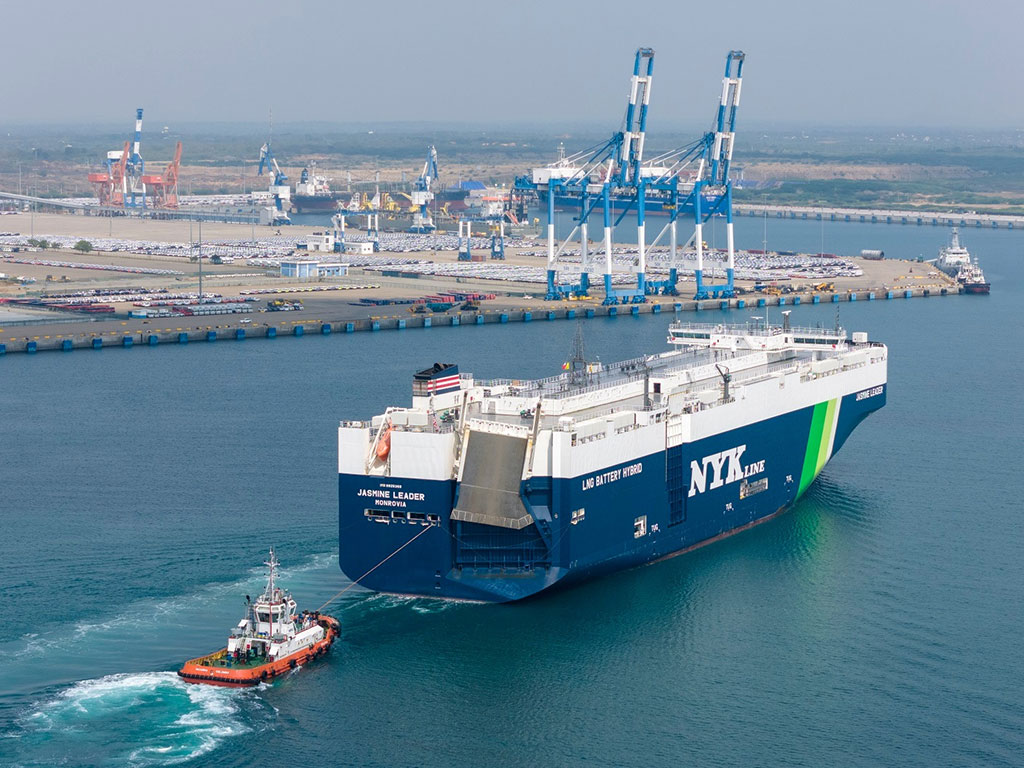
The most telling sign of a sea change in Sri Lanka’s maritime, energy, and regional trade landscape is the dramatic rise in cargo volumes at Hambantota Port.
Cargo volumes at the Hambantota International Port have seen a strong surge, with tonnage surpassing 6 million metric tons by September 2025, while recording a growth of 151% over the corresponding period last year. This unprecedented growth reflected the expanding capability and the strategic evolution in key sectors such as container handling, liquid bulk, bunkering, and vehicle transshipment. The figures underscore the emergence of this port as a major maritime hub in support of Sri Lanka’s trade aspirations and its growing Indian Ocean presence.
The port recently completed a large-scale infrastructure upgrade through an investment of 41 million dollars in high-performance equipment. This involved four advanced quay cranes with a further thirteen rubber tyred gantry cranes, all designed to significantly raise capacity. These works raised the annual handling ability of the port to 1 million TEUs and further consolidated the operational efficiency with the introduction of upgraded automation systems and enhanced anti-collision technology. The modernization drive is intended to ensure long-term competitiveness while supporting increased industrial activity in the environs of Hambantota.

The new quay cranes at Hambantota have twin-lift capabilities and can lift between 50 tons in single mode and up to 75 tons under beam, with a reach of 65 meters. The rubber-tyred gantry cranes, each capable of lifting 41 tons, allow faster stacking and retrieval of containers. These enhancements position Hambantota International Port as a major transshipment gateway prepared to meet surging regional cargo growth and the needs of new logistics and manufacturing zones developing nearby.
The rapid rise of the port does not stop at container operations. There has been strong growth in LPG throughput, bunkering services, and vehicle transshipment, all contributing to the diverse portfolio of the port. LPG volumes have almost doubled in the last year, with bunker fuel sales and vehicle transshipment operations recording substantial rises. This multi-sector performance increases the ambition of the port to act as a fully integrated maritime ecosystem, capable of handling a wide range of cargo and vessel services.
The growth in cargo volume generated operational difficulties because of the congestion created from importing vehicles. In support, the port authority optimizes container yard allocation, revises stacking strategies, and further strengthens its work force to ensure smooth vessel handling and uninterruptible service delivery. Situated on one of the most important stretches of Sri Lanka’s southern coastline, Hambantota Port enjoys the strategic advantage offered by one of the busiest shipping routes in the Indian Ocean. The expansion and modernization efforts of the port are placing it in competition with major regional ports and enlarging its role as an overall maritime hub for containers, energy products, industrial cargo, and roll on roll off operations.