
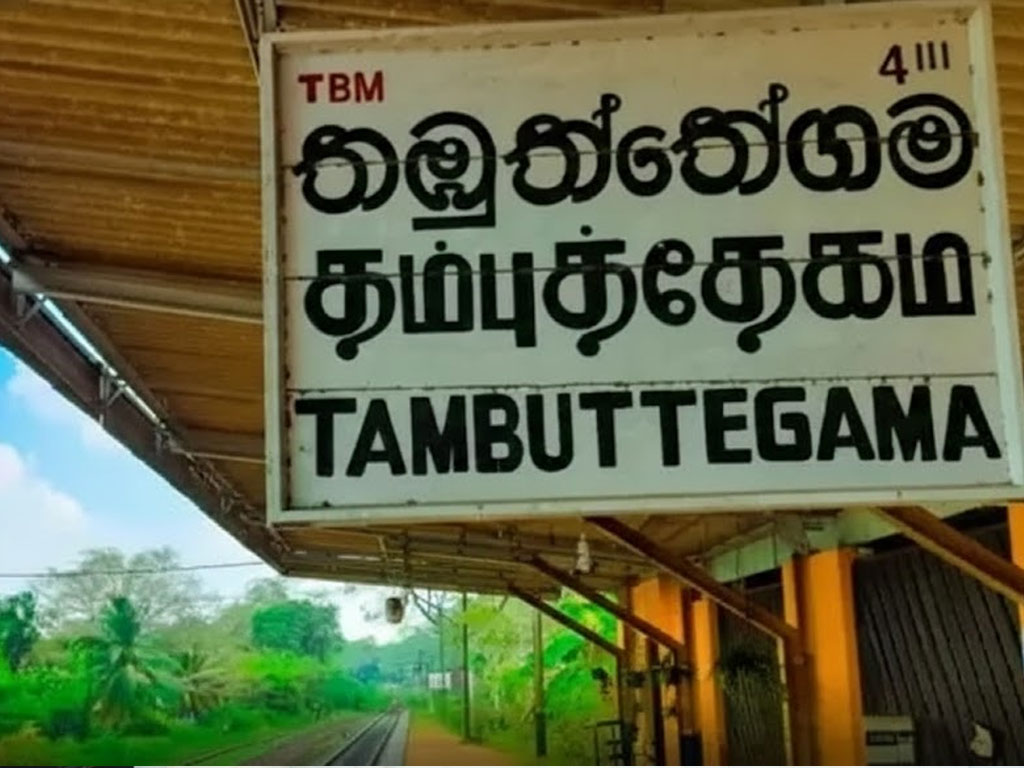
A budget promise tied directly to the President’s hometown is now under scrutiny, as officials admit the Rs. 100 million feasibility study for the Thambuttegama agricultural rail project has not even begun.
President Anura Kumara Dissanayake announced during his first budget speech that funding would be allocated for a feasibility study on transporting agricultural products by rail. He added that his hometown had become known by the line, “My home address has become, near the single signal post towards Colombo, Nallachchiya, Thambuttegama,” as he highlighted the plan to begin a pilot project from the Thambuttegama railway station. However, BBC Sinhala has now learned that the much-publicized study, funded with Rs. 100 million in the 2025 budget, has not yet started.

After this year’s budget presentation, social media users began questioning what happened to the funds set aside for the feasibility study and whether any progress had been made by the Railways Department, which was initially responsible for launching the project.
A senior official from the Ministry of Transport, Highways and Urban Development confirmed that the project had been transferred to the ministry because the Railways Department was unable to carry it out. The official explained that the funds had already been moved. “The project is to collect vegetables from Thambuttegama and bring them to Colombo for distribution. The Railways Department was supposed to carry out the study. But since they are in a difficult situation, it was difficult to do it through the department. Then we took that money to the Ministry.”
When asked how long it would take for the feasibility study to begin, the official said that arrangements were underway to secure the funds from the Railways Department and initiate the process under the ministry. He also stated that the conditions required for the feasibility study had already been drafted.
“The conditions that need to be fulfilled in the feasibility study have been prepared, and the work to get the money to the ministry is underway. After that, a notice needs to be issued and a consultant will be found. He will be found within about 21 days. After selecting him, the work will be able to start in about 2 months,” he said. According to him, a consultant is expected to be selected by January next year, and physical work will begin after the study is completed.
The ministry is also considering whether agricultural goods collected from Thambuttegama can be distributed via Veyangoda, which has food-storage warehouses connected to railway tracks. Since Veyangoda is an established economic center, the idea is being evaluated as part of the broader feasibility study.
Deputy Minister of Transport Dr. Prasanna Gunasena told BBC Sinhala, “We have to travel a long way from Thambuttegama to Veyangoda. The project will be started after conducting a feasibility study and finding out how it should be done.” Officials insist that the study is essential before selecting the final transport route.
The ministry’s Coordinating Secretary, Rajitha Dassanayake, explained why the project was removed from the Railways Department. He said that a previous attempt by the department to transport agricultural goods by rail had failed. “Considering that, the feasibility study was taken under the ministry,” he said. Dassanayake added that several areas require careful evaluation before the project can proceed. “It emerged during a discussion that a similar project previously undertaken by the Railways Department had failed. That is why the Minister intervened and said that this should not be a white elephant project.”
He further explained that if the Railways Department conducted the feasibility study, it would only examine the railway’s internal operations. In contrast, the ministry could assess all external factors such as storage, market logistics, distribution diversity and stakeholder coordination. “If the project is to be successful, the section outside that section needs to be done properly. That is why this is being taken under the ministry.”
Dassanayake stated that ministry officials have been visiting locations, speaking with farmers, transporters and warehouse operators to identify all aspects that must be included in the feasibility study. He added that these preparatory steps are what have contributed to the delays. “Those who choose to conduct the feasibility study should be told to study these and those parts. That is why ministry officials go to many places and talk. That is what takes a lot of time. A lot of that work is done.”
The ministry confirmed that a consultant will be selected by the end of the year and that funds have been requested for the next stage of the study.
The origin of the project dates back to a key government promise made after coming to power: developing the agricultural sector. In the 2025 budget speech, President Dissanayake said, “Transportation of agricultural goods through the road network remains a major challenge due to high costs, post-harvest losses during transportation, road congestion and environmental issues. As a solution to this, we propose to introduce a dedicated rail-based transport of agricultural products from their production centers to their destinations.” Thambuttegama railway station was chosen because it is the only station located near a major economic center, making it a strategic point for agricultural distribution.
Items such as rice, coconuts and pumpkins are already transported from Thambuttegama to various parts of the island, raising expectations that the new rail system could expand and streamline agricultural distribution nationwide.



The President and his cabinet announce various initiatives without understanding their purpose, outcome, or the output. Some initiatives, like improving 90 railway stations, are hilarious. I suppose they are the consequences of having ministers who for decades were thinking about how to form a government than what a government can do. It’s like the “dog that caught the car”!