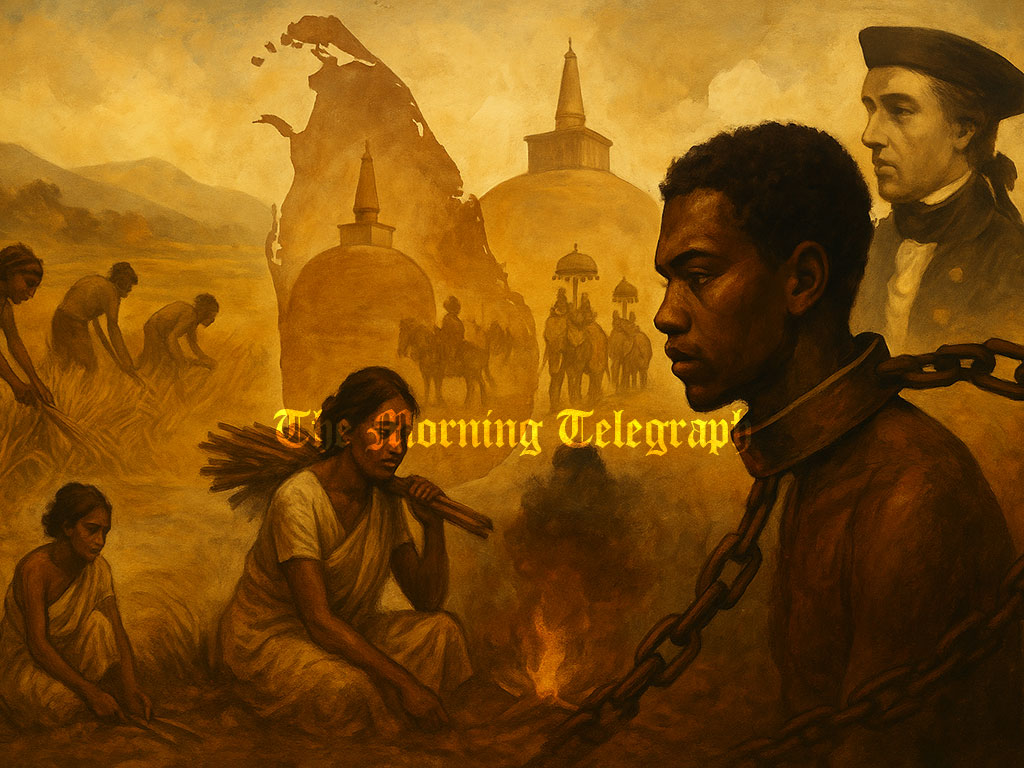
A forbidden chapter in Sri Lanka’s past that reveals how caste, religion, empire, and economics kept entire families in bondage from ancient kingdoms to British abolition, and how the legacy of slavery in Sri Lanka still shapes identity, land, and power today.
It is widely recognized by anthropologists that as human communities moved from roaming bands of food gatherers to settled villages and then to complex urban societies, the way people treated one another changed as well. In the earliest times, raiding parties killed captured enemies after battle. Later, when societies turned to herding animals, they began to capture people not simply to destroy them but to trade them as human cattle. In some cultures, captured men were executed while the young women were carried home, forced into menial service, concubinage, or sold for profit. As agriculture spread and men settled on the land with their livestock, they shifted into a more sedentary life centered on farming and warfare. Prosperity grew, and with it the need for permanent labour. Large estates required a reliable workforce, so the labour of serfs and slaves was used to cultivate broad stretches of land that fed both master and kingdom.

Today the words “serf” and “slave” are often used interchangeably, yet historically they signified two related but distinct forms of unfreedom. A serf was tied to the soil. When land changed hands, the serf went with it, like a tree or a well. A slave, by contrast, was legally the property of another person or group, subject to complete authority, bought, sold, and punished at the owner’s will. The difference may appear technical, but it mattered deeply to those who lived and died under these systems of servitude.
Across almost every ancient civilization, some variety of serfdom or slavery emerged. Over time, these practices hardened into formal institutions regulated by laws, customs, and religious rules. In classical societies such as Greece, Italy, Egypt, Arabia, India, and China, slavery generally took the form of domestic and household bondage. Sri Lanka, or ancient Lanka, followed a similar pattern. Enslaved people were often treated harshly, and many dreamt of escape, sometimes attempting to flee their masters or their assigned lands. In response, cultures developed magical or religious rituals intended to recapture or curse a runaway slave. An Arab narrative tells of a magic circle traced on the ground, a nail driven at its center, and a beetle tied to the nail with a thread chosen according to the sex of the missing slave. As the beetle crawled around and wound up the thread, people believed the absent slave would be irresistibly drawn back to the master.
In ancient India, slavery was fully recognized as part of social and legal life. The lawgiver Manu listed seven types of slaves. There were those seized in war, those who surrendered themselves, those born in bondage, those sold, those given as gifts, those inherited, and those condemned to slavery as a punishment. Neither wives nor slaves could own property in their own right. The Sudra caste was described as a permanent slave community by birth. Later, the sage Nārada would expand this list to fifteen classes of slaves, showing how deeply the institution had been woven into social structure. Adoption itself, in some later periods, was seen as a surviving trace of older practices where people were absorbed into households almost as dependants or bond servants. Historians such as V. A. Smith have noted that mild forms of agricultural and domestic slavery seem to have existed across much of India since early times. In more recent centuries, communities such as the Pariahs were treated as hereditary servile groups. Sri Lankan culture preserved similar echoes, with the folk drama Sokari nādagama portraying a pariah figure in a lowly, menial role.
Within Vedic India, the word “dasa” carried the basic meaning of “non Aryan,” which gradually became synonymous with “slave.” Many scholars believe it referred originally to the Dasyus, described as flat faced, broad nosed, dark skinned inhabitants who lived in the subcontinent when the Aryan groups advanced into the region. The masculine form dāso could signify enemy, demon, infidel, servant, or slave. Captured men and women were frequently kept in households for domestic service. The term dāsajana referred specifically to domestic slaves, while dāsa in the masculine and dāsi in the feminine came to mean slave generally. The expression dāsaputra, “son of a slave,” became a biting insult rather than a neutral family description.
By the fifth century before Christ, Pali literature in India distinguished two closely related categories. The phrase “dāso ca kammakāra” referred collectively to slaves and labourers, yet within this phrase, kammakāra denoted the paid worker whose service was compensated, while dāsa referred to the unfree person whose labour could be claimed without normal wage bargaining. Over time the word “dasa” broadened from meaning outsider or enemy to conveying the fuller sense of “slave.” Pali texts speak of “dāsagaṇa,” bands of slaves, and “dāsagaṇi,” groups of female slaves. Four varieties of “dāsaporisa,” or slave attendants, are also mentioned. Some fortune tellers specialised in reading the signs of a slave’s body and manner, a practice known as “dāsa lakkhana.” The trading of slaves, captured men and women, and their children, described as “dāsa dāsi patiggahana,” was not unusual. The expression “dāsiputta,” the child of a slave mother, stayed in circulation as an abusive label, illustrating the stigma attached to such origins.
Early Buddhism had to confront the entrenched power of caste and the social interests that benefited from slavery. The Buddha’s teaching affirmed the fundamental equality of all human beings in spiritual worth, even though the broader society remained graded by birth and occupation. Entrance into the Buddhist monastic order was theoretically open to everyone regardless of caste, colour, rank, or previous life. Individuals from low-status communities were welcomed into the Sangha without official discrimination. Punnā, the daughter of a slave woman, became a respected nun. Two learned monks, later honoured as Panditas, were born to a nobleman and a slave woman. Even so, the right to receive ordination was withheld from specific categories for practical reasons. Those suffering from serious illnesses, men who lacked parental permission, soldiers under duty, and slaves were generally barred from taking vows. The exclusion of slaves was not meant as a judgment on their worth but was tied to the legal view that they belonged to another’s household. A slave could not simply leave a master without causing loss to that master’s property. In daily life, however, enslaved people often ranked higher than hired labourers or casual workers. In cities that were carefully planned, space had to be set aside for various social groups, including quarters for slaves. Markets in human beings were common enough that the buying and selling of slaves became a familiar sight.
Christian Europe would later develop its own debates about the religious status of slaves. During the reign of the Byzantine emperor Justinian, enslaved people were permitted to enter convents without their masters’ consent, a striking difference from Anglo Saxon practice where candidates for ordination had to prove they were free born and not of servile ancestry. Buddhism, by contrast, did not normally examine birth or caste for admission, except in those practical cases already mentioned. A key term in these discussions is “vasala.” This word and several related forms had long been in use. Derived from the Vedic “Vrsala,” a diminutive of “Vrsan” meaning “little man,” it came to indicate an outcaste or person of low status in the caste order. Over time, “vasala” appears to have absorbed some of the nuances of “dāsa,” yet it never formally denoted a particular caste. As an adjective, it carried the sense of mean, base, or vile, colouring how a person might be spoken of, but not necessarily assigning them to a fixed social group.
Within Sri Lanka, slavery likely emerged in ways closely parallel to India, and the structure of the institution may have been imported or adapted from the subcontinent as early as the fifth century before Christ. One origin story tells that King Panduvās of Dambadiva in India sent his daughter as queen to Prince Vijaya, accompanied by seven hundred maidens of varied castes destined as wives for Vijaya’s followers. Along with the princess and her retinue came gold, silver, pearls, and both male and female slaves. From this moment, the narrative suggests, slavery became a recognised part of courtly and social life in Lanka. Over the centuries, the practice solidified into two main types. One group consisted of domestic servants who worked inside houses and on estates in intimate contact with their masters and families. The other group carried out menial tasks that were often considered ritually polluting, such as scavenging, cleaning, and managing dead bodies. Two different terms reflected this divide. The earlier word “dasa” likely referred more to the serf tied to land or household, while the later term “vahali” became associated with the fully enslaved person. Over time, both words were used broadly to mean “slave,” although this older distinction between serf and slave lingered in custom.
Traditional Sinhala legends and later literary works almost always use the word “dasa” when they speak of servile people. Early Sri Lankan society included both male and female slaves, many of whom formed a category of domestic workers known as “gowigē” who laboured in fields and homes. Stories speak of “dāsas,” often emphasising groups of women cutting firewood in forests or harvesting rice in paddy fields while singing work songs. Others served as maidservants and performed the humble tasks that sustained households. These references suggest that a system of slave service existed in Lanka before the Christian era, particularly between the second and first centuries before Christ. Women often became domestic slaves in exchange for clothing, food, or modest payments. Wives of slaves and wives of free labourers were usually grouped together as female slaves, indicating how gender, not just status, shaped people’s lives. Those slaves who worked the land functioned as serfs and were regarded as slightly superior to purely domestic servants. In one tale, a poor couple worked as dasa domestics, saved money diligently, and eventually left service to establish themselves as independent householders.
The earliest rock inscription to use the word “dāsa” reads “dāsi Anula, dini dasa Kala ca,” which translates as “gave female slave Anula and male slave Kala.” This inscription dates from around the second to ninth centuries after Christ. If dāsa once meant a subordinate or dependent person in Sri Lanka, by the end of the ninth century the term had clearly taken on the sharper sense of slave. The usage continued into the thirteenth century. Inscriptions from Velalikāra mention dāsa, and texts from the Dambadeniya period describe at least five categories of dāsa, known collectively as “panca dāsa.” These categories included artisans such as ironsmiths, carpenters, potters, goldsmiths, masons, brickworkers, and woodworkers. They performed tasks seen as inferior or lowly, yet they were not necessarily slaves in the strictest legal sense. Instead, they occupied a grey zone between dependent artisan and bonded serf.
The word “vasala” does not appear in inscriptions prior to the sixth century after Christ, but a slab inscription mentions “pahal,” believed to be an older form of “vahāl,” meaning slave. This suggests that from early times there were two broad categories of unfree labour in Sri Lanka. Domestic slavery served the households and retinues of chiefs and nobles. These slaves provided personal services, tended fields, and lived close to their masters. Institutional slavery, on the other hand, was attached to the state, to guilds, to Buddhist monasteries, and to other religious institutions. In this category fell messengers, people captured in war, convicted criminals, and others who were forced into service as a result of judicial or political decisions. Notably, neither domestic slaves (dāsas) nor institutional slaves (vasalas or vahals) formed a caste in the same way as groups like the Chandalas, Rodiyas, kinnaras, or gahalayas, although their conditions could at times resemble those of marginalised castes.
Written records about slavery in early Sri Lanka are sparse, and much of what is known comes from a small number of Sinhala stories and later stone inscriptions. When more detailed lithic records begin to appear after the sixth century, they reveal that slavery had been categorised along four main lines. There were hereditary slaves, known as anōjatā, whose status passed automatically from mother to child. There were those acquired by purchase, called dhanakkitā. A third group consisted of slaves captured during war, or karamarṇitā. Finally, there were those who voluntarily submitted themselves, described in records as sāmam dāssabhyam upagatān. Male and female slaves alike were subdivided again according to the tasks they performed. One notable category was the flag bearer, or dhaja hata, who was often a female messenger entrusted with carrying the white flag of truce during wartime or bearing secret messages during peace. There were also slaves assigned specifically to daytime duties, nighttime duties, or both, called ratti dāsā.
Contractual agreements regarding slave labour could be surprisingly formal. A woman might borrow sixty gold coins, or kahāpanas, on condition that she worked by day until the debt was repaid, and another sixty on condition of night work. Such agreements were recorded on ola leaves and were enforceable. A woman bound by such a contract was called ñadaśi. One inscription tells of a husband and wife who had to labour together because they could not repay a debt of sixty gold coins. In another case a cow in calf was purchased for eight gold pieces, illustrating the value attached to livestock compared to human labour.
From these and other records, historians have grouped Sri Lankan slaves into several main categories. The first category, slaves by birth, included all children born to female slaves, known as dāsiputta, regardless of whether their fathers were free or enslaved. The principle followed was simple and harsh: the legal status of the mother determined the status of the child. If a free woman married a slave, she remained free and so did her children, demonstrating that paternal status did not automatically make offspring slaves. This pattern points to a strong matrilineal element in ancient Sri Lankan social thinking. Even today, echoes of this custom linger in rural speech, where a child may be casually identified as belonging to a particular mother rather than to a father.
A second category, slaves by circumstances, consisted of those children who were sold or abandoned by desperate parents. Poverty, famine, war, or misfortune often forced families into heartbreaking choices. In such cases the mother, more than the father, usually controlled decisions about young children until they reached an age where they could judge for themselves. Under Portuguese rule the seduction and enticement of children to be sold into slavery became a profitable and sinister trade. Certain brokers maintained groups of young female slaves whose physical labour and sexual exploitation yielded significant income. Stories preserved in texts like the Sīhalavatthu describe slaves of this type, whose bodies and futures were treated as commodities.
The third category, slaves by punishment, grew out of a strict moral and caste code, particularly regarding women’s sexuality. In Sinhala society, caste boundaries were rigid, and intimacy across caste lines could bring ferocious penalties. Women who engaged in illicit relations with men of lower caste might be executed or handed over to the royal household as slaves for life. Economic crises also pushed people into this category. A man might pledge his wife, children, and himself as security for a debt and, failing to repay, see his whole family pass into slavery. During periods of famine it became common for impoverished parents to sell sons and daughters for gold. One record speaks of a farmer who sold his daughter for eight gold pieces, while other parents pawned daughters and sons for similar amounts. The deep cultural habit of swearing oaths on one’s child, spouse, god, or sacred object reflects the weight that family bonds carried in such matters. When debts could not be honoured, those who had been pledged as surety were forfeited to the creditor as slaves.
Ancient stories such as the Cakkupāla narrative describe a wife who vows that she and her children will become slaves if certain conditions are not met. In the Kukkutaṁitta account, a man declares that he and his family dedicate themselves to the dagoba if they fail to fulfil a promise. Thieves who could not repay stolen goods sevenfold might be sentenced to slavery as compensation. Prisoners of war, captured enemies, and individuals bought and sold in markets formed part of this group. Tamil captives in Sinhala territories and Koviars in Tamil regions often became slaves under such compulsions. Historical chronicles recall how King Gajabāhu brought South Indian prisoners back from the Chola country in the second century after Christ and distributed them across his realm. Later, King Silāmeghavanna parceled defeated Tamil invaders out as slaves to various Buddhist monasteries.
The final category, slaves by submission, covered those who willingly traded their liberty for security, protection, or religious merit. Some wealthy individuals voluntarily placed themselves under monasteries, hoping that relatives or patrons would later redeem them by payment. Persons purchased outright by monasteries or compelled into servitude later came to be described as gold slaves, or vahāl, because money had directly changed hands. Those who pledged themselves or their children as collateral for loans were sometimes called slaves in debt, or ina dāsa, until the debt was repaid.
State owned slaves performed heavy and menial labour in public institutions and royal households. In the king’s own villages, known as gabada gam, slaves tilled royal fields and carried out household duties. Tradition records that female slaves were sometimes used as trusted messengers in secret missions. One story tells of Princess Cittā entrusting her slave woman with the task of carrying young Prince Pandukabhaya to safety around 400 before Christ, suggesting that enslaved women could hold positions of significant responsibility. Monasteries relied on slave labour to farm temple lands, or vihāra gam, while messengers known as payinda kārayas carried the business of the royal establishment, gabada va. Others served as servicemen, nilakārayas, at the king’s pleasure.
The wealth and prestige of aristocratic families and government officials were often measured in part by the number of slaves they possessed. These slaves formed part of their household retinues, working the fields, tending animals, and handling tasks that free men considered degrading. Duties such as collecting and carrying firewood to the residence, or Walawwa, were reserved to slaves. These tasks recall the earlier stories about dāsi servant girls cutting firewood in the jungle. Another important duty was preparing the body of a deceased family member, washing and laying it out for funeral rites. Any job seen as menial or socially lowering was assigned to slaves. Only someone from the executioner caste, the wāssa, would accept similar work, and even other low castes often refused it. If a noble household lacked slaves when a death occurred, relatives might lend their slaves rather than allow a chief to hire an executioner, which would have marred his social standing.
Within the Kandyan provinces, slavery was valued as much for the status it conferred as for the labour it produced. Owning slaves was a badge of rank. Certain ceremonial services that symbolised servitude could not be hired but had to be rendered by people in a recognised slave relationship. Inscriptions indicate that Buddhist monasteries maintained their own slave populations from at least the second century after Christ. These temple slaves may have been under similar controls as those exercised by private owners. Kings and ministers donated both male and female serfs to monasteries and sometimes exempted them from taxes so that temple estates could be maintained. Hindu temples in India, Buddhist temples in Burma and Cambodia, and other religious establishments across Asia followed similar patterns. King Buddhadasa of Sri Lanka assigned temple revenues and servants called kappiya kāraka to look after monastic needs. Chronicles such as the Cūlavamsa mention temple slaves explicitly.
Family owned slaves were frequently inherited as anvayāgata vahāl, passing from master to heir upon death. Others were acquired by paying a specific sum, often a hundred gold coins, as ran vahāl to a temple or viharā. By the fourteenth century, texts refer to whole groups of slaves as vahāl rũ, literally bodies of slaves, similar in language to how herds of cattle were recorded as saru. These slaves were considered personal property not attached to land. They could be directed to perform any service the owner required. Under the Kandyan Kingdom, the conditions of such slaves seem to have been relatively tolerable compared to other forms of bondage in world history. Many were permitted to cultivate land and own cattle on estates for their own support. They could accumulate movable and sometimes immovable property and dispose of it through wills or other legal arrangements, although they could not transfer certain types of land and often faced restrictions on earning money independently. Some were promoted to positions of authority on estates or even abandoned if they became a burden. There was no comprehensive legal code laying out the rights and duties of slaves and masters, so much depended on local custom and the temperament of owners.
Despite these gaps in formal law, many slaves managed to improve their material position. Masters often allowed industrious and trustworthy slaves to keep what they earned through extra work. When a master bought a new slave, he might also arrange a wife for him and encourage the couple to settle on estate lands to reduce the risk of escape. Slaves born to high caste parents sometimes retained their caste honours, though they were required to adopt lower status names and avoid certain dress styles. For example, they might be forbidden to wear cloth reaching down to the ankles, which was associated with higher rank.
Historical chronicles note, “The kings avenged those guilty of treason at will; it may be he kills them altogether or gives them away for slaves.” Many slaves in the kingdom of Kandy came from high caste backgrounds, and even when they lost legal freedom they often kept caste titles such as “etāna.” In this system, becoming a slave did not automatically remove caste identity. Low caste men could rarely own slaves, and the only consistent exception seems to have been among goldsmiths, who sometimes possessed slaves despite lower caste status. An edict of King Sena IV instructed that buffaloes, slaves, and men from one village should not be used in another. With royal approval they might be transferred to serve a different monastery, but casual movement was restricted.
Caste rules shaped every aspect of slave management. Masters were free to impose any punishment short of killing or mutilating a slave, yet certain protections applied in cases involving women. A master could not force a female slave to accept the advances of a man of inferior caste, whether that man was free or enslaved. Overall, historical records describe Sri Lankan slaves as being treated relatively mildly. Families were rarely split up for sale, and slaves were often given as dowry in marriage or distributed among heirs rather than auctioned off. Owners were expected to consider the feelings and dignity of their slaves. Extreme cruelty was frowned upon and considered rare, though punishments could still be brutal. Masters retained the right to subject slaves to torture using red hot irons, to whipping, confinement in stocks or chains, shaving of hair, and sale to new owners.
In legal matters, slaves were treated as competent persons. They could testify in court and sometimes served as witnesses to contracts involving their masters. If a slave died without a will, the master inherited his or her property as heir at law. However, the Kandyan legal tradition held that children born to a slave or to a woman of low caste could not automatically inherit their father’s hereditary property. Any claim had to be supported by a written document, a formal oral gift, or a bequest authenticated by reliable witnesses, often accompanied by a ritual pouring of water on the hands to seal the transaction.
During the period of the Malabar invasion, a brisk trade in slaves flourished between South India and the northern provinces of Sri Lanka. Enslaved people transported in this trade often saw little change in their daily conditions. They remained subject to the same duties and restrictions. The perquisites associated with slave held offices could not be seized by others. If a free man engaged romantically with a female slave owned by someone else, the owner might claim the intruder’s labour for as long as the relationship lasted. If the outsider wished to depart, he had to relinquish any property accumulated during the affair. In Kandyan times, female slaves received a modest allowance of five fanam and a piece of cloth six cubits long at each childbirth, reflecting a formal recognition of their reproductive roles.
Masters were obliged to keep their slaves in reasonable health, assist them during illness, and assign work proportionate to their physical strength. Buddhist teaching, as mentioned earlier, extended spiritual privileges to slaves, allowing them to participate in religious activities and seek merit, even though ordination remained restricted. Commentaries such as the Samantapāsādikā note that slaves born in households or bought in markets could be offered to monastic communities as park keepers or attendants. In such cases, they were to be ordained only after being formally freed.
Comparative history offers intriguing parallels. In ancient Italy, the Saturnalia festival, held each December, temporarily abolished the distinction between slave and free. During this time, slaves were allowed to speak openly to masters, share meals at the same table, drink wine, and joke freely. On the seventh of July, Roman tradition held a similar celebration where female slaves dressed as matrons, walked through the streets, mocked others, and even fought among themselves for amusement. This ritual reversal of roles resembles the Holi festival in India. It is quite possible that Sri Lanka had its own version of such a festival, known as nekat keli, during which slaves could act as free people for a short time. Modern customs surrounding the Sinhala New Year, when householders sometimes allow servants to scold them playfully after sighting the new moon, may preserve a faint echo of this practice.
Further insight into Sri Lankan slavery comes from the processes by which slaves achieved freedom. Early Sinhala literature mentions three main methods. A master could grant freedom on his own initiative. A slave could perform all the humble household tasks, such as drawing water and chopping firewood, required by the master, thereby earning manumission. Or a slave could pay a specified sum in gold coins, usually sixty kahavanu, to the legal owner. This practice is attested from pre Christian times. The earliest stone inscription recording manumission bears the same phrase as the earlier inscription about slaves: “dāsi Anula dini dāsa Kala ca,” indicating that the named slaves had been freed.
Buddhist monasteries sometimes accepted slaves brought by patrons who hoped that a monastic life would lead them to freedom. If the new recruits adapted happily to religious life, they were considered free. If not, they continued to serve as slaves. In the sixth century, during the reign of King Dala Mugalān, a bricklayer named Puyagomula freed his wife by paying one hundred gold coins. Another bricklayer, Boya Gonula, used the same amount to free his brother, while Pati Salala purchased freedom for his child. Dalameya Vesilimiyan Aba paid one hundred gold coins to the Kasabagiri monastery to free himself and possibly family members. At the royal monastery of Tisaramū, a bricklayer donated one hundred gold coins to gain his own release. In each case, the fixed amount of one hundred gold coins appears as the accepted price of personal freedom in that era.
Texts describing these manumissions emphasize that such acts were performed for the spiritual benefit of all beings, helping donors and beneficiaries move toward Buddhahood. Lists of those who paid one hundred gold coins to free themselves or others are preserved by name. Freeing a slave was regarded as a pious act that generated great merit for everyone involved. Maintaining and feeding slaves at a monastery, whether through direct payment or kind donations, was also considered a meritorious deed. Stories tell of a Lambakarna noble who, in imitation of King Vessantara’s legendary generosity, offered his wife, children, and finally himself to a monk, then redeemed the entire family by paying money. Another account tells of a slave who wanted to be ordained as a monk. He was freed so that he could take vows, but it was agreed that if he later failed to join the order, he would revert to slavery. A friar named Puvijayi Siddhata is said to have purchased his own freedom with one hundred gold coins.
Several kings demonstrated their piety by symbolically enslaving themselves. King Mahadathika Mahānāga dedicated himself, his queen, his two sons, his state elephant, and his horse to the Sangha, then redeemed them with payments. The mother of King Agabodhi, at her son’s request, gave him as a gift to the monastic order and later reclaimed him by donating wealth. King Nissankamalla offered his son and daughter to the Tooth Relic and Bowl Relic and redeemed them later, highlighting how the idea of becoming a slave or offering one’s children to religious institutions could be inverted into a powerful statement of devotion. These stories underline the belief that releasing someone from slavery was among the highest acts of merit. Kings often donated slaves to monasteries, and King Silā Megavhanna is remembered for placing many slaves at monastic disposal.
Other donors came from the ranks of slave owners, relatives of slaves, and patrons of monks. Potthalakutta, a Tamil officer, granted an entire village with its slaves to a religious institution. Bhaddā, a military commander, built a monastery or pirivena and endowed it with slaves. Mindal or Mahinda, who served as Demala Adikāri, donated slaves, lands, and other resources to Galapita vihāra. Low caste individuals were usually forbidden to own slaves. If such a person acquired a slave, the local chief would often purchase that slave and add him or her to his own retinue. Buying the freedom of slaves or paying for their upkeep brought religious merit. One officer is said to have freed all children under his authority as an offering of merit. The earliest rite confirming a slave’s freedom involved pouring buttermilk or clarified butter on the person’s head, a symbolic cleansing of servile status.
Scholars have debated the meaning of the term “vaharala.” Dr Paranavitana interprets it consistently as “slave,” tracing the word back through Geiger’s derivation from Sanskrit “vrsala” to Pali “vasala,” then Sinhala “vahala” and “vahal.” Dr Wijeratne suggests a different line of origin, linking “vaharala” to words meaning timber or wood, such as visaralaka, visarala, veherala, and viherila. The first view has gained wider acceptance because the word’s usage across contexts often aligns better with the sense of “slave.” At the same time, the second theory may capture a partial truth. Since many slaves were involved in collecting firewood and building funeral pyres, a functional connection between wood and slave labour may have contributed to the term’s meaning.
Legal and documentary evidence confirms that slaves could be transferred and bequeathed much like other forms of property. Registers recorded the position of slaves within families or institutions. Grants made by kings or ministers sometimes included both male and female slaves. Occasionally a single slave was given, but often entire families were donated to a monastery. Monks were allowed to receive such gifts, and in some cases they insisted that donated slaves be exempt from taxation because they were now temple property. Comparable practices existed in other parts of Asia. In Burma, monasteries received slaves as offerings. In Cambodia, a sixth to seventh century inscription records a man named Pon Prajña Candra dedicating male and female slaves to the three Bodhisattvas Sīstata, Maitreya, and Avalokitesvara, one of the earliest records of Buddhist slavery in that region.
Sri Lanka developed its own custom of dedicating individuals and families to religious monuments. People sometimes pledged themselves, their wives, and their children to a dagoba, thereby becoming “slaves of the dagoba.” Inscriptions referring to grants of slaves to temples, vihāras, and dagobas suggest that this practice was well established. It likely included dedicating slaves to Bodhisattvas and to the Bodhi tree itself. Over time, such customs may have faded, especially with shifts in Buddhist practice and the influence of Mahayana traditions, yet traces remained. King Kirti Nissankamalla, who ruled in the late twelfth century, recorded several such grants. These examples establish that slaves were recognised as personal property that could be legally traded, donated, and freed. Grants of slaves were often declared tax free for a period of five years, during which the king relinquished revenue in order to aid temple communities and enrich local residents with lands, serfs, cattle, and other permanent assets.
Large rock inscriptions such as those at Galapita vihāra show the scale of these endowments. One inscription records that around ninety slaves were granted to serve the vihāra and its monks. Some of these slaves had belonged to the donor’s family for generations, some had been purchased, and others had been acquired using temple funds. No similar muster roll of temple tenants has been found elsewhere in Sri Lanka. The donor, Mindal or Mahinda, who served as Demala Adikāri and administered the Pasdun Korale district, appears to have been responsible for organising Tamil captives into a structured slave community attached to the temple.
The enduring presence of villages such as Indigasduwa, Mahāvila, Galganda, and Valambagalama within ten miles of Galapita vihāra, where Tamil speaking populations still live, and nearby Berawa drummer villages such as Suddegoda, Damplayagoda, Tundiva, Boltuduva, and Kendalapitiya, suggests that these ancient slave settlements persisted for centuries. Entire families, including parents, children, siblings, and servants, were once granted as slave communities to support temple lands. Many historians place these developments during the reign of Parākramabāhu I. Later inscriptions from the Gampola period record similar grants of fields, seed paddy, and specific numbers of slaves, reinforcing the picture of a well organised system of religious slavery.
Under such conditions it is reasonable to imagine that the state eventually created offices specifically to manage slaves across districts. Officials would have been responsible for assigning duties, overseeing the welfare and discipline of slaves, and ensuring that punishments for disobedience were applied consistently. Slaves could not be moved freely from one district to another without state approval, and when they were freed, officials kept records of their manumission. Monasteries followed similar procedures for their own slave populations, documenting transfers and releases. Private owners also relied on legal mechanisms, although within household estates the master often exercised broad discretion. Many able bodied male slaves worked permanently on hereditary private estates known as pannambūm, where they passed from generation to generation along with the land.
By the sixth century after Christ, there is mention of an officer called the Superintendent of Slaves under the Pandyan king. The Galapita inscription refers to slaves donated by the Tamil Superintendent, Demala Adikāri, who oversaw entire districts. Kings such as Agabodhi I made donations to monasteries specifically earmarked for the maintenance of slaves. Devotees contributed money so that important institutions like Abhayagiri vihāra could feed and house their slave retinues. King Kassapa V ordered that village lands should not be taken back by the crown until both monks and slaves had been adequately provided for. Later, Mahinda IV issued rules that addressed the roles of the monastic community, lay employees, and slaves in similar terms, showing how integrated slavery was into the administration of religious and royal estates.
Over many centuries, inscriptions demonstrate that slaves formed a recognised, semi permanent class of servitors around monasteries and temples. Their upkeep was often funded by grants of land or rights to village revenues. Although the total number of slaves in Sri Lanka cannot be calculated with certainty, it is clear that almost every major vihāra with royal patronage maintained a group of slaves. These individuals were not considered untouchables or outcasts but rather workers belonging to an acknowledged social category. Later, both the Dutch and the Portuguese would exert control over slave populations by appointing overseers to manage them. High caste women who engaged in relationships with low caste men were sometimes punished by being made royal slaves and resettled in special villages such as Gampola, as recorded in early nineteenth century documents.
In earlier Sinhala stories, slaves are rarely given individual names, being described simply as dāsa or dāsi. Where names do appear in inscriptions they tend to be ordinary Sinhala names without foreign or overtly degrading elements. Examples include Anula and Kala, Bricklayers with names like Puyagomula and Boyagomula appear in sixth century texts and may have been brothers. Other names include Patisalala, Sahasarakula, Dalameya, and Sakana Kana Vesnimiyan Aba. A rock inscription from the sixth or seventh century mentions slaves who freed themselves by paying one hundred gold coins, including Gāla Arakl Buyu Deviyā, Buyu Peri Saba, Hillsela Sivigonahi Bada Aba, and others.
With the arrival of European colonial powers, slavery in Sri Lanka entered a new phase. When the Portuguese surrendered Colombo in 1656, two generals and the son of the commander Coutinho were allowed to leave with their personal belongings, including Portuguese servants and slaves. In most other cases, however, slaves were confiscated along with property. Married soldiers permitted to relocate to Goa after the capitulation were not allowed to take possessions or slaves. Both Portuguese and Dutch authorities treated slaves as a normal part of the owner’s property, to be seized, transferred, or recognised according to the fortunes of war.
The Dutch, who eventually supplanted the Portuguese, brought with them a more formal legal code regulating the treatment of slaves, shaped by practices developed in Batavia and other colonial outposts. As humanitarian ideas slowly gained influence in Europe, the Dutch authorities introduced rules that gradually restricted and then reduced slavery. In 1660 they issued an order banning the sale or mortgage of free born Sinhalese. By 1771 the number of slaves in Colombo had dropped markedly. By 1787 transactions involving slaves had become more difficult, and trafficking in Christian slaves was forbidden outright. Before the British took over Sri Lanka, the Dutch already had several laws aimed at curbing and eventually eliminating slavery, including a regulation in 1802 that imposed a fine of one hundred rix dollars on anyone attempting to enslave a free born person.
Yet on the ground, the everyday system of slavery changed slowly. When the Dutch transferred power to the British in 1795, slaves remained in much the same position. Treatment varied across regions. In the Northern provinces, enslaved people were still sold to South India. In the maritime areas, slaves were treated as chattel and personal possessions, often used primarily for domestic service and private pleasure. In the Kandyan provinces, by contrast, slaves lived more like retainers who enhanced the prestige of their masters. They were often treated with a measure of respect, and their presence signified the dignity and rank of their owners.
Colonial administrators kept registers of slaves, but the total number of enslaved people remained uncertain. A census in 1829 counted 2,113 men and women in the Kandyan provinces and suggested that the slave population in those regions probably never exceeded 10,000. When the Dutch capitulated, the price of a male slave, regardless of age, averaged fifty rix dollars, while a female slave commanded one hundred rix dollars. A female child was valued at three rix dollars. These prices highlight both the economic weight of slavery and its gendered dimensions.
Legal disputes erupted over whether slaves should be regarded as personal property. In 1795 a serious controversy arose around this issue, and the colonial administration had to refer to the Statute of Batavia and interpretations of Islamic law in the Koran to settle questions of redemption and transfer. When British forces under the Governor’s authority extended the meaning of “property” to include slaves, all enslaved persons were returned to previous owners. Slaves were required to be registered and could testify under oath in colonial courts. Governor North initiated measures to alleviate suffering among slaves by allocating money for their support. Although the system of slave bonds allowed some to claim rights or compensation, fewer than six percent actually possessed such documents.
Resistance to change came from influential Kandyan chiefs, who objected strongly to attempts to register slaves and move towards abolition. They insisted that emancipation without compensation would deprive them of necessary services, including important religious duties such as washing and preparing bodies for burial. Anyone else attempting such duties would be seen as insulting religious norms. In 1843 the chiefs petitioned for a sixty year delay in abolition, arguing that losing slaves would be both a financial blow and a deep affront to their honour. “If there were to be no slaves, there would be no religion, no respect,” they claimed, insisting that such a situation would be intolerable.
The British had previously attempted to abolish slavery in other colonies, such as the Isle of France, and met stiff resistance. In Sri Lanka, however, broader global trends began to catch up with local practices. The modernising forces of nineteenth century Europe and the growing international movement against slavery increasingly shaped British policy. Under the governorship of Edward Barnes, slavery was abolished in the maritime provinces on 12 August 1816, the birthday of the Prince Regent, later King George IV. This move was notable not only for its symbolism but also because a group of slave owners in Galle and Jaffna voluntarily agreed to free all children born to their slaves.
Churches such as Wolvendaal set aside special pews for freed slaves and invited them to attend Sunday services as full participants. Enslaved people could usually secure freedom if there was any doubt about their legal status. Those who claimed ownership bore the burden of proof and were required to accept responsibility for maintaining and controlling the slave. If they failed to establish clear rights, the slave could be freed.
Even with these reforms, many Kandyan slave owners remained dissatisfied, feeling that their social position and economic security were threatened. Government officials did not vigorously enforce slave registration in the early years, leading to delays and inconsistencies. Over time, however, public awareness grew. Around 1832 the colonial government prepared a census of the slave population, and in 1837 it formally registered slaves in the Kandyan provinces.
| Province | Male Slaves | Female Slaves | Total Slaves |
|---|---|---|---|
| Western Province | 373 | 352 | 705 |
| Southern Province | 431 | 342 | 773 |
| Central Province | 687 | 694 | 1,381 |
| Eastern Province | 12 | 11 | 23 |
| Northern Province | 12,605 | 11,940 | 24,545 |
| Combined (small-scale record) | 1,491 | 1,368 | 2,859 |
In Tamil speaking areas, the estimated number of slaves in 1837 was 27,397. At the same time, the global campaign for the abolition of slavery had gathered unstoppable momentum. European governments faced growing pressure from activists, religious groups, and humanitarian societies. Anti slavery organisations estimated that Sri Lanka might have had as many as 37,000 slaves. British commissioners in Ceylon described local slavery as being “of the mildest possible character,” pointing out that numbers were relatively small compared to other colonies, yet the fundamental injustice remained. Kandyan chiefs and other elites pressed for compensation if slavery was to be abolished, but global opinion increasingly favoured immediate emancipation without payment.
In 1841 an ordinance was passed to abolish “all vestiges of slavery” in Sri Lanka. The first areas to implement this new law were the Northern and Maritime Provinces, where the abolition took effect gradually. In 1845 Lord Stanley oversaw the final act of legal abolition across the island. No compensation was granted to slave owners, and in many cases none was formally demanded. As economic and social structures evolved, plantation agriculture, wage labour, and new forms of dependency replaced traditional slavery.
With this final ordinance, an ancient system of bondage that had threaded through Sri Lankan society from the days of early kingdoms, through the rise of Buddhism, into the era of Portuguese, Dutch, and British rule, came to an official end. In a world increasingly shaped by ideas of equality, human dignity, and universal rights, the institution of slavery in Sri Lanka could not survive. Yet the legacy of those centuries persisted in land ownership patterns, caste hierarchies, and social memory. Understanding this hidden history of slavery in Sri Lanka remains crucial today, both for confronting injustices of the past and for recognising how deeply those “chains of history” still influence identity, power, and opportunity in the present.
SOURCE :- SRI LANKA GUARDIAN