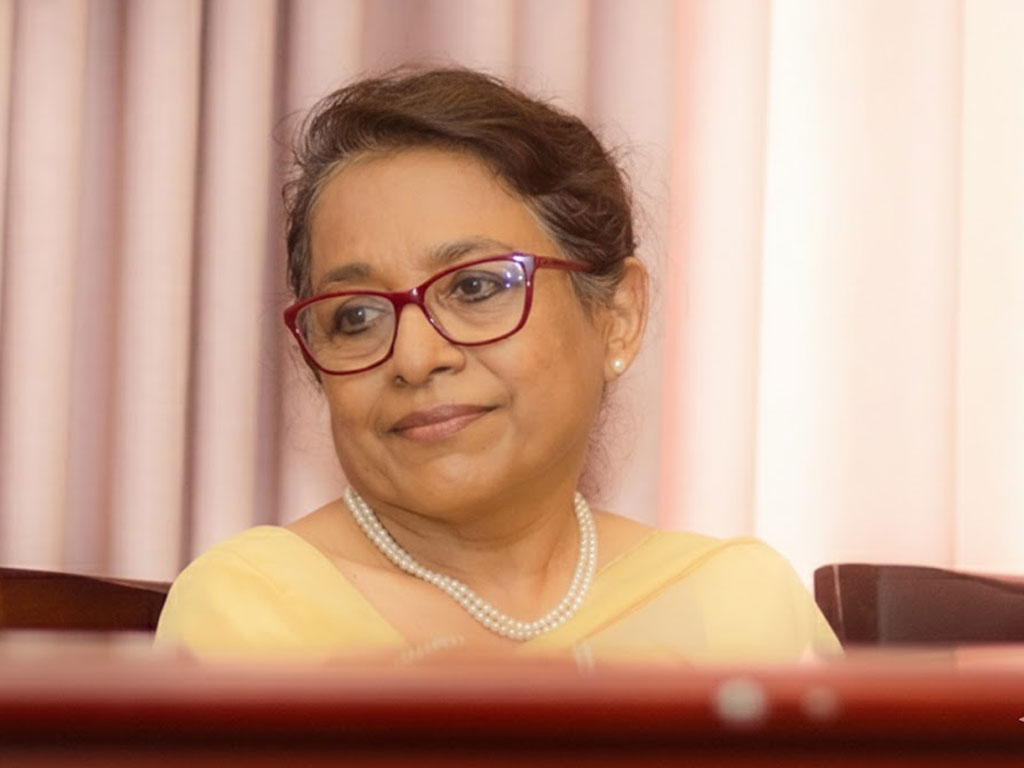
A legendary legal scholar breaks her silence on how greed and politics corrupted Sri Lanka’s justice system, leaving ordinary citizens without protection. In this explosive interview, Professor Deepika Udagama exposes the grim reality behind the country’s legal education crisis and the profession’s alarming ethical collapse.
“Nothing is sacred anymore,” Prof. Nelum Deepika Udagama remarks during this conversation, reflecting on how education, law, and public institutions have been pulled into the logic of the market. This striking statement comes from someone who spent over forty years inside Sri Lanka’s public university system and helped shape how law is taught, debated, and understood. Her observations are neither nostalgic nor sentimental; they come from a lifetime of working at the intersection of legal education, public advocacy, and institutional reform.
Prof. Udagama, who recently stepped down from the University of Peradeniya after a long career as an academic and public figure, is forthright about the contradictions that now define the profession. She recalls how legal education once placed great weight on ethical conduct, quoting senior lawyers of an earlier era who believed that “preserving the honour of the profession was considered a high priority.” Today, she notes the irony of a system where students receive “a more progressive view of the law,” yet enter a professional world dominated by commercial pressures, high fees, and a narrowing sense of public duty.

Throughout this interview, she discusses these shifts without evasion. She argues that the law cannot function if its moral core is compromised, insisting that “the moral core must triumph over cynical instrumental goals.” She also speaks about the deeper failures of Sri Lanka’s political and constitutional development, the erosion of democratic habits, the burdens facing young lawyers, and the possibilities for rebuilding trust in the justice system. What emerges is not merely a portrait of decline, but a sober assessment from someone who has spent decades teaching, contesting, and defending the role of law in public life.
Excerpts of the interview:
Question [Q]: How do you assess the evolution of legal education in Sri Lanka during your career from the time law was viewed as a vocation for service to the present, where it is often seen as a competitive and sometimes commercial profession? Has this shift affected the ethical foundations of the legal community?
A: First, let me say that I can only speak about public legal education in the country. As you know, there are several private institutions that offer degrees in law from overseas universities which follow their own curriculum based on their legal system. I cannot speak authoritatively about the legal education they provide. I think the approach taken by legal education in Sri Lanka has seen a gradual transformation from a somewhat rigid black letter, positivist approach to a more progressive public interest orientation, at least in public law. When I had my legal education in the late 1970s, public interest jurisprudence of the Indian Supreme Court led by Chief Justice Bhagwati had already caused a great stir in many Commonwealth jurisdictions.
Formal legal education commenced in Sri Lanka with the establishment of the Ceylon Law College in 1874. Before that, lawyers in training had to complete a practical pupillage in the chambers of a senior lawyer. It was based more on practical dimensions of the law. Legal education entered the university system in the late 1940s. University legal education had taken a more theoretical and philosophical tone at the inception. I remember the eminent lawyer, the late Mr. R. K. W. Goonesekere, one of the first law students to be enrolled in the University of Ceylon, reflecting on the legal education he received when I interviewed him for an article on the legal profession some years ago. It was a solid education, he said, very theoretical and conservative in orientation. But he pointed out that there was a great emphasis on the ethical dimensions of the legal profession, as preserving the honour of the profession was considered a high priority.
Today, although the orientation of legal education has taken on a more public interest tone even the teaching of commercial law subjects today focuses on human rights and environmental concerns the actual practice of the profession has, like everything else in society, become captive to imperatives of market forces. So, yes, there is a greater focus on the commercialised dimensions of the services offered by the profession, which has also witnessed a dilution of ethical standards. There is, in that sense, a strong contradiction in the system students get a more progressive view of the law, but when they enter practice, they must grapple with the hard nosed commercialisation of the profession and make difficult choices. The reality the world over is that access to justice is severely curtailed by the emergence of this strong business like approach in the legal profession.
Q: In a democracy or even in the realm of personal liberty law should ideally serve as a guideline for the common person to live safely and justly. Yet, law today has also become a lucrative business, both in teaching and in practice. How do you reconcile this tension between law as a moral compass and law as a commercial enterprise?
A: Well, given the all pervasive influence of the market, it is rather ambitious to think that the law will escape its grip! Similarly, so with any type of education. Even pre school education is a huge commercial venture today. All services are market oriented at present. Nothing is sacred anymore. There was a time when we thought that sectors like education, healthcare, and justice would never be business propositions. They were too fundamental to human well being to be commercialised. But that idealistic position has clearly eroded over time. So, it is a continual struggle to preserve the core values and the moral dimensions of the law, as in the case of all social institutions. We have to constantly remind ourselves of what indeed is the role of law in a democracy. Some, of course, would question whether there is an eternal moral core of law. Positivists would maintain that law is what is enacted and that always anticipating a moral core in the law is unnecessary and unacceptable. But we know that even the hard hearted, when they face a crisis, expect the law to be fair, just, and to champion rights and liberties. That is a truism.
I must admit, though, that it is not just the market dimensions that have proven corrosive; authoritarian politics has been lethal. Advocates for democratization, human rights, and environmental justice although small in numbers are constantly taking on the challenge of preserving the law’s moral core. They are constantly challenging offensive laws, policies, and practices. Without this small group of public interest advocates, the legal system would have very little public legitimacy. As we know, struggle is often an uphill task, as the struggles for progressive constitutional reform or legislative reform (think PTA) have proven over time.
The Aragalaya brought these tensions to the fore, especially the tension between legality and legitimacy of the law. In my opinion, the tensions cannot and should not be reconciled through compromise. Always the moral core must triumph over cynical instrumental goals for which the law is used. That is necessary if the law is to be respected and have enduring public value. Think, for example, of the negative legacies of the PTA and the Eighteenth and Twentieth Amendments to the Constitution. They are detested by the public. This principle applies not only to public law but also to private law, including dimensions of commercial law.
Q: What do you consider the major challenges facing Sri Lanka’s legal education and professional practice today? Are these primarily institutional, ideological, or structural in nature?
A: If I were to focus on legal education (again, I am focusing only on public legal education), the greater challenge is one of vision and perspective. So, in that sense it is ideological. I think the challenge is to provide an education that gives a perspective on the law that is holistic and faithful to the humanistic goals of a democracy. Even though, as I said earlier, over the years the orientation of legal education has become public interest prone and progressive in nature, there are still pockets that are resistant to questioning orthodoxies and change.
First, there must be a recognition that legal education cannot be viewed in isolation. The law operates in society. Therefore, a legal professional must understand the social dynamics which impact the operation of the law. The law, to be effective and relevant to society, must always be based on its social moorings. Like all other disciplines, the law too has a close relationship with other bodies of knowledge, especially in the social sciences and humanities such as political science, psychology, sociology, philosophy, economics, and indeed linguistics. Those disciplines continue to play a key role in the development of the law. Today, we are conscious of the linkage between technology and the law as well. Therefore, law must be taught in a multidisciplinary, or more idealistically in an interdisciplinary, manner. That was the philosophy on which the curriculum of the Peradeniya Department of Law was based.
Secondly, the law must be taught in a manner that respects its philosophical foundations. The intellectual tradition of the law must be respected. The rule based approach to legal education betrays the richness of the law and the potential of the legal professional to effectively contribute to society and the growth of the law. Mastering the legal codes alone, with perhaps a smattering of case law, does not do justice to the learned tradition of the legal profession. From ancient Rome, where the idea of a legal profession first emerged, onward legal professionals were expected to be a highly learned segment of society, and I think with good reason. I am not suggesting for a minute that the legal profession must be elitist as it has turned out to be. I am referring more to the substantive richness that must be present in the profession given what the law is all about. One does not have to be elitist to be substantively solid!
Thirdly, legal education must be cosmopolitan, democratic, and steeped in its ethical foundations. The teaching methodology employed must recognise those needs. A legal professional must not have a limited view of the world or the reach of the law. For instance, I think we cheat the students if we were to compel them to be in linguistic ‘solitary confinement’. A legal professional must be bi lingual, ideally tri lingual in the Sri Lankan context. All must possess a good command of an international language (English in our case), not as a class statement, but to broaden one’s worldview and knowledge base. I am constantly reminded that most of our graduates will end up in provincial Bars and, therefore, proficiency in English is not a must. That’s an insult to clients from outside the city. They deserve to be represented with the same thoroughness and vigour as clients in the metropolis.
In my opinion, it is that sort of well rounded legal education that will cultivate the knowledge and value base that a modern legal professional ought to possess. A legal professional must be very knowledgeable, be steeped in the ethical and humanistic foundations of the law, and understand the social dynamics that impact the law. Today, the popular view of a legal professional is that of a combative personality like a warrior who can spar and come out a winner in the adversarial process in courts of law and, of course, charge prohibitive fees. That’s a very limiting and damaging view that is at odds with the noble nature of the legal profession. Our view at Peradeniya is that litigation is only one dimension of being a legal professional. We take the view that a lawyer is also expected to be a public educator, a community leader intervening in public issues, helping to untangle and resolve complex conflicts, and negotiate or mediate to reach solutions. It should be so whether at the community level or the boardroom. Pursuant to that view, we have made alternative dispute resolution methods a core course of the LLB Degree Programme. That is what eminent legal scholar Roscoe Pound, a former Dean of the Harvard Law School, termed ‘social engineering through the law’. We witnessed how the legal profession’s stock went up during the Aragalaya as the public witnessed lawyers playing a constructive role during a critically difficult time in national life.
Q: Sri Lanka has long described itself as one of Asia’s oldest democracies, invoking the ideals of the rule of law and equality before the law. Yet our history reveals moments when these ideals were compromised. Could you identify a few milestones or critical turning points that contributed to this deterioration and how we might rebuild public confidence in the justice system?
A: As the late Kethesh Loganathan argued, we are a country that missed many opportunities at meaningful state building. The first setback was the inability to give judicial expression to Article 29(2) of the Soulbury Constitution in a positive manner. That Article, as we know, sought to prevent the enactment of discriminatory laws. No dent could be made to the corrosive nature of the Citizenship Act of 1948 or the Official Language (Sinhala only) Act of 1956, although the laws were challenged in court.
The next major setback was the failure to capture the all important republican moment in 1972 to establish an inclusive democracy based on the Rule of Law. What we got by way of the first republican constitution was a basic law that entrenched majoritarianism and political authoritarianism. It was short on democratic features such as separation of powers and checks and balances. Sinhala was constitutionally recognised as the only official language, and a special status was conferred on Buddhism. All state powers were concentrated in the National State Assembly, compromising judicial independence.
The 1978 Constitution pretty much did the same, except that powers were concentrated in the executive presidency. It is in this backdrop that the devastating 26 year civil war commenced, along with the second southern insurrection. Those gave rise to horrendous human rights violations and a serious dilution of the Rule of Law. We expected the end of the civil war in 2009 would bring about a remarkable transformation in governance and a re democratisation of the state. What we got instead was the maligned Eighteenth Amendment, which further empowered an already omnipotent presidency. So, we missed that opportunity too. Similarly, so after the Aragalaya. All these failures point to the corrosive anti democratic nature of the political establishment, which did not possess the sincerity or the necessary vision to bring about positive change.
I must also point out that, as a polity, we too have not worked hard enough to internalise a strong democratic ethos. The major failure I see here is the inability of our formal education system which plays an important role in national life to align itself with democratic values and ideals. Betraying the ideals of the Kannangara Reforms, the education system has evolved into one that has adopted a strange idea of ‘success’, defined entirely in exam based and market oriented terms. I always say that the free education system is now all about facilitating social mobility and consumerism rather than idealising the personality development of the student and moulding strong citizenship. Senior secondary students spend more time in tuition classes than in school. In fact, the poor quality of school education is posing serious challenges to tertiary education, including legal education. So, we have missed opportunities on both fronts. Reform is an uphill task but must be undertaken with serious commitment.
Q: It is often said that the public has no right to criticise judicial decisions. But as many jurists have asked, “Who judges the judges?” How can we balance respect for judicial independence with the democratic need for transparency and accountability in the judiciary?
A: Of course, the people have the right to comment on judicial decisions, including being critical of them. We must remember that the judiciary is the repository of the sovereign judicial power of the people. So, it is a branch of government that is integral to people’s lives. The issue here is protecting the authority of the courts so that the system can work effectively on behalf of the people. It is not about protecting the judicial branch for its own sake. Fair comment on judicial decisions must be protected and is anticipated by the Constitution. In a democracy, we must develop the skills to critique the judiciary where necessary, but with responsibility, as it is about protecting our own entitlements.
Q: In The Rule of Law, Lord Tom Bingham writes that the rule of law is not just about legality but about fairness, accessibility, and moral integrity in governance. Based on your experience, where does Sri Lanka stand on these deeper ethical dimensions of the rule of law?
A: The rule of law means the rule of just and fair laws. When the laws themselves are unjust, the rule of law fails. Yes, not only are the legality of laws and actions important, but also their legitimacy. We are on a weak wicket in that regard, beginning with the Constitution. First, it is not possible for people to question the constitutionality of laws after enactment. The Constitution prohibits that. There is only a brief window of opportunity to challenge laws at the pre enactment stage. Our Constitution, by its own terms, is not a supreme instrument. Article 16 declares that all existing laws at the time of the adoption of the Constitution whether written or unwritten shall continue to operate notwithstanding any incompatibility with fundamental rights. The Constitution itself permits the existence of unconstitutional laws. That is ironic, to say the least. That must of course change.
The other negative dimension is what your question refers to namely, the tendency on the part of the political establishment to instrumentalise the law for its own benefit. Rampant impunity and the weakening of democratic institutions are direct results of such instrumentalism. Instrumentalising the legislative agenda is a major feature of our political practice. The Eighteenth and Twentieth Amendments are prime examples of that tendency. It is also the case that people, too, habitually tend to find loopholes in the law to avoid legal responsibility. I do see a positive change, though, after the meltdown in 2022 and the Aragalaya. People have called the bluff of the political establishment and are more reflective about their own civic responsibility. That development must be sustained by civil society and all concerned.
Q: Justice V. R. Krishna Iyer once said, “Courts must act as vigilant sentinels of liberty, especially for those who have no voice.” How far do you think our courts have lived up to this ideal, particularly in protecting marginalised or vulnerable communities?
A: Public interest litigation is now a regular feature in fundamental rights actions. That is very positive. Also, in the recent past there have been some pathbreaking judgments in response to fundamental rights petitions involving large public issues that have negatively impacted the people such as the dissolution of Parliament in 2018, the financial crisis, declarations of states of emergency, and the abuse of the hate speech provision of the ICCPR Act targeting members of minority communities. There are also a couple of recent judgments taking a strong position against sexual harassment of women in the workplace. However, speaking of marginalised communities, we need to see more petitions grounded in the non discrimination clause (Article 12(2)) of the Constitution. There are very few such petitions, which is astonishing. As a result, we have very little jurisprudence on the non discrimination clause.
Q: As someone who has consistently championed gender equality and human rights, do you feel women’s representation in the judiciary, academia, and legal institutions has led to a genuine transformation of legal culture, or do patriarchal frameworks still dominate?
A: There is strong feminisation of legal education in public institutions, with around 95% of students being women. Similarly, we are seeing a considerable expansion of women’s entry into the judiciary, with many still occupying seats in the lower judiciary. More women are entering the profession. Numbers notwithstanding, however, legal practice still remains a bastion of male dominance. Its patriarchal ethos permeates almost all dimensions of the profession. Women lawyers must be more proactive in asserting their rightful place. As for the impact of the increasing number of female judges on jurisprudence, it is important to conduct scientific research to gauge the real impact.
Q: Your scholarship has often focused on globalisation and its impact on human rights. In an era shaped by transnational corporations, digital surveillance, and global migration, how should domestic legal systems like Sri Lanka’s adapt to uphold the rule of law across national and technological boundaries?
A: As pointed out long ago when our work on economic globalisation and human rights was released, the antidote to adverse impacts on human wellbeing through such activities is another form of globalisation namely, the development of international law standards on human rights and environmental protection. Sri Lanka, like many other vulnerable nations, has accepted those standards. What remains is to incorporate those standards into national law, use them at the national level, and leverage such standards in bilateral and multilateral relations. If we take a principled position without bending whenever adverse winds blow, we ought to be able to stand our ground. Such a position requires political courage and doing right by the people at home. When authoritarian governments raise arguments based on human rights and environmental justice in the international arena, it rings very hollow.
Q: Concerns are often raised about the lack of transparent fee structures and financial accountability in legal practice. Should Sri Lanka move towards standardisation or regulatory oversight of legal fees and professional ethics to restore public trust? How do we balance professional autonomy with accountability?
A: Professional autonomy is never absolute. Professions must be regulated in the public interest. We know that unregulated legal fees keep large segments of the population from accessing justice. In a recent survey carried out by my students for the Sociology of Law course, the two main grounds of public dissatisfaction with the legal system were delays in the law and high legal fees. When one gets down to basics, what is clear is that the law is enacted for the people’s protection, but the reality is that many cannot enter the temple of justice because the guardians are not letting them in. Then, what use is the law? Of course, there are some very committed and conscientious practitioners who take up cases in the public interest pro bono.
Looking back, we realise that most of the landmark judgments, for example in public law, have emanated from such cases. Sometimes the lawyers have borne expenses out of pocket. Such activist lawyers are the redeeming feature of the legal system. Otherwise, the law and the legal system would not have much resonance with the people. So, it is important to start a conversation on this matter under the leadership of the BASL as the professional body. It is not going to be an easy or popular topic. My own sense is that a reasonable fee structure will increase the demand for lawyers’ services. In the meantime, however, it is very important that state legal aid services be expanded. That is something we should strongly advocate. In some jurisdictions, legal aid is considered a constitutional right because, without such a facility, one cannot enjoy the right to a remedy.
Q: As you transition from academia, how do you reflect on your journey as a scholar, activist, and public servant? What message would you offer the next generation of law students and young lawyers about preserving the ethical soul of the legal profession in a rapidly changing world?
A: I have been reflecting on this phenomenon called ‘retirement’ for a while now! I’ve come to realise it is just a formality that tells you that you no longer have institutional responsibilities. The routine is gone, but once an academic, one is always an academic. It’s a mindset, a way of life. In any case, this formality has opened a new chapter in my life, and I want to make it interesting and useful. When I reflect on my four decade long career in the public university system combined with public advocacy, what I honestly feel is gratitude.
I feel immensely grateful to the public education system that nurtured me and gave me unique opportunities over the decades. I am very much a product of the public education system, having attended public schools and a public university, and then ended up as an academic in two public universities. Not only has the system given me an opportunity to develop myself, but also a tremendous opportunity to work with and influence the thinking of young people from various socio economic backgrounds.
They, after all, are the future of the country. I have not only had the opportunity to constantly grapple with ideas, I have also had the opportunity to engage in institution building and play a pioneering role in integrating human rights into legal education. The insights I have gained from those experiences are invaluable. They have informed my public advocacy. Even though I idealise the Kannangara Reforms and the public education system, I am very cognisant that the system has shifted gears and is now on an altogether different trajectory.
Today, ‘success’ is defined in terms of exam achievements, social mobility, and hyper consumerism (conspicuous consumption) not about deep thinking, developing one’s personality, and contributing richly to society as a free thinking and responsible citizen. What I constantly discuss with my students is the need to reflect on and move away from the current plastic vision of life and the world that is sold to them, which is really about temporary glitter. Even though their world is dominated by market forces and technology (the logic of which often escapes me!), I encourage them to develop a worldview based on basic strengths in life ethicality and humanism which add depth to life, both personally and professionally, and will never let them down. When all the gold dust and glitter settle, what is left behind are the sincere and ethical services we have rendered and the lives we have touched in a meaningful way. A simple message, but one that is hard to push in this confusing world of virtual realities and the promise of easy wealth.
SOURCE :- SRI LANKA GUARDIAN