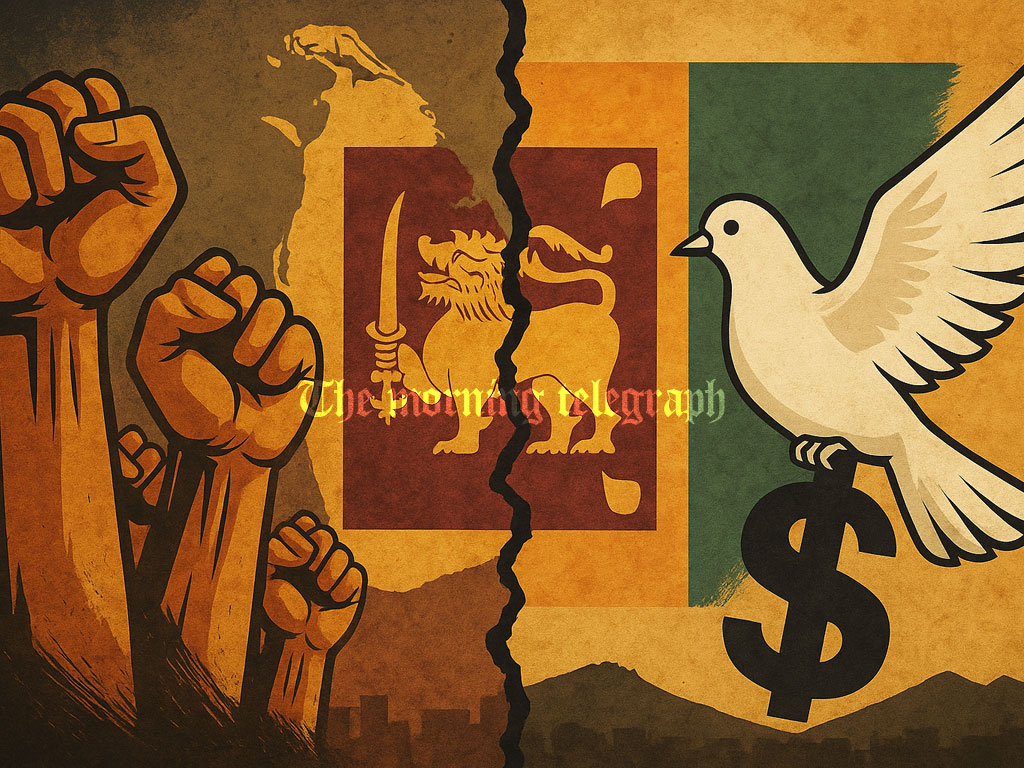
The untold story of how the island’s business elite survived every political turn, from 1970s import bans to today’s JVP-led government, by making deals with their former enemies.
Sri Lanka’s corporate elite has perfected the art of political reinvention. Their journey through socialism, open markets, and economic crisis has now landed them at the heart of JVP-led governance, showcasing a stunning flexibility that transcends ideology. This is the story of Sri Lanka’s new political dealers.
When Mrs. Bandaranaike’s left-wing government took power in 1970, she inherited a business landscape dominated by UNP-aligned multinational networks. Previous nationalization attempts had failed to dismantle this structure. Her new approach was revolutionary: hand the Finance Ministry to LSSP’s N.M. Perera and create an entirely new local business class through import bans. The strategy was simple: ban imports and let local entrepreneurs fill the vacuum.

The textile trade became the breeding ground for this new business elite in Sri Lanka’s protected economy. Dasa Mudalali led with Duro shirts and pioneered Sri Lanka’s first supermarket chain. Gnanam built Sintex Mill, then the country’s largest textile factory. Others included U.K. Edmund Macallans in books, Jinadasa Mudalali with water motors, Vipula Dharmawardena in batik, and Seelanatha Kunupu manufacturing marble flooring and carpets.
By the 1977 government change, these were Sri Lanka’s leading businessmen. Among them was Upali Wijewardena, who had married Mrs. Bandaranaike’s niece while being J.R. Jayewardene’s relative. Ironically, it was at Upali’s house that J.R. plotted the Bandaranaike government’s downfall, arranging meetings with Anura Bandaranaike to sow family discord.
When J.R. Jayewardene stormed to power with a massive majority, he systematically dismantled the business class Mrs. Bandaranaike had nurtured. His open economy policy welcomed back multinational corporations and created new business networks, including Lalith Kotelawala. The UNP became a house of competing business networks, with J.R. building Western connections while Premadasa, Gamini, and Lalith cultivated their own circles.
President Premadasa’s era saw him secure garment quotas from America and Europe, building Sri Lanka’s dominant garment industry and elevating businessmen like Omar Ashraf and Mahesh Amaleen as his champions. He also transformed Harry Jayewardene from a minor businessman into a major player.
Chandrika Kumaratunga continued J.R.’s open economic policies but kept businessmen at arm’s length. They could conduct business and assist during elections, but she didn’t seek their governance advice. Mahinda Rajapaksa followed this pattern after 2005, creating new business allies without destroying old networks, welcoming electoral support but not consulting on economic policy.
The turning point came with the Maithri-Ranil government in 2015, whose tax policies burdened the entire business community. These businessmen pushed back through politics, rallying around Gotabaya Rajapaksa through the Viyath Maga movement. When Gota won in 2019, he delivered on his promises, removing taxes and making history by appointing businessmen as heads of key government institutions. For the first time, business leaders advised on budgets and economic policy directly.
Then came the 2022 economic crisis and bankruptcy. President Ranil Wickremesinghe dissolved Gota’s business advisory committees, while opposition leader Sajith Premadasa only approached them for donations, not policy input. Having lost the influence, profits, and tax benefits they enjoyed under Gota, these businessmen found themselves politically adrift.
This created the perfect opening for Anura Dissanayake and the JVP. They approached the same Viyath Maga crowd that had advised Gota, asking for identical support. On the night of the presidential election, these businessmen met with Anura, briefing him on economic management. After victory, Anura appointed Duminda Hulangamuwa, a key member of Gota’s 2022 bankruptcy advisory committee, as coordinator for these businessmen. The same individuals Gota appointed to chair government institutions now received similar positions under Anura.
So, are these businessmen now JVP theorists? That is how it looks. If Wijeweera were still around, he would be eating dirt. The great political irony is complete: Sri Lanka’s business elite has outlasted every political system by making deals with whoever holds power, proving that in the nation’s political economy, survival trumps ideology every time.