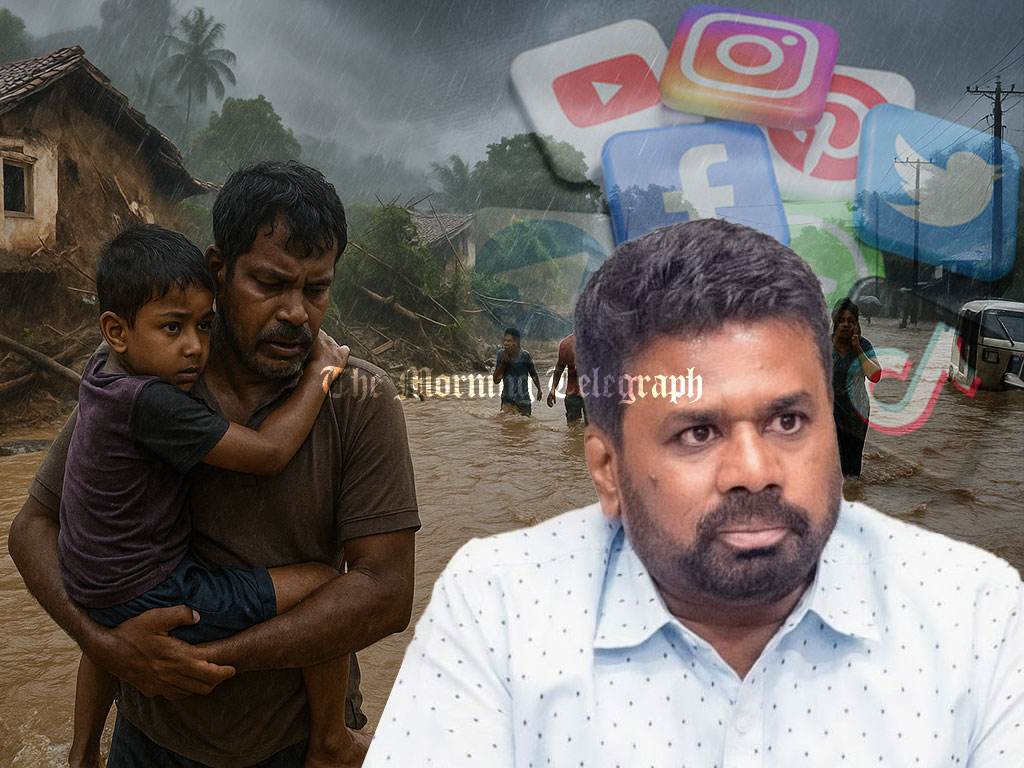
As Sri Lanka battles its worst weather crisis in years, anger and frustration boil over as citizens question where the state machinery has gone and why lifesaving action arrived far too late.
Some people affected by the heavy rains and strong winds are complaining about the current government’s actions. Residents in several districts say they feel abandoned and unsupported at a time when homes are underwater, roads are blocked and families are struggling for basic necessities.
“In the past, the army would come, the police would come. Today, there is no one. Only D.S. is in the village. There is no one else here. Look at the people who are suffering,” a disaster victim in the Kaduruwela area told reporters. For him, the absence of visible state response during this emergency has made the hardship far worse.

This is an allegation made by another person who stood nearby and expressed deep frustration. “No one. Today, they have given half a loaf of bread.” According to him, the relief brought to their community felt insufficient and far below expectations seen during past disasters.
However, another person at the same location in Kaduruwela insisted that the President has taken the necessary steps. He said, “The President has made it very clear that no matter where Colombo is submerged, money will be passed on. You cannot give money immediately when the water has receded. Who will look at this when the whole of Sri Lanka is submerged? I am making these false allegations. I am not a JVP supporter. I am a villager.” His view suggests there is a divide among affected residents regarding who is to blame and how much responsibility rests on the central government versus local administrative structures.
What on earth is going on?
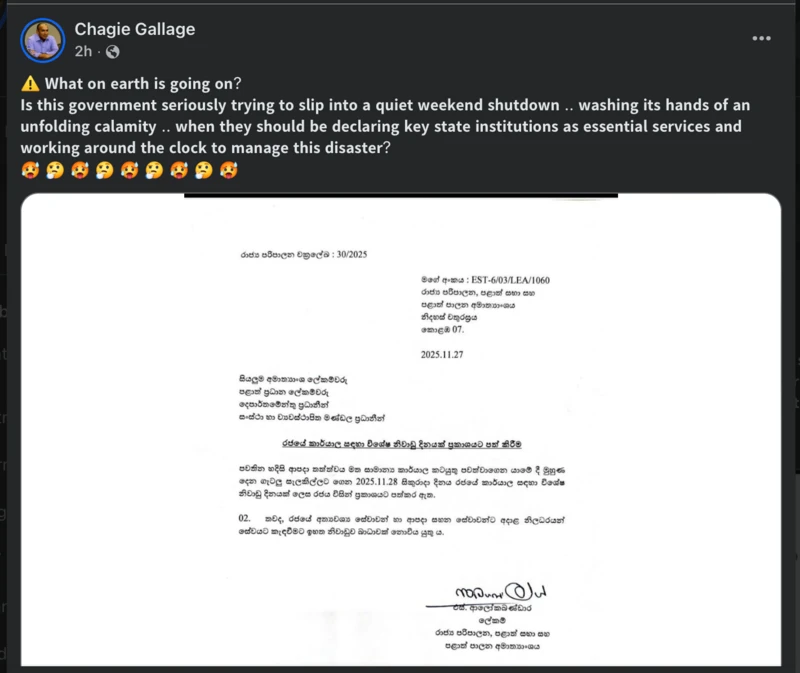
Meanwhile, retired Army Major General Chagi Galle posted on Facebook expressing concern over the government’s performance. In his post, he questioned why the government did not declare essential services and activate a 24 hour disaster response mechanism. His post stated, “What on earth is going on? Is this government, which should have declared major government institutions as essential services and worked 24 hours a day to manage this disaster, trying to slip away with a silent shutdown over the weekend?”
Other social media users also expressed anger and disappointment claiming that the government did not take proper steps even though early warnings were issued. Many questioned why emergency units were not mobilized in advance and why evacuation programs were not prepared earlier.
One widely shared post claimed, “The biggest stupid decision a government can take during a disaster has been announced. The state has been closed. Officials have been given leave.” The post argued that during disasters the government must remain fully functional because shutting down affects hospitals, public service and emergency administration.
The post further criticized the lack of essential medical supplies in hospitals stating that patients admitted to hospitals are dying without critical items. The writer also alleged that provincial health directors have not been authorized to purchase medicines from the private sector and that Divisional Secretaries have not been provided funds to buy basic food items. The note concluded with a statement claiming that the state is effectively absent during this critical moment and questioned why a once efficient public service reached this point.
Colombo talks will not be successful
Meanwhile, Parliamentarian Namal Rajapaksa said that officers should be given freedom to make decisions according to the situation without fear. He said that discussing issues in Colombo and expecting officials to follow complicated procedures will not work effectively during disasters. His comments to journalists highlighted the serious challenges faced at village level and the need for decentralized authority.
“Clearly, the government should act quickly for this. The idea of discussing in Colombo and informing the Parliamentarian is not very successful. Why, especially the people at the village level have been inconvenienced to a great extent. Similarly, officials should be given the freedom to make decisions according to the situation without fear. The President should go in accordance with the Disaster Management Act and allow those officials to go outside the circular and do the work of the people. Otherwise, it seems that it is difficult to intervene in this situation by acting according to the existing circular.”
Rs. 100 have been allocated so far
At a media briefing held at the Ministry of Defence regarding the disaster situation, an Additional Secretary presented key details. According to him, the disaster period officially began on the 21st of this month. So far, 148,603 people from 44,191 families across 285 Divisional Secretariat Divisions in 25 districts have been affected. A total of 5,024 families have moved to 195 shelters and the number of individuals currently in shelters is 14,766.
He stated that the government is providing three meals per day to all those in shelters. Pregnant mothers, lactating mothers and infants are being provided two milk meals. Other adults receive two tea meals daily. Those who cannot reach shelters are also being fed based on circular guidelines. The Additional Secretary explained that circulars instruct officials to provide cooked food to anyone who has lost income during the disaster period.
He added that Rs. 100 has been allocated per person to maintain good health. According to him the President has instructed officials to take decisions based on the District Coordination Committee and to spend funds even beyond circular limits when necessary.
For houses that have been completely destroyed, Rs. 2.5 million will be provided. The same amount will be allocated to 42 homes that were fully damaged. Partial damages will also be compensated based on assessments.
Meanwhile, Cabinet Spokesperson Minister Nalinda Jayatissa told Parliament that financial provisions have been arranged for all District Secretaries to support victims of the disaster.
What steps has the government taken so far?
At a special meeting in Colombo, President Anura Kumara Dissanayake instructed District Secretaries not to let financial barriers delay rescue and relief efforts. He stated that Rs. 1.2 billion has been allocated for disaster relief services and ordered the immediate issuance of a new circular to eliminate administrative obstacles.
The Presidential Fund has been instructed to allocate Rs. 1 million for every person who died due to sudden disasters including floods and landslides. The government also announced holidays for state institutions except for essential services. Additionally, the amount a Divisional Secretary can spend during a disaster situation has been increased to Rs. 50 million.
The Ministry of Finance has informed the Procurement Committee that procurement activities up to Rs. 50 million can be carried out quickly. Treasury Secretary Dr. Harshana Suriyapperuma has authorized Divisional Secretaries to use these funds immediately and to request further adjustments if additional provisions are needed.
At a media briefing today, Prime Minister Dr. Harini Amarasuriya said that necessary financial arrangements have been made to address the crisis. She also noted that international assistance will be sought if required to rescue those in danger.
What is the government’s plan to deal with the Colombo floods?
Jathika Jana Balawegaya MP Lakmali Hemachandra stated that an evacuation program for residents along the Kelani River is underway. Divisional Secretariats are identifying safe locations and preparing places for displaced people. Food distribution will continue for the next several days.
She said that people in high risk areas such as Bloemendal and Grandpass have been requested to evacuate. However, some residents hesitate to leave due to concerns about the safety of their property. The MP explained that the army and police are preparing a security plan to address these concerns and that transportation is being provided to move people to designated centers.