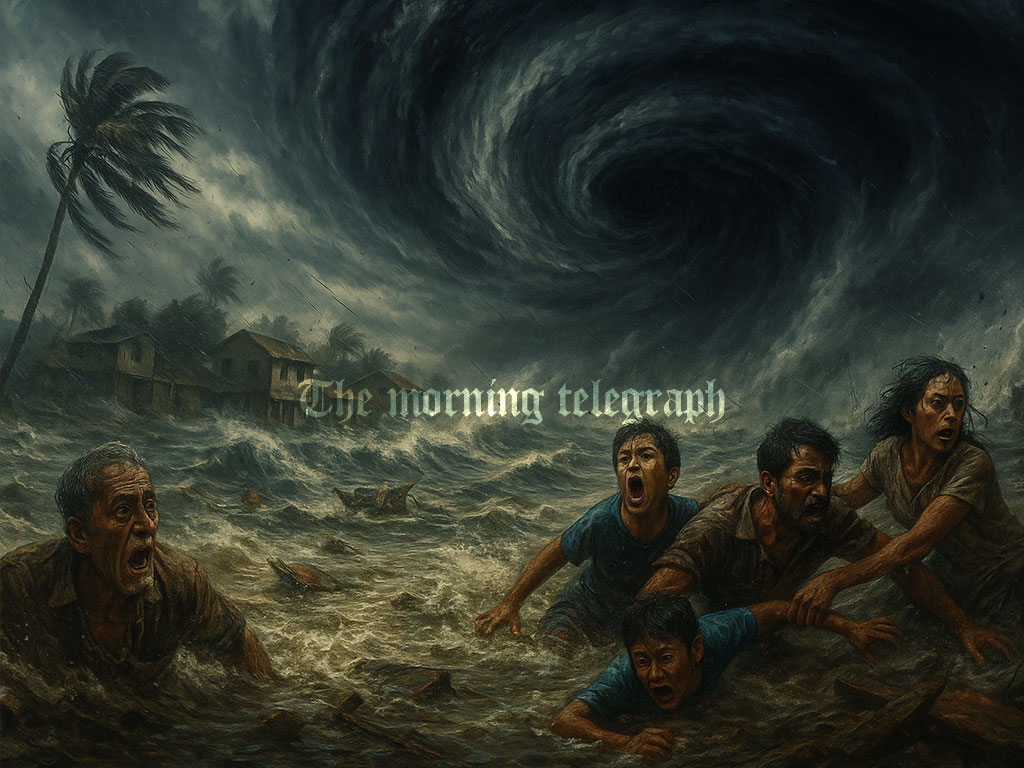
A devastating national tragedy has revealed not the wrath of nature, but the collapse of a government that chose theatre over action, sentiment over responsibility, and self-preservation over the safety of 22 million people.
Sri Lanka continues to suffer from the consequences of a disaster that every credible warning predicted with absolute clarity. Despite repeated alerts from experts, regional bodies, and local agencies, the government deliberately ignored calls to prepare. When catastrophe struck, and the nation was submerged in misery, the administration scrambled not to save lives but to save face.

President Dissanayake appeared nearly 72 hours after the flooding began, long after families had been swept away, roads destroyed, and entire communities displaced. His televised address presented itself as leadership, yet what the people witnessed was performance. It was a staging of sorrow, a display of theatrical remorse, as though he were auditioning for a dramatic tragedy instead of guiding a nation through its darkest hour. He lamented like a man wronged by fate rather than a head of state responsible for safeguarding the lives placed under his care.
The country did not need a soliloquy. It needed leadership that recognised danger early, acted decisively, and positioned competence above loyalty. The people needed swift mobilisation, coordination, and emergency planning. Instead, the President has surrounded himself with insiders whose qualifications disintegrate under scrutiny. One adviser is simultaneously employed by a globally controversial audit firm. Another volunteers in digitalisation while quietly protecting the corporate interests of his true employer by obstructing telecommunications upgrades. Yet another secured a diplomatic post for his niece within days. These are not experts in disaster management or national security. These are symptoms of a government weakened from within, addicted to insider networks, and habitually distrustful of professionals.
The mishandling of the vehicle import relaxation became another striking symbol of administrative chaos. As soon as the gazette was issued, Chinese vehicles flooded the market within hours, a feat impossible without advance insider notice. This was not policy. It was pre-arranged advantage. The government’s actions become indistinguishable from the very practices it once condemned. For all their shortcomings, at least some previous administrations understood the fundamentals of crisis management.
But the most unforgivable failure lies in disaster preparedness. Countries in the region, including Thailand, the Philippines, and Indonesia, issued early warnings after experiencing their own devastation. Local meteorologists and irrigation engineers urged immediate action. Experts called on the government to implement emergency protocols. Yet the administration, obsessed with restructuring institutions under the name of reform, weakened the very systems responsible for protecting the nation. The government dismantled essential mechanisms such as the Office of the Chief of Defence Staff, which had always acted as the backbone of national disaster coordination.
The SOPs for emergencies, including Operation Cloud Burst, were already written, tested, and ready to activate. What was missing was leadership. When the waters rose, the institutions meant to launch the response had been left toothless. It was not committees of political loyalists who stepped in. It was not advisers with overseas connections. It was not the carefully curated panels that appear during media briefings. The ones who rescued families, carried the injured, transported food, and restored hope were the military. An institution that certain foreign elements, activists, and politically aligned groups have spent years attempting to weaken, discredit, and shrink. Yet in the end, it was the armed forces who lifted a drowning nation while the political leadership remained paralysed.
The President’s address, when it finally came, contained no frank admission of failure. Instead, it floated on a cloud of poetic sentiment. Declaring that he would hesitate at nothing to restore life to the dead reduced a national catastrophe to dramatic exaggeration. Leaders are expected to face reality, not retreat into emotional spectacle. His speech sounded less like a national directive and more like the mournful pleas of a man struggling with his own conscience. It was an address meant to manage optics rather than manage disaster.
The nation deserved honesty. It deserved acknowledgment that warnings were ignored. It deserved recognition that essential institutions had been dismantled. It deserved a clear admission that reckless appointments, political insecurity, and personal loyalties had placed Sri Lanka at risk long before the first raindrop fell. Instead, the country received sentimentality. Instead of a call to accountability, the people received consolations. Instead of a roadmap for prevention, they received emotional fog.
Poetic language cannot rebuild homes. Symbolic gestures cannot replace livelihoods. Tears on a podium cannot restore lives lost. The people watched the floods wash away their possessions, their memories, and their loved ones. They do not need consolations about humanity and courage from a government that failed to demonstrate its own.
The President’s call for unity might have carried weight if he had shown even a fraction of the competence he now demands from citizens. His appeal for collective rebuilding rings hollow when foundational systems are broken, emergency protocols dormant, data infrastructure outdated, and government institutions entangled in political insecurity. His emotional performance cannot erase the fact that months before this tragedy, his own administration held warnings in their hands and chose not to act.
Sri Lanka now stands on a long and difficult road to recovery. Roads lie shattered. Schools remain underwater. Fields are ruined. Industries are paralysed. Communities across the island will take months, if not years, to rebuild. But reconstruction requires more than committees, budget allocations, or speeches. It requires a government capable of coordinating a national recovery strategy, one that is not controlled by insiders or manipulated by personal agendas. It requires leadership not driven by insecurity, but by competence.
The President must understand that Sri Lankans will no longer tolerate leadership that replaces action with apologies, direction with sentiment, or responsibility with theatrics. If he wants to rebuild the nation, he must rebuild the administration he destroyed. He must remove those who misled him, dismantle corrupt advisory circles, and restore the operational structures his own reforms weakened. Only then can Sri Lanka hope to rebuild a governance system capable of protecting the public.
The rain fell from the sky, but the collapse came from the top. The disaster may have been natural, but the depth of destruction was political. This was not merely a failure of planning. It was a failure of governance. It was a failure of responsibility. It was a failure of courage. Sri Lanka needed action and received a performance. It needed leadership and received lamentation. It needed preparation and received excuses.
The waters rose because nature was unforgiving. The nation drowned because its leaders were unprepared. And as homes washed away, livelihoods disappeared, and communities suffered, the government proved that the true collapse was not in the reservoirs or the rivers, but in the very structure charged with protecting its people.
Sri Lanka will rise again. But it will rise not because of its leaders, but despite them.