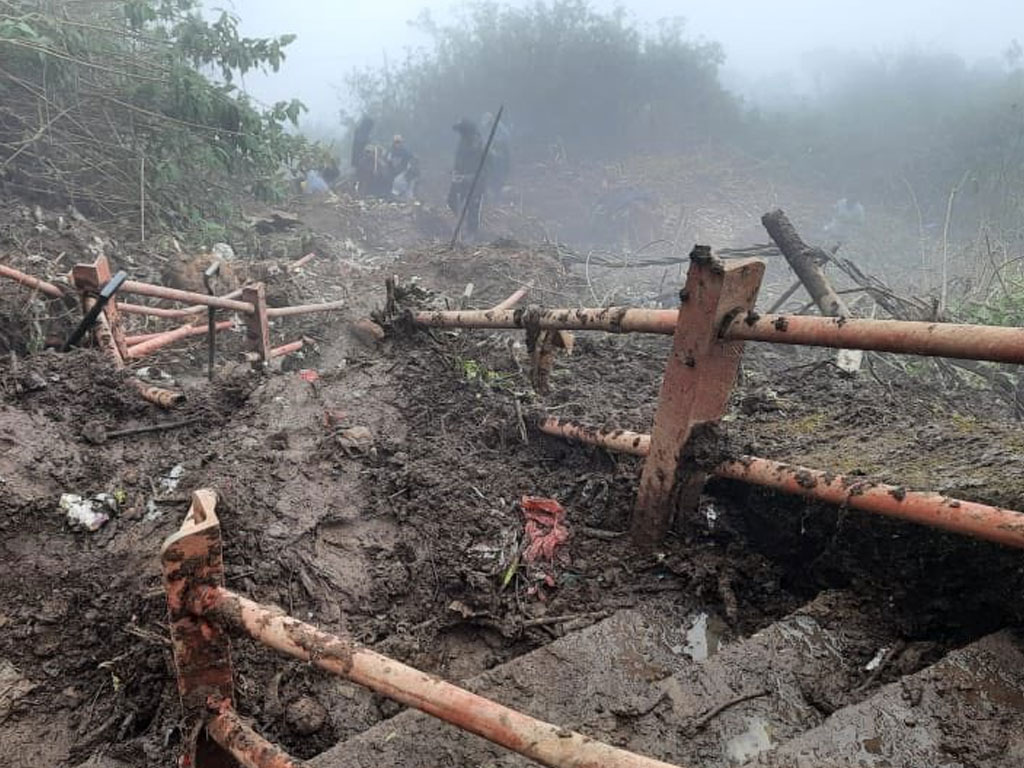
Authorities have issued an urgent warning after fresh instability at Mahagiri Damba on the Hatton route to Sri Pada, prompting strict access restrictions and demanding rapid safety measures as landslide risks escalate.
The National Building Research Organization has formally notified the Ratnapura District Secretary that access through the unstable Mahagiri Damba zone must be restricted until all recommended measures to stabilize the area are fully implemented. This directive follows growing concern over the recent landslide activity along the Hatton access road to Sri Pada, a key pilgrimage route that attracts thousands of worshippers during the season.

According to the Director General of the National Building Research Organization, Asiri Karunawardena, a detailed set of safety recommendations was forwarded to the District Secretary after a team of experts conducted a preliminary field inspection on the second of this month. Their assessment confirmed significant geologic instability that requires immediate action to avoid further landslide development and ensure the safety of pilgrims, residents and workers in the affected zone.
As part of the structural recommendations, the National Building Research Organization has instructed that the damaged section of the stairs where the instability occurred must be repaired using a reinforced concrete or stone retaining wall. It also stresses that the foundation of this structure should be securely anchored to the bedrock using a dowel to improve long term stability. The report further highlights the need to construct a side wall of at least 300 millimeters in height on both sides of the stairs to divert surface water away from the vulnerable slope and reduce erosion during heavy rains.
In addition, the National Building Research Organization has stated that all visible cracks in the unstable rock layers should be sealed thoroughly with a cement mixture to prevent water infiltration. To further strengthen slope stability, a side wall of about 500 millimeters in height must be built along the right side of the lower section of the access road. This measure is essential to prevent loose soil, debris and stones from flowing onto the Hatton route during rain.
The organization has also recommended the careful removal of plant parts, shrubs and overhanging soil above the stairs to minimize the weight and pressure on the active landslide section. Furthermore, unstable bushes on both sides of the slope must be removed to prevent further loosening of the soil structure. These interventions, combined with structural reinforcements, are expected to reduce the immediate risk of continued slope failure.
Given the current situation and the severity of the geologic instability, the National Building Research Organization insists that public access through the Hatton entrance to Sri Pada must remain restricted until all corrective actions are completed. The organization emphasizes that consistent night-time illumination of the area is crucial to detect rapid terrain changes, especially during ongoing wet weather conditions that heighten landslide risks.
Once the recommended safety measures have been implemented, the Director General has confirmed that the Hatton entrance can be reopened as usual for pilgrims and travelers. Copies of the official letter detailing these recommendations have been sent to the Chief Incumbent of Sri Pada, Ven. Bengamuwe Dhammadinna Thero, the Governor of Sabaragamuwa Province, the Deputy Minister of Defense, the Secretary of Defense, the Army Commander, the Inspector General of Police and the Conservator General of Forests, underscoring the urgency and national importance of the matter.