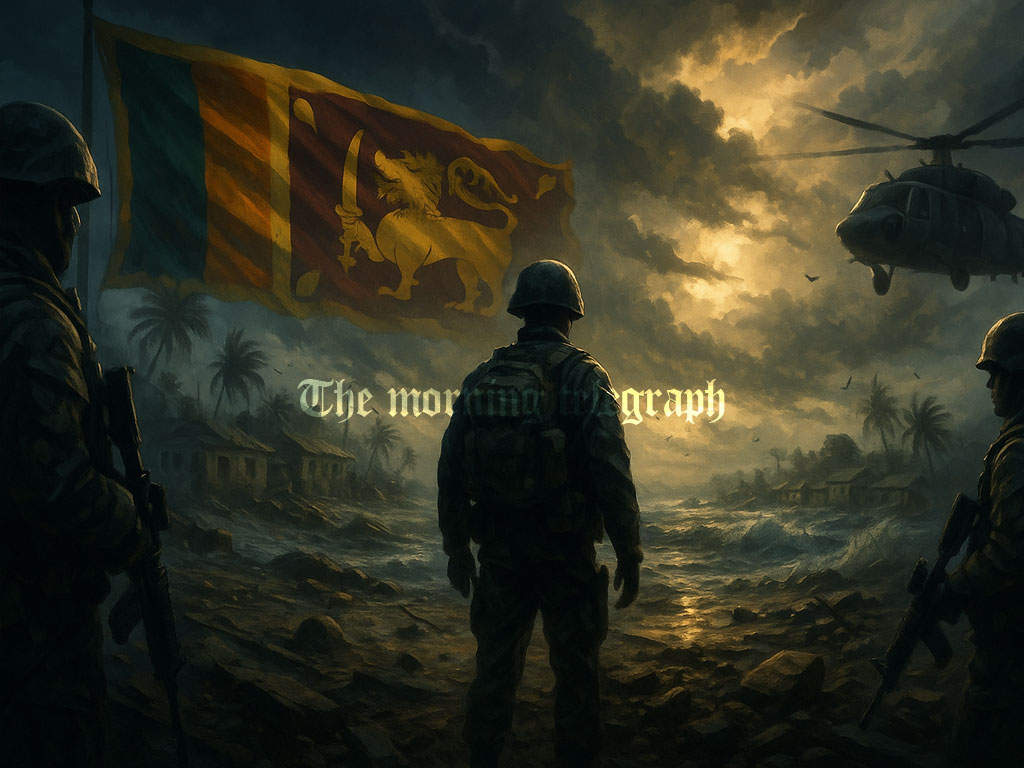
Sri Lanka woke up to foreign boots on its soil nine days after Cyclone Ditwah, but no one was told who approved it, why it was hidden, or whether it was even legal.
Nine days after Cyclone Ditwah tore through Sri Lanka’s coastline and flooded towns, uprooted families, and shattered infrastructure, the public awoke to a startling image. A United States military team had landed in the country under the banner of “emergency assistance.” The phrase itself was reassuring at first glance, but the timing immediately raised alarm. In any functioning democracy, the arrival of foreign military personnel, even under humanitarian cover, is not a casual matter. It is a serious act of state that demands transparency, procedural clarity, and public accountability. Yet in this case, none of that was visible. There was no prior public announcement, no briefing to Parliament, and crucially, no authorising Order published in the Gazette under the Visiting Forces Act. What should have been a routine legal disclosure instead became a disturbing example of how executive power can operate quietly in the shadows, even while presenting itself as humanitarian concern.

The core concern is not whether humanitarian aid is needed, nor whether foreign assistance is unwelcome. The central issue is the complete absence of due process. Democracies are defined not only by elections but by the predictability and visibility of their legal procedures. When foreign armed forces enter domestic civilian space, even temporarily and even for assistance, the laws governing such entry must be followed precisely. In Sri Lanka, the law is unambiguous. The Visiting Forces Act requires an Order to be issued by the President and published in the Gazette. This publication is not symbolic. It is the act that grants legal authority and informs the public. Without publication, the force has no visible legal standing. Yet nine days after the cyclone struck, no Gazette notice existed in the public domain confirming the legality of these troop movements. If the Order was issued but not disclosed, the government violated transparency. If the Order was never issued, the government violated the law. Either scenario weakens public trust and damages democratic legitimacy.
Some defenders argue that the disaster created an emergency so severe that procedural formalities had to be set aside. That argument may have carried limited weight on the first day or two, when roads were underwater, rescue efforts were frantic, and communication systems were collapsing. But by the ninth day, that justification collapses entirely. This was not a spontaneous rescue mission involving foreign soldiers pulling people from rooftops in the middle of a storm. It was a pre arranged deployment that required diplomatic coordination and preparation. During those nine days, government institutions functioned normally. Ministers issued routine statements. Parliament remained active. The machinery of the state continued to operate. It is therefore impossible to describe the absence of public notification as an unavoidable consequence of crisis. It reflects a deliberate decision to avoid democratic procedure.
When compared with how other democracies manage such situations, Sri Lanka’s silence becomes even more glaring. In Germany, parliamentary approval is mandatory for military deployments, and the presence of foreign forces under NATO arrangements is publicly documented and debated. In the United Kingdom, even though the executive enjoys broader discretion, deployments under the Visiting Forces Act are formally announced, legally documented, and visible to the public. In Canada, foreign military assistance, whether from the United States or elsewhere, requires public disclosure and parliamentary scrutiny, even during natural disasters. Australia operates under publicly available status of forces agreements and ensures that disaster relief deployments involving foreign troops are clearly communicated to the citizenry.
Even the United States, a country with vast executive flexibility in military affairs, does not allow foreign armed forces to operate domestically without public visibility. The principle across democracies is consistent. Foreign military presence affects civilians, jurisdiction, sovereignty, and the rule of law. Therefore, it must be visible, debated, and legally authorised. Democracies do not quietly insert armed personnel into their territory. They cannot afford such secrecy because history clearly shows what follows when they do.
The Cold War era offers sobering lessons. In Italy, the clandestine Gladio network operated for decades without parliamentary knowledge under the pretext of national security. When exposed in the 1990s, it provoked massive national outrage and permanently damaged trust in state institutions. In Iran under the Shah, secret agreements allowed U.S. intelligence and military presence to operate beyond public scrutiny, fuelling resentment that later contributed directly to the collapse of the regime. In the Philippines, the Marcos government permitted foreign military operations without legislative oversight, generating decades of constitutional disputes over sovereignty. Even in democratic Japan, early post war agreements involving U.S. forces were kept from the public, causing political instability when later revealed. Across all these cases, the pattern is clear. Secrecy surrounding foreign military activity almost always erodes public trust and weakens democratic legitimacy.
Sri Lanka is not immune to that historical logic. The country carries a long legacy where opacity in defence matters, whether during civil conflict, foreign assistance programmes, or post war security operations, has repeatedly fuelled suspicion and institutional instability. The lesson should already be obvious. When the public is excluded from information about foreign military presence, speculation rushes in to fill the vacuum. Conspiracy theories flourish. Political instability deepens. Public confidence erodes. The government’s silence on the legal status of the U.S. military team, especially when Indian forces had already arrived earlier under similarly opaque circumstances, strengthens the perception that transparency is being treated as optional. Yet transparency is not optional in a democracy. It is the very foundation of lawful governance.
This transforms the legal question into a democratic one. Does the Sri Lankan public have the right to know, clearly and promptly, when foreign military forces enter the country during civilian circumstances? If Sri Lanka claims the status of a democracy, the answer must be yes. Democratic states do not grant foreign military access without informing their citizens. They do not rely on leaked photographs and social media sightings. They do not hide authorising procedures or delay their publication. They do not wait nine days and suddenly invoke “emergency assistance” as though time sensitive rescue decisions suddenly began more than a week after the disaster. Emergencies demand speed. Bureaucracies demand order. Democracies demand transparency. Sri Lanka’s government appears to prioritise the first two while neglecting the third.
If the government complied with the Visiting Forces Act, it should publish the relevant Gazette immediately. If it did not comply, it owes the public a direct explanation, not a delayed press release filled with technical justifications. Silence is not a neutral position when foreign armed forces are involved. The public deserves clarity on the mandate, operational scope, authority, and legal jurisdiction of U.S. and Indian military personnel currently operating on Sri Lankan soil. Without that clarity, the state risks normalising ad hoc military access without public oversight, a dangerous precedent in any democracy.
This issue also extends beyond one cyclone. Sri Lanka must confront whether its legal safeguards for foreign military deployments are strong enough, respected enough, and visible enough. If not corrected now, the same pattern will reappear in future crises, perhaps under far more sensitive geopolitical conditions. A democracy cannot operate on unwritten understandings, private executive arrangements, or withheld legal documents. It must operate on law, visibility, and informed consent.
Nine days after Cyclone Ditwah, what should have been a straightforward humanitarian deployment instead exposed a deeper accountability deficit. The damage is not only legal but institutional. The government may hope this controversy fades with time. But in a democracy, silence is rarely just silence. It is a warning.