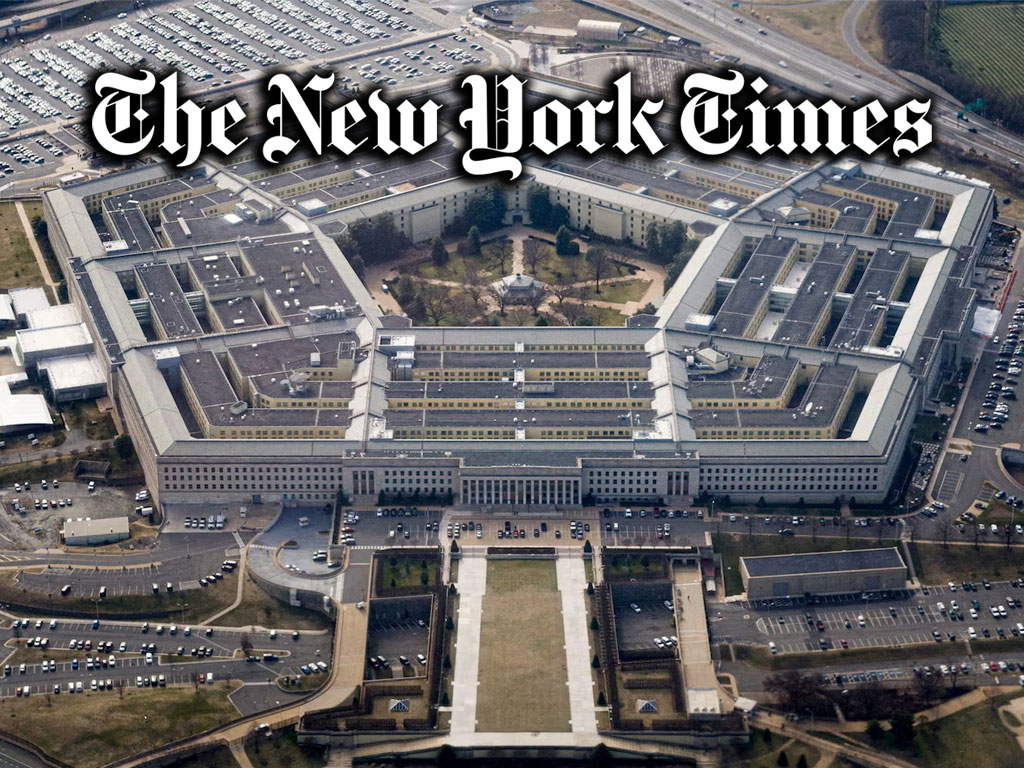
A landmark legal battle has erupted in Washington as the New York Times directly challenges the Pentagon’s restrictive media policy, raising serious constitutional questions about press freedom, government transparency, and the future of independent war reporting.
The New York Times has filed a lawsuit against U.S. Defense Secretary Pete Hegseth over a newly enforced Pentagon media policy that requires journalists to pledge they will not gather or report information unless it is formally authorized for public release by defense officials. The lawsuit was filed on Thursday and names both the Defense Department and Hegseth as defendants, along with chief Pentagon spokesman Sean Parnell.

The controversial policy, introduced in September, effectively bans credentialed journalists from reporting even unclassified material unless it has been approved by Pentagon leadership. The Times argues that this policy attempts to force reporters to rely exclusively on official government sources for military news and also threatens punishment for journalists who do not comply. The newspaper described the policy as an illegal attempt to control the flow of information and suppress independent reporting.
Rather than accept these conditions, the New York Times and NPR voluntarily surrendered their Pentagon press credentials. Despite losing physical access, both organizations continue to publish aggressive investigative coverage on military actions, including United States strikes on Iranian nuclear facilities and Venezuelan vessels. Some of these reports directly contradicted early official statements.
Sean Parnell acknowledged the lawsuit in a public statement, saying, “We are aware of the New York Times lawsuit and look forward to addressing these arguments in court.” The legal filing states that Hegseth’s actions violate constitutional protections for free speech and freedom of the press. According to the court brief, “It is exactly the type of speech and press restrictive scheme that the Supreme Court and D.C. Circuit have recognized violates the First Amendment. The Policy abandons scrutiny by independent news organizations for the public’s benefit.”
The complaint also alleges that the Pentagon violated due process rights by abruptly stripping press credentials without warning and without providing any appeals process. The Times legal team referenced a similar case from President Trump’s first term, when the White House revoked the press pass of then Playboy reporter Brian Karem. A federal judge later overturned that decision, and the administration was also forced to restore CNN correspondent Jim Acosta’s access.
The conflict comes amid heightened scrutiny of Hegseth’s leadership. A recent inspector general investigation found that Hegseth’s private Signal chats with senior government officials regarding upcoming United States airstrikes in Yemen may have put American troops at risk. Those conversations were originally exposed by The Atlantic editor in chief Jeffrey Goldberg, whose number was mistakenly added to the private chat group. NPR chief executive Katherine Maher also chairs the board of the Signal Foundation, which oversees the messaging platform.
The Times is represented by prominent free speech attorney Theodore J. Boutrous. He is also representing NPR in a separate lawsuit against the White House over an executive order barring federal funding for NPR and PBS. A key hearing in that case is scheduled to take place later this week in Washington.
Hegseth has also introduced new restrictions requiring reporters to be escorted through many areas of the Pentagon, reversing a long standing tradition that existed under both Republican and Democratic administrations. He later announced the policy forcing journalists to sign acknowledgments agreeing not to seek or disclose unauthorized information. Hegseth defended the strategy publicly, stating on social media, “The press does not run the Pentagon. The people do.”
Hegseth is a military veteran and former Fox News host who gained national recognition through his television career. Fox News correspondents were among those who opposed the new policy and were also forced to surrender their press credentials as a result.
Gabe Rottman of the Reporters Committee for Freedom of the Press criticized the move, stating, “The Pentagon’s press access policy is unlawful because it gives government officials unchecked power over who gets a credential and who does not. The public needs independent journalism and the reporters who deliver it back in the Pentagon at a time of heightened scrutiny.”
In the wake of traditional media exits, the Pentagon has welcomed a new press corps willing to follow the policy. These new arrivals include figures from pro Trump and conspiracy based media outlets. Pentagon press secretary Kingsley Wilson told them, “Legacy media chose to self deport from this building. National trust in these mainstream media outlets has cratered to 28 percent. The American people do not trust these propagandists because they stopped telling the truth.”
Among the new arrivals are far right activist Laura Loomer, Gateway Pundit, and LindellTV backed by MyPillow founder Mike Lindell. Several posted on social media claiming they had been assigned former offices of Washington Post reporters. At least one later admitted he had been given incorrect information.
The case is now shaping up to become one of the most serious press freedom battles in modern Pentagon history.