As U.S. pressure tactics fail and global alliances shift, the rise of India and Russia signals the quiet collapse of American dominance and the birth of a new world economic order that no single superpower can control.
Today, we live in one of the most critical and complex periods in world history. The global system that functioned for decades under the dominance of the United States is visibly unraveling before our eyes. The era of unchallenged American hegemony is coming to an end. This is not merely a political or economic transition. It is the beginning of a deep philosophical transformation that will redefine how humanity understands power, sovereignty, and global cooperation.

For the first time since the Cold War, major nations are openly acting against Washington’s wishes without fear of collapse. Nowhere is this shift more visible than in Asia, where two powerful states, India and Russia, continue to prioritize their national interests despite tremendous pressure from the United States. Their resistance is not symbolic. It is structural. It reflects a broader shift in how the world now functions economically, strategically, and diplomatically.
For decades, the United States believed its power was absolute. It assumed that economic pressure, sanctions, and diplomatic isolation were sufficient tools to force any nation into submission. This belief was tested when Washington attempted to apply the same pressure strategy against India. The U.S. leadership assumed that India’s economy was deeply dependent on exports to American markets and that sanctions would shatter its growth. That assumption was catastrophically wrong.
The entire framework of American pressure against India was based on assumption rather than data. The reality is that India’s exports to the United States account for only 5 percent to 10 percent of its Gross Domestic Product. Experts openly mocked Washington’s miscalculation, with some stating, “I am amazed at the stupidity of these people.” A temporary dip in exports may sting. But it is nowhere near as devastating as cutting off access to affordable Russian energy, which forms the backbone of India’s industrial and consumer economy.
The fundamental strength of India’s economy does not lie in exports alone. It lies in domestic consumption powered by a massive population and an internal market unlike any other. India is not prepared to sacrifice its people’s welfare to satisfy external demands. That refusal alone signals that the world economy no longer operates at the will of the United States.
American foreign policy failure is further deepened by its ignorance of history. U.S. policymakers look only at the present balance of power, disconnected from the strategic memory of nations. One expert described modern American leadership as part of “an Alzheimer’s generation.” From Trump to Biden, and even in earlier administrations under Obama, George W. Bush, and Bill Clinton, there is little understanding of the historical roots of India Russia relations.
The friendship between India and Russia dates back to the Soviet era. During the Cold War, Pakistan served as a key operational base for the CIA. India, meanwhile, served as Moscow’s most reliable regional partner. That relationship survived ideological shifts, regime changes, and economic transformations. The bond between Russians and Indians remains deeply rooted in strategic trust. American media, unaware of this historical continuity, expressed surprise when Indian Prime Minister Modi welcomed Russian President Putin warmly. One blunt observer mocked the reaction by saying, “Modi welcomes Putin. It is like a dog meeting another dog and sniffing its back. That is what dogs do. This is not what India and Russia do. They are friends. So accept it.”
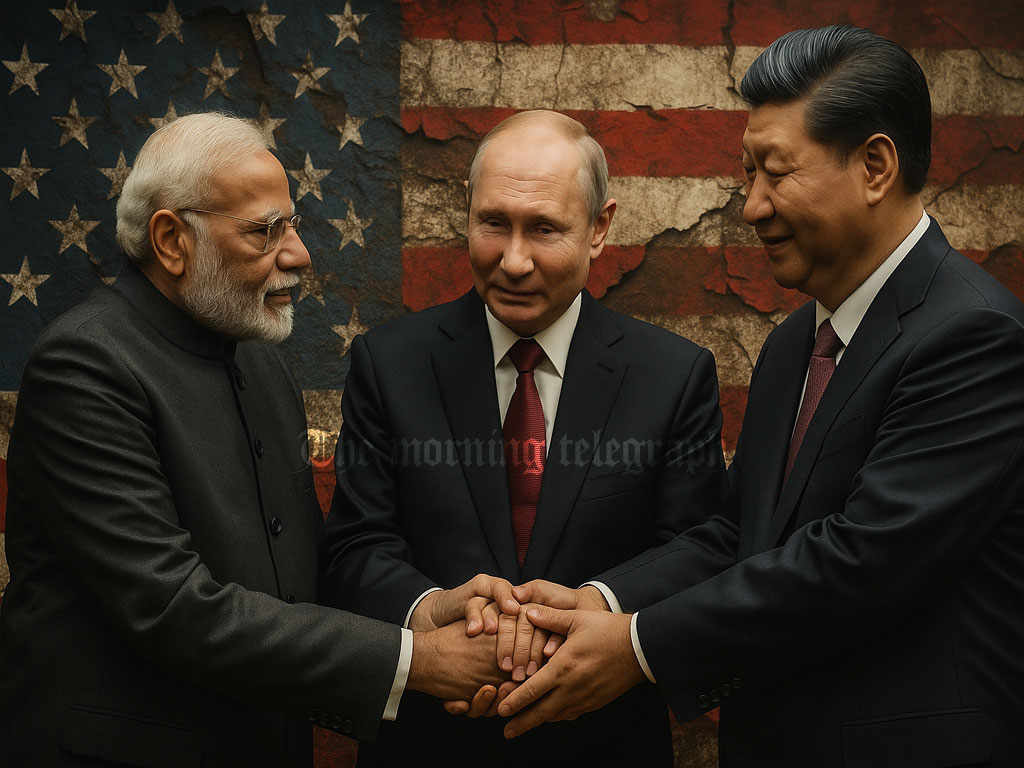
The U.S. strategic vision was to weaken Russia first and then pivot toward China. Instead, the opposite has happened. Russia is now serving as a mediator between India and China. Even long standing border tensions between the two Asian giants are slowly losing their explosive intensity. As Modi and Xi Jinping engage diplomatically, Russia quietly facilitates this emerging balance. What Washington intended as isolation has become integration. Instead of collapsing, Russia has repositioned itself as a central pillar of the new world economic order.
The arrogance of American power projection is best illustrated through the story of EF Hutton. Decades ago, an American investment company ran a famous commercial with the slogan, “When EF Hutton talks, everyone listens.” Conversations would stop the moment the name was mentioned. That was once how the United States saw itself. But now, the reality is different. The United States still speaks loudly. But very few are listening.
This declining influence is visible in concrete military and technological cooperation between India and Russia. Russia has announced plans to manufacture its fifth generation fighter jet, the SU 57, on Indian soil. India already fields the S 400 air defense system and is now exploring options to acquire the more advanced S 500 platform. Beyond defense, Russia is constructing one of India’s largest nuclear power plants. Two reactors are already operational and supplying energy to Indian cities. All of this proves that India is intensifying cooperation with Russia rather than retreating under American pressure.
It is now undeniable that a new world economic order is being born. This order is no longer anchored solely in Washington. It stands firmly on three pillars: Russia, China, and India. While BRICS nations like Brazil and South Africa also play supporting roles, real structural power now rests within this strategic triangle. Together, these three countries represent nearly three billion people within the global economy. The United States was not prepared for this outcome. It still assumes global leadership by default. But the evidence increasingly contradicts that belief.
Recent developments confirm this shift. China and other nations are no longer purchasing U.S. Treasury bills in the volumes they once did. As global demand for U.S. debt declines, Washington has been forced to buy its own debt instruments. This marks the early signs of deep fiscal vulnerability. For decades, the U.S. could print money freely because the world absorbed its dollars. That era is fading. Nations are now trading increasingly in their own currencies. De dollarization is no longer a theory. It is unfolding in real time.
The Ukraine war offers another stark example of the limits of American power. Regardless of Western ambitions, the battlefield defines reality. Militarily, Russia is gradually overwhelming Ukraine. Experts now openly state that the only path for Ukraine to survive as a functioning state is to negotiate with Russia and accept Russian terms. Ukrainian losses continue to mount while Russian territorial gains accelerate. In November alone, Russia captured 701 square kilometers of territory. For perspective, the entire Gaza Strip covers just 350 square kilometers. In one month, Russia seized twice the territory of Gaza.
Meanwhile, Israel, despite possessing one of the world’s most advanced militaries, has failed to defeat Hamas even after 25 months of sustained operations across half that territory. These comparisons highlight the scale and permanence of the shifts now unfolding.
Russia’s military capacity has expanded dramatically. Its ground forces, which numbered approximately 300,000 in February 2022, now exceed 1.5 million troops. This allows multi axis operations across vast fronts. The United States and its allies can impose more sanctions. But the question remains, has it worked so far? Instead of weakening Russia, sanctions have fortified its economic self reliance. Russians have concluded that they no longer require Western approval to survive or grow.
This evolving reality confirms one truth. The center of global power is rapidly shifting eastward. Strategic alliances now matter more than ideological dominance. Power is no longer exercised solely at Washington’s command.
For small island nations like Sri Lanka, this global realignment offers a crucial lesson. Blind dependence on any single power bloc is no longer sustainable. Strategic balance, economic diversification, and diplomatic independence are no longer luxuries. They are survival strategies.
The world order is not collapsing into chaos. It is reorganizing itself into a multipolar system driven by shared interests rather than enforced obedience. India’s resistance to pressure, Russia’s economic resilience, and China’s financial independence together reflect a new geopolitical logic.
The illusion that one nation controls global destiny has finally been broken. What comes next will shape the lives of future generations across every continent. Those who adapt early will thrive. Those who cling to yesterday’s power structures will fall behind.