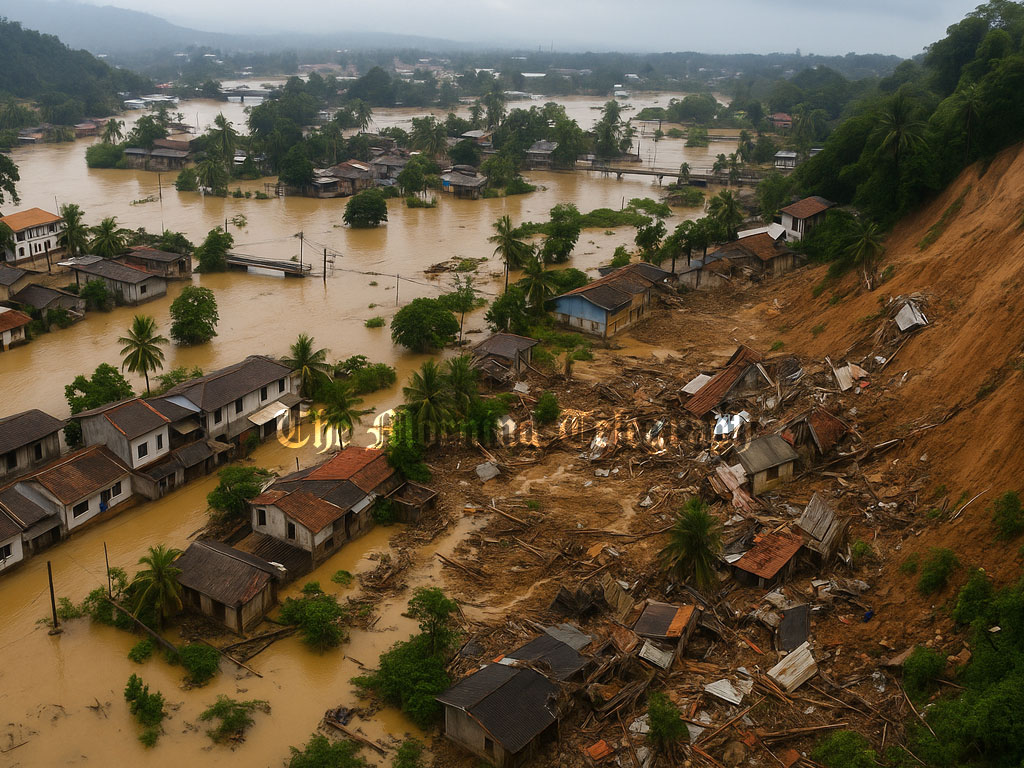
Millions affected, vast tracts of land submerged, and critical infrastructure damaged as a new UNDP assessment lays bare the true scale of Cyclone Ditva’s devastation while Sri Lanka mobilizes global support for recovery.
The United Nations Development Programme has released a comprehensive new report detailing the severe impact of Cyclone Ditva on Sri Lanka, confirming that 2.3 million people have been affected by widespread flooding and heavy inundation across the country. According to the findings, more than 1.1 million hectares of land, nearly 20 percent of Sri Lanka’s total land area, were submerged by floodwaters. The Dimbulagala Divisional Secretariat in the Polonnaruwa District has been identified as the area with the highest extent of flooding, with more than 23,000 hectares recorded as inundated.

The report further states that 530,000 hectares of paddy land were submerged, dealing a serious blow to agricultural production and food security. The scale of structural damage is equally alarming, with close to 720,000 buildings affected, amounting to one in every twelve buildings in the country. More than 16,000 kilometers of roads were exposed to flooding, along with over 278 kilometers of railway lines and 480 bridges located in affected zones.
Vulnerable groups account for a significant share of those impacted by the disaster. Of the people exposed to the floods, 1.2 million are women, 522,000 are children, and 263,000 are adults over the age of 65. The report also notes that more than 60 percent of the affected population resides in the Colombo and Gampaha districts, highlighting the heavy urban impact of the disaster.
In addition to flooding, the UNDP report confirms that around 1,200 landslides have been reported in the mountainous regions due to continuous heavy rains. The highest number of landslides, 135 in total, has been recorded in the Kandy Ududumbara Divisional Secretariat Division. More than 60 landslides have also been reported from Laggala in the Matale District, Kotmale West in the Nuwara Eliya District, and Lunugala and Passara in the Badulla District. The disaster has also generated approximately 25 tons of non-construction waste, amounting to nearly 60,000 cubic meters of debris added to the environment.
Meanwhile, the National Planning Department has initiated a nationwide program to collect data on businesses and properties damaged by Cyclone Ditva. Dr. Harshana Suriyapperuma, Secretary to the Ministry of Finance, Planning and Economic Development, said that accurate data will be gathered through Divisional Secretariats and field visits. He stated that the digital reporting system for this effort has been developed free of charge by MillenniumIT ESP with technical support from Microsoft.
Dr. Suriyapperuma further noted that substantial financial and in-kind assistance has already been received for the Rebuilding Sri Lanka program, with continued support from countries including Australia, New Zealand, England, the Maldives, the United States, Nepal, Switzerland, Canada, Ireland and Korea, as well as global institutions such as the World Bank, the International Monetary Fund and the Asian Development Bank. He also confirmed that India, Pakistan, Bangladesh, the United Arab Emirates, Switzerland and Qatar were among the countries that extended immediate in-kind assistance after the disaster.