By Roshan Jayasinghe
Most of us live with a quiet pressure humming in the background: the feeling that time is running out.
We look back and see what we didn’t do.
We look forward and see what we still haven’t done.
Somewhere in between, the present moment slips by almost unnoticed.

We speak about “the past” and “the future” as if they are solid places. We divide our lives into years, decades, phases, deadlines. We measure ourselves against the calendar and the clock. But behind all of this is something very simple and very human: we are observing.
We observe our bodies changing, our parents aging, our children growing. We observe the sun rising and setting, seasons cycling, days beginning and ending. From these observations, we built our entire idea of time.
This article is not written as an authority, but as one physical human being reflecting with another. What happens if we slowly walk back through all these layers and ask: what is really going on here? What is time, once we strip it back to what we actually observe? And what changes when we realize we are not just inside our thoughts about time, but also the conscious observer of them?
We can start with a simple image: a wheel.
Imagine your life as a wheel rolling along a road. At any given moment, only one tiny point of that wheel is touching the ground. That point of contact is the present moment. The part of the wheel that has already touched the ground is what we call the past. The part that has not yet touched is what we call the future.
But the wheel itself is one piece. It doesn’t split itself into past, present and future. We do that in our minds.
The earth turns in exactly the same way. Long before we had clocks or calendars, it was already spinning. The sun appeared and disappeared from our sky whether anyone was there to name it or not. There was movement, change, rhythm. But there were no numbers attached.
Then we started to observe.
We noticed the sun rising and setting.
We noticed our bodies waking, tiring, sleeping, waking again.
We noticed patterns in the seasons, harvests, tides, animal behaviour.
From these observations, we began to measure: one sunrise to the next, one full moon to the next, one planting season to the next. Out of that came days, months, years, birthdays, ages, deadlines, anniversaries.
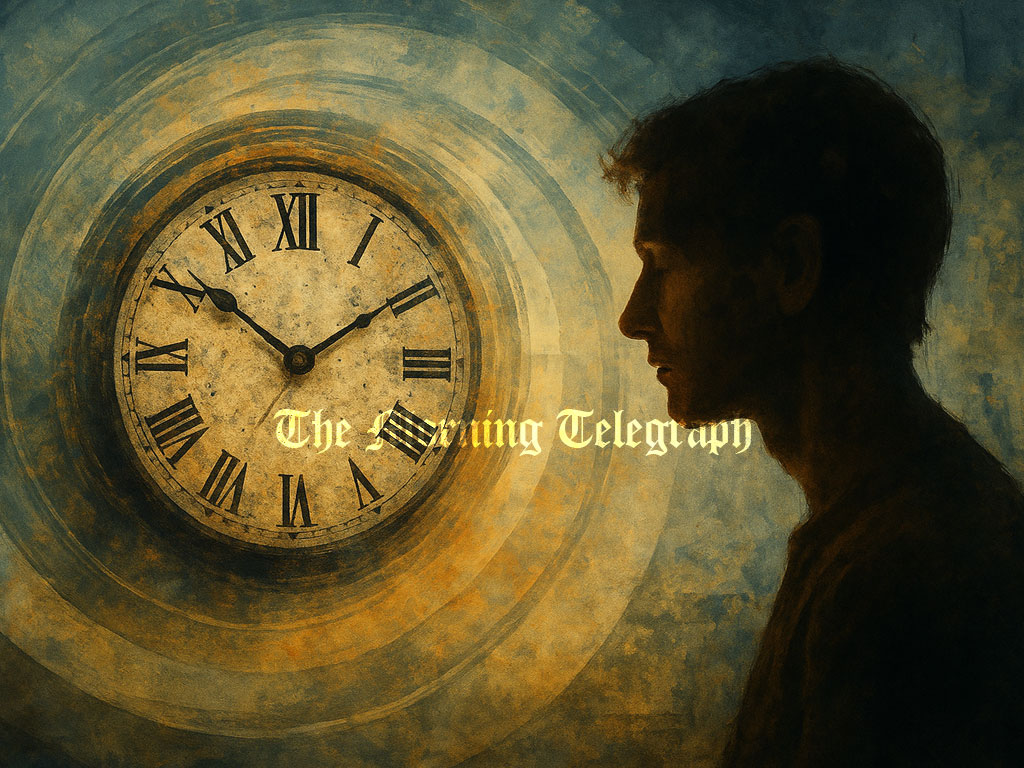
Time, as we usually talk about it, is a map we built on top of movement.
It is a useful map. Without it, we couldn’t say, “Let’s meet at 3pm tomorrow” or “The train leaves at 6:45” or “Your surgery is next week.” But when we confuse the map for the reality, time turns into something heavier. It stops being a tool and starts feeling like a master.
Behind this whole structure sits a very basic fact: we are in physical bodies that are limited.
We age.
We tire.
We get sick.
We heal.
And eventually, we die.
If our bodies did not age, if nothing decayed, if no one we loved ever left, we would not be as obsessed with “before” and “after,” “too soon” and “too late.” Our deep awareness of physical limitation is what gives rise to the entire psychological drama of “my past” and “my future.”
We observe the body’s changes.
We observe others being born and others dying.
We feel the gap between when we arrived and when we will leave.
Out of that gap, we start counting.
From there, the thoughts arrive:
“I am behind.”
“I am running out of time.”
“My best years are gone.”
“I don’t have enough time left to fix this.”
These aren’t observations. They’re conclusions. They sit on top of the simple fact of limitation and turn it into a story about personal failure, regret or panic.
Before going any further, it might be helpful to take a moment and actually test this in yourself.
Right now, as you are reading, just notice one or two simple things:
The feeling of where your body is supported – chair, bed, floor.
The rhythm of your breath, without changing it.
Any sound you can hear in the distance.
Nothing special. Just a few seconds of raw observation.
This is the point of contact on the wheel. Whatever story your mind is telling about past or future, this is where your life is actually touching the ground, right now.
When we talk about observation, there are really two levels.
The first is raw observation: direct, simple noticing.
The texture of your skin under your fingers.
The sound of a car passing outside.
The light in the room.
The tightness or openness in your chest.
This is physical observation. There is almost no story in it. It’s just, “this is here.”
The second is mapped observation: the mind taking what it sees and dropping it into its filing system.
“This happened yesterday.”
“That reminds me of my childhood.”
“In ten years I’ll be retired.”
“I wasted so many years back then.”
This is where past, present and future live. This is where dates, regrets, plans and timelines appear. They are all attempts to organise what has been observed.
Both levels are natural. The problem is not that we think this way. The problem is that we forget they’re different. We stop noticing simple reality and live almost entirely in the mental map.
Instead of, “I feel tired right now,” we jump to, “I am getting old, my life is slipping away, I’ve done nothing with my time.” Instead of, “I feel afraid,” we jump to, “My future is ruined.”
At this point, another quiet truth becomes important: we are not the thoughts themselves; we are the one who notices them.
A thought appears: “You’re running out of time.”
Another appears: “You should have done more by now.”
Another appears: “Why do you always mess things up?”
If you pay attention, you can see these sentences rising and falling in your mind like waves. They arrive, they speak loudly, and they pass. But something in you doesn’t come and go with them. Something in you is simply aware that they are happening.
That “something” is what I mean by conscious observation.
From this observing place, the relationship to time changes. Your body is still aging. Your days are still finite. That doesn’t disappear. But the crushing interpretation – “too late,” “finished,” “no chance” – can now be seen as a story, not as an unquestionable fact.
This doesn’t turn life into a fairy tale. It just makes it more honest.
You are in the middle of an argument with someone you love. You feel the familiar fear rise up: “If this continues, I’ll lose them. I don’t have time for another broken relationship. I’ve already wasted so many years.” Instead of drowning inside that thought, you suddenly notice it:
“Oh. Here is fear speaking. Here is the old story about wasting my life. Here is my mind rushing into the future again.”
Nothing outside you changes in that moment, but something inside does. You are no longer completely fused with the story. There is a bit more space. A bit more air. You can respond rather than just react.
This is what conscious observation looks like in daily life.
It’s important to say this clearly: observation is not cold distance. It is not numbing yourself out, or pretending not to care. It is not watching your own life like a scientist staring at an insect in a jar.
Real observation has warmth in it.
It’s like turning on a light in a dark room. When the light comes on, you don’t shout at the furniture for being in the wrong place. You just see it. Because you see it, you can move differently, without bumping into everything.
In the same way, when you observe your thoughts and feelings with honesty, you’re not judging yourself for having them. You’re simply recognising, “This is here.” You don’t have to fight every thought. You don’t have to believe every thought. You just have to see them clearly enough to stop being controlled by them.
Physical observation told us: life in a body is limited.
Mapped observation created: past, present, future, age, deadlines.
Conscious observation now allows us to see the whole structure at once.
We begin to realise:
Time, as we live it psychologically, is built out of observation and story.
We can’t erase our limitation, but we can stop torturing ourselves with extra layers on top of it.
We can use clocks and calendars for what they are good for, without giving them power over our worth.
The wheel keeps turning.
The point of contact is always now.
The observer in us can see the whole movement.
From that place, our sense of time becomes less of a threat and more of a context. We still plan. We still remember. We still care. But we stop treating every regret and every worry as a final verdict on our life.
We remember that everything we know – including our ideas about time – is arriving through the doorway of observation: physical and conscious. And that how we relate to that observation determines whether we live frightened inside our own mental maps, or with a little more clarity, kindness and peace.
Author’s Note
I did not write this as a teacher of time or a scholar of philosophy, but as a fellow human being who also feels the weight of days and years. I have watched my own mind panic about the future and punish itself over the past. I have also tasted, in small moments, the quiet relief that comes when I simply observe what is happening instead of immediately judging it.
If there is any “message” here, it is a simple one: your thoughts about time are not the whole truth of your life. Underneath the counting and comparing, there is a part of you that is just watching. That observing presence is not dramatic or loud, but it is steady. It is there in your happiest moments and your darkest nights.
If this article does anything, I hope it gently reminds you of that presence in yourself. Not to escape your life, but to live it more fully at the point where it actually touches the ground: this breath, this choice, this moment.
About the Author
Roshan Jayasinghe is a writer and observer of human systems. His work explores the gap between man made constructs and lived humanity, with a focus on how economics, trade and everyday choices intersect with questions of fairness, responsibility and inner alignment. Through essays for publications in The Morning Telegraph, he aims to remind readers that they are not passengers in a fixed machine, but active custodians of a shared world.