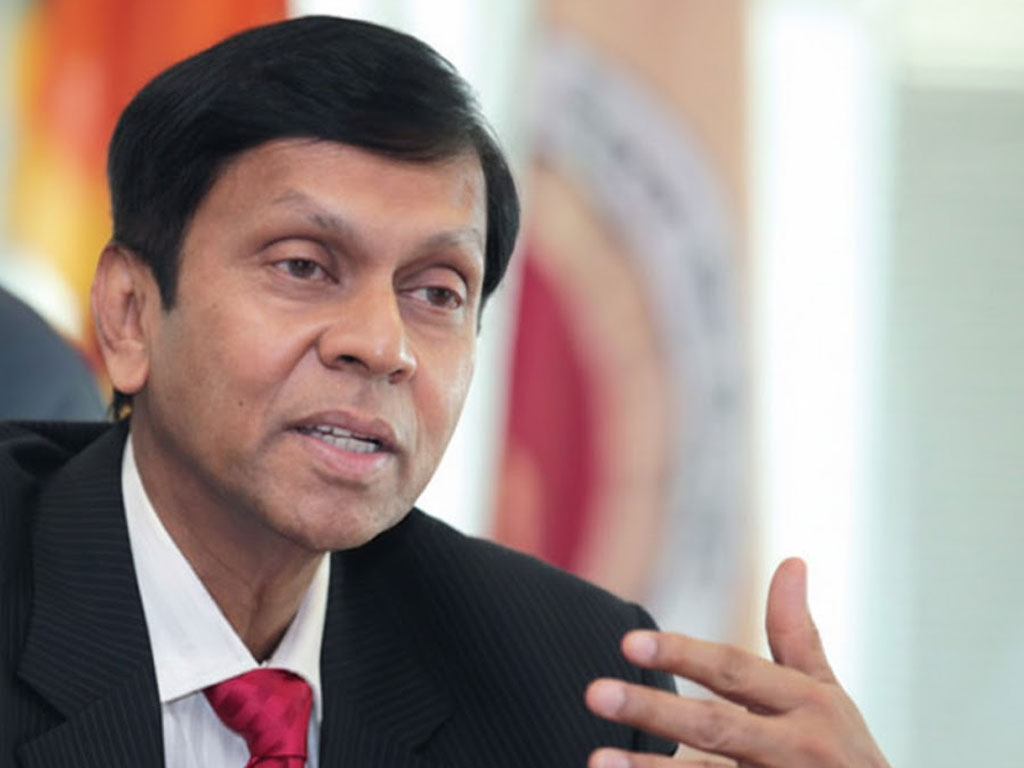
A dramatic courtroom showdown unfolds as former Central Bank Governor Ajith Nivard Cabraal rejects compensation demands, forcing the court to rule on the fate of a high profile corruption case tied to Sri Lanka’s controversial Greek bond investment.
According to the judgment report in case HCB 303/24 heard before High Court Judge M.M.M. Mihal at the Western Provincial High Court No. 06, former Central Bank Governor Ajith Nivard Cabraal has clearly stated that he does not agree to the condition of paying Rs. 1,843,267,595.65 as compensation to the Central Bank within three months, as proposed by the Commission to Investigate Allegations of Bribery or Corruption. He further stated that he will not admit fault and maintained that the decision in question was a collective one.

The Deputy Director General appearing for the prosecution sought court permission to withdraw the indictment against the first accused after bringing to the attention of the Commission and the Director General a written request submitted by President’s Counsel Dilan Ratnayake on behalf of Ajith Nivard Cabraal. This request was made under Section 67 of the Anti Corruption Act.
Permission was sought to withdraw the indictment on the condition that the sum of Rs. 1,843,267,595.65, calculated under Sections 63(2) and 63(3) of the Anti Corruption Act, be credited to account number 65911 of the Central Bank of Sri Lanka as compensation. The court was informed that if this condition was not fulfilled, steps would be taken to re file the indictment under Section 67(5) of the Act.
Permission was also sought to withdraw indictments against the second, third, and fifth accused under Section 194(3) of the Code of Criminal Procedure.
President’s Counsel Dilan Ratnayake, appearing for the first accused, informed the court that his client could not agree to a conditional withdrawal of the indictment. “We do not admit this guilt” and “We cannot agree to this condition. We did not take money,” he stated, emphasizing that there was no criminal wrongdoing.
He explained that a detailed submission had been made to the Bribery Commission outlining that there was no legal basis to maintain criminal charges or lead evidence against the accused. He stressed that the transaction in question was not an individual decision but a collective decision taken by the Monetary Board of the Central Bank as part of the accused’s official duties.
The counsel described it as unfair to demand repayment for a single loss when the majority of Monetary Board decisions had yielded benefits. He also noted that the imposition of conditions under Sections 67(2) and 67(3) of the Anti Corruption Act is not mandatory unless accepted by the accused.
Lawyers appearing for the second, third, and fifth accused expressed full agreement with the prosecution’s request to withdraw indictments under Section 194(3). They pointed out that the accused were public officers acting in their official capacities and that the Supreme Court had already delivered judgments on the relevant transactions.
Counsel for the second accused further stated that the foreign reserve investment was made in line with accepted international principles and Monetary Board decisions, and that there was no basis for criminal liability or personal compensation.
Accordingly, the court rejected the conditional withdrawal of the indictment against the first accused due to his refusal to accept the condition, while granting permission to withdraw indictments against the second, third, and fifth accused.