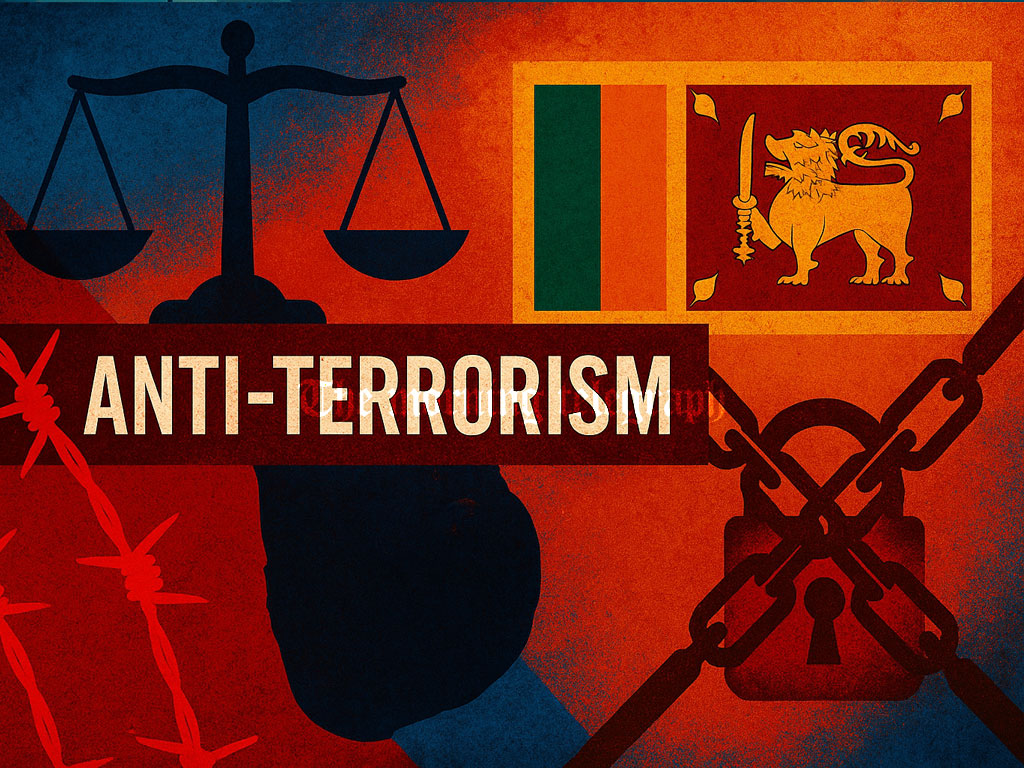
A sweeping new Anti-Terrorism law proposes life imprisonment, expanded police and military powers, and stricter detention rules as Sri Lanka moves to replace the controversial PTA.
The government has finalized a new Anti-Terrorism Bill that introduces significantly tougher penalties for terrorism-related offences, including long prison sentences, life imprisonment, and substantially increased fines.
Under the proposed legislation, individuals convicted of committing terrorist acts will face rigorous imprisonment ranging from twenty years to life, following a High Court trial. The Bill has been drafted by the Ministry of Justice and National Integration and is titled the Protection of the State from Terrorism Act No. 2026. Once enacted, it will repeal and replace the existing Prevention of Terrorism Act.

The proposed law defines a terrorist offence broadly. It includes any act committed intentionally or knowingly that causes, or is likely to cause, a state of terror. It also covers acts intended to intimidate the public or a section of the public, compel the Government of Sri Lanka or any other government or international organisation to act or refrain from acting, engage in propaganda of war, or violate the territorial integrity or sovereignty of Sri Lanka or any other sovereign nation.
Under the Bill, individuals found guilty of joining a terrorist organisation, encouraging or spreading terrorist propaganda, or providing terrorist training will face up to fifteen years of imprisonment. In addition, such offences will carry a fine of up to fifteen million rupees.
The 64 page draft legislation also expands enforcement powers. It grants military officers authority to stop and search individuals on reasonable suspicion and to seize materials found in the possession of suspects during such operations.
Once an arrest is made under the proposed law, authorities are required to notify both the Human Rights Commission of Sri Lanka and the Inspector General of Police within 24 hours. This provision is aimed at introducing a level of oversight and accountability following criticism of prolonged detentions under earlier legislation.
The Bill further allows the Inspector General of Police or a Deputy Inspector General of Police to obtain a detention order from the Secretary to the Ministry of Defence. Such an order may authorize detention for an initial period of two months.
According to the proposed framework, detention orders may be renewed, allowing suspects to be held for up to one year following arrest. The provisions relating to detention, enforcement authority, and penalties are expected to generate significant public and parliamentary debate as Sri Lanka seeks to balance national security concerns with human rights safeguards.