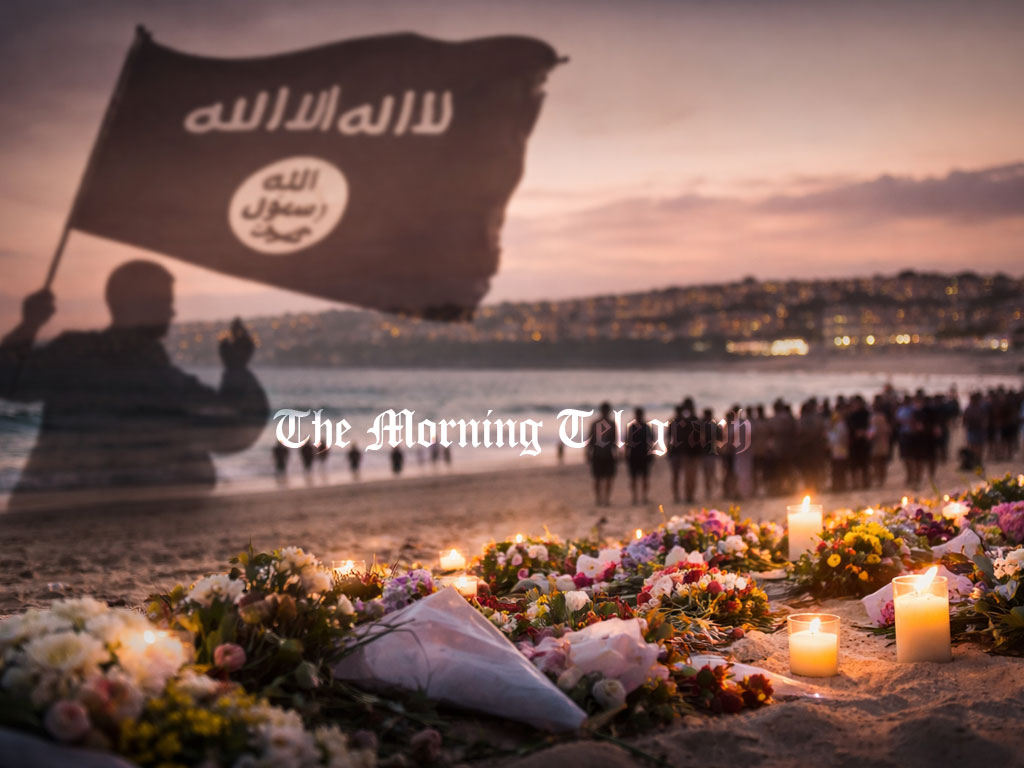
A closer examination of the Sydney attack reveals disturbing indicators of ISIS ideological influence, highlighting a dangerous shift in how the terror group survives pressure, inspires violence abroad, and adapts its global striking pattern.
ISIS attacks broadly fall into three distinct categories. The first involves direct operations carried out by the group itself. The second consists of enabled attacks, where ISIS provides indirect coordination, guidance, or logistical support. The third, and increasingly concerning, is inspired violence, where lone actors carry out attacks after self radicalising through ISIS propaganda without direct operational links. The recent Sydney Bondi Beach attack fits uneasily within this third category, raising serious security concerns.

The Sydney Bondi Beach attack involved two gunmen opening fire in a public space and specifically targeting the Jewish community. What has drawn heightened attention from security analysts is not merely the violence itself, but the ideological imprint linked to ISIS. According to reports, one of the attackers had come to the attention of Australia’s domestic intelligence agency six years earlier due to close associations with a Sydney based Islamic State terrorism cell. Investigators also reportedly discovered two Islamic State flags inside the attackers’ vehicle at Bondi Beach, further reinforcing suspicions of extremist influence.
The timing of the attack has also raised alarms. It occurred almost 24 hours after an ISIS ambush in Syria that killed three Americans and two US soldiers. While there is no confirmed operational coordination between the incidents, the proximity in timing reflects a familiar ISIS pattern of symbolic messaging through violence in different theatres, particularly when the group is under pressure.
The Same Design
The Sydney incident echoes a pattern seen in previous lone actor attacks linked to ISIS ideology. Almost last year, a 42 year old US Army veteran, Shamsud Din Jabbar, drove a Ford F 150 pickup truck into a crowd gathered to celebrate New Year’s in New Orleans before exiting the vehicle and opening fire. Reports indicate that at least 15 people were killed and more than 30 were injured. This marked one of the deadliest lone wolf style attacks on US soil in nearly eight years.
Before that, the most notable similar incident was the 2017 New York City truck attack, where a vehicle was deliberately driven into pedestrians, killing eight people and injuring twelve. ISIS later claimed responsibility for that attack. Since then, however, terror dynamics have shifted. The Sydney attack suggests a possible evolution in ISIS’s approach, moving away from centrally directed operations toward ideologically inspired violence carried out by individuals or small cells.
ISIS Lone Wolf Attacks
Historically, ISIS has relied on suicide bombings and mass casualty attacks as its primary tactics. Over the past year, however, lone wolf assaults have regained prominence, even as the group’s overall operational capabilities have diminished. Suicide bombings remain frequent, particularly following the twin bombings in Iran in January last year and the Moscow concert hall attack. These high intensity strikes demonstrate that while ISIS may be weakened, it remains capable of inflicting significant harm.
The last reported lone wolf attack in a major metropolitan area prior to Sydney occurred in Solingen, Germany, where a Syrian ISIS supporter stabbed three men during a public festival. Similar lone actor incidents were recorded in France and Belgium in October 2023. However, intelligence assessments suggest ISIS has struggled to replicate the scale of earlier Western attacks, such as the 2016 Bastille Day truck attack in France that killed 86 people and injured 434.
Most ISIS attacks in recent years have occurred in Africa, Central Asia, and the Middle East. These incidents often involve suicide bombings or coordinated mass shootings rather than lone actors. In Western countries, attacks have been fewer and generally limited to stabbings or vehicle assaults. These incidents, while less complex, remain dangerous due to their unpredictability and low detection threshold.
ISIS Limited Capabilities
Since 2017, ISIS has suffered sustained losses due to intensified counter terrorism operations led by the United States and its allies. Operation Inherent Resolve significantly reduced ISIS’s territorial control and operational reach between 2017 and 2019. The group was militarily defeated in Syria and Libya in 2019, marking a turning point in its global campaign.
That same year, US forces killed ISIS leader Abu Bakr al Baghdadi during Operation Kayla Mueller. Further blows followed in 2023, when several senior ISIS leaders were eliminated and approximately 795 ISIS operatives were detained. These actions fragmented ISIS’s command structure and sharply reduced its ability to conduct over the horizon attacks targeting Western countries.
ISIS’s presence is now largely confined to pockets in Africa, Central Asia, and parts of the Middle East. High intensity attacks over the past two years have been concentrated in these regions. One of the most decisive moments in ISIS’s decline came with the killing of its intelligence and foreign operations chief, Abu Muhammad al Adnani, in October 2016. His death severely disrupted ISIS’s recruitment and external attack planning.
Despite repeated setbacks between 2016 and 2020, and again in 2023, the possibility of an ISIS resurgence was often underestimated. Patterns suggest that whenever ISIS perceives its influence waning, it seeks to send a message to the West through dramatic attacks, even if those attacks occur outside Western borders.
ISIS Resurgence And Shift In Pattern
Over the past year, the US led coalition has intensified operations against ISIS’s remaining networks. Since January 2024, coalition forces have conducted approximately 200 missions against Daesh, killing 44 ISIS operatives and detaining around 166 more. Despite these efforts, ISIS has maintained cohesion within its fragmented structure and continues to look for opportunities to reassert itself.
Three key factors have contributed to ISIS’s periodic resurgence. First, the US has shifted strategic focus toward Iran amid the Israel Hamas conflict, potentially diverting attention from ISIS. Second, increased destabilisation in Syria and West Africa, along with the eventual fall of the Syrian government, has created power vacuums. Third, ISIS Khorasan has gained greater freedom of operation in South and Central Asia, particularly in Afghanistan.
These conditions have enabled ISIS to regroup at a regional level, allowing it to carry out low intensity attacks worldwide. The collapse of the Assad government last year and the mobilisation of various Islamic coalitions in Syria have provided ISIS, especially its Khorasan branch, with renewed space to rebuild networks and capabilities. While resurgence itself is a concern, an accompanying shift in striking pattern poses an even greater threat.
Shift in Striking Pattern
ISIS terror operations now fall into three identifiable patterns. The first is direct attacks carried out by ISIS operatives. The second involves enabled attacks, where ISIS provides encouragement or guidance, as seen in the 2015 Texas attack, in which an attacker who opened fire at a community centre had been communicating with ISIS through encrypted messages.
The third pattern is inspired violence. In these cases, individuals self radicalise through online propaganda and carry out attacks independently. The 2016 France truck attack, which killed 80 people and injured hundreds, exemplifies this model. Although ISIS claimed responsibility, the attacker had no direct operational link to the organisation.
A similar case occurred in Stockholm in 2017, when a self radicalised individual carried out a vehicle ramming attack. ISIS did not claim responsibility, reflecting the group’s weakened position at the time. Under intense pressure in 2017, ISIS lost much of its territory and operational strength, allowing coalition forces to defeat it in Iraq by year’s end.
Today, ISIS again faces pressure in Syria from US air strikes. In this environment, it appears increasingly reliant on online propaganda and inspired attacks that do not expose its leadership or infrastructure. This approach allows ISIS to maintain relevance while avoiding direct retaliation.
The shift in Daesh’s striking pattern is designed to preserve limited capabilities while reducing risk. By encouraging inspired attacks, ISIS can project power without revealing networks or command structures. If left unchecked, this model could lead to a new wave of terrorism that is difficult to detect and potentially lethal due to the absence of clear warning signs.