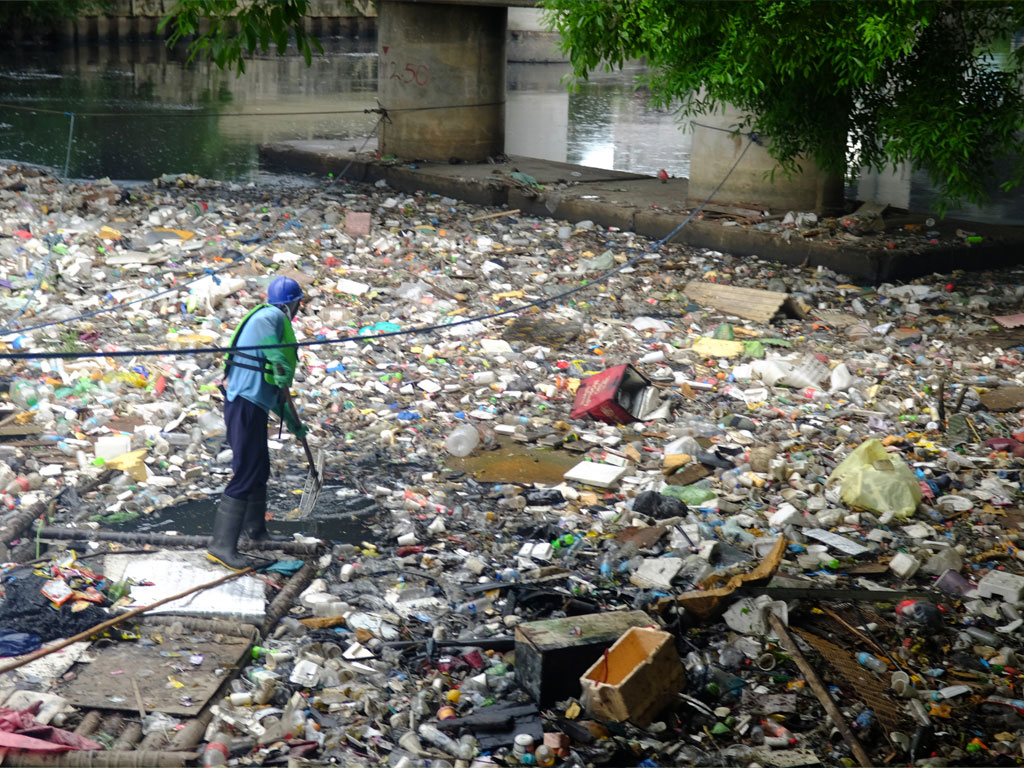
Mountains of post disaster waste now threaten public health, the environment, and recovery efforts across Sri Lanka, exposing deep flaws in disaster preparedness and waste management systems.
After Cyclone Ditwah swept across Sri Lanka, flooding homes and triggering landslides, residents in many disaster hit areas are now grappling with a new and overwhelming crisis. Vast mountains of garbage have accumulated in streets, neighbourhoods, rivers, and coastal zones, turning recovery into a daily struggle for tens of thousands of families.
For Muditha Jayawardena, a resident of Brandiyawatte in Kotikawatta, the nightmare did not end when floodwaters receded. Her home was submerged, forcing her to stay away for nearly twelve days. When she finally returned and cleaned what she could, a far more persistent problem remained.

“There is still garbage piled up on both sides of the road in our area,” she said. “The road is about twelve feet wide. Garbage has been dumped on both sides, so much so that two vehicles cannot pass. This is what we see every morning and evening when we go to work.”
Nearly two weeks after the cyclone left the country, the situation in many flood and landslide affected areas remains largely unchanged. The piles of waste continue to grow as more homes are cleaned and damaged belongings are discarded.
Piles of garbage weighing tens of thousands of tons
Authorities acknowledge that the garbage crisis has reached critical levels, particularly in the Western and Central Provinces, which suffered the worst flooding. In a statement issued on 12 December 2025, Central Environmental Authority Chairman Professor Thilak Hewawasam detailed the scale of waste accumulation.
“About fifty thousand houses in the Kolonnawa area were flooded, resulting in around eight thousand tons of mixed garbage. About twenty thousand houses in the Kaduwela area were flooded, generating another eight thousand tons. Garbage removal in Kaduwela has been completed. In areas such as Kotikawatta and Mulleriyawa, between ten thousand and twelve thousand tons have accumulated,” he said.
He warned that these figures are likely to increase as cleaning continues in homes and institutions. Similar conditions are reported in the Central Province, where Gampola alone has accumulated an estimated six thousand five hundred cubic units of waste.
Western Province produces the most garbage
The Western Province has emerged as the epicenter of the post cyclone waste crisis. National Solid Waste Management Centre Director Engineer N. D. N. Pushpakumara said more than one thousand five hundred tons of waste are being removed daily in the province.
“On December 10, we disposed of one thousand seven hundred and sixty nine tons. On December 9, one thousand four hundred and eighty eight tons. On December 8, one thousand one hundred tons. On December 7, eight hundred and forty three tons. Since December 1, the amount has steadily increased to around one thousand five hundred tons per day,” he explained.
Much of this waste has been piling up directly in front of homes before removal. It is now being transported to final disposal sites at Karadiyana, Kerawalapitiya, and Dompe.
Colombo Municipal Council Solid Waste Management Director Engineer Shahina M. Maisan said the council has extended assistance to neighbouring local authorities. “Large parts of Colombo were not submerged, so we have completed clearance there. Our vehicles are now supporting Kolonnawa and Wellampitiya, but the work is far from finished. As soon as garbage is cleared, more comes onto the road. They cannot manage it alone.”
Gampola faces a growing waste emergency
In the Central Province, Gampola has become a focal point of concern. Professor Hewawasam confirmed that approximately six thousand five hundred cubic units of waste have accumulated in the area. Social media posts from residents show roads, railway stations, and side streets clogged with debris.
Gampola Municipal Council officials said they are still unable to provide an exact count of collected waste. “We are collecting and temporarily storing it while continuing removal around the main road,” a health department spokesperson said. Garbage has been temporarily stockpiled at Nidahas Mawatha and near the railway station to prioritise clearing the town center, while villages remain largely uncleared.
Relaxed waste collection criteria
Faced with the sheer scale of the disaster, the Central Environmental Authority has relaxed its usual waste collection and segregation guidelines. Professor Hewawasam explained that strict segregation rules cannot be applied in catastrophic situations.
“Our standard guidelines require waste separation. But after flooding, wet and contaminated waste cannot be segregated. We issued relaxed guidelines to local authorities to allow mixed waste collection and temporary storage, with proper segregation to follow later,” he said.
He added that technical guidance is being provided to manage waste safely under emergency conditions.
However, field level engineers question the practicality of separating waste later. Kandy Municipal Council Chief Engineer Namal Dhammika Dissanayake described the reality on the ground.
“This is mixed waste. Pillows, mattresses, furniture, shop goods, rice, dhal, everything mixed with mud. Even a new mattress is useless once water enters it. Who will separate this later? Water is needed to wash items, and it is simply not practical,” he said.
Senior environmental engineering lecturer Dr. A. K. Karunaratne also highlighted the gap between guidelines and reality, particularly in areas affected by landslides and floods where garbage collection vehicles cannot even reach.
Gohagoda landfill under pressure
The situation has been further complicated by instability at the Gohagoda landfill, which serves Kandy. Engineer Dissanayake revealed that a pile of decomposing waste collapsed at the site, sending four hundred to five hundred tons into nearby paddy fields.
“There is no space left at Gohagoda. But people must rebuild their lives, so waste is still being brought. Under normal conditions, we strictly prohibit mixed waste, but this is not a normal situation,” he said.
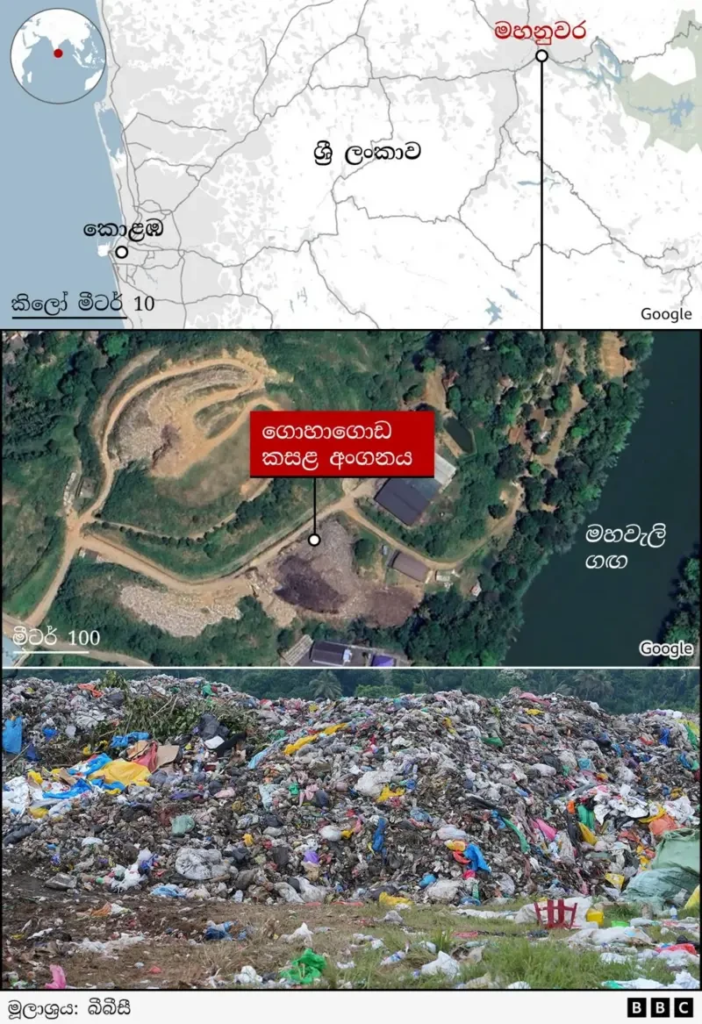
More than one thousand tons of mixed waste have already been sent to Gohagoda this year, including waste from religious events and festivals. Dr. Karunaratne warned that the landfill reached capacity over a decade ago and now poses risks similar to the Meethotamulla disaster.
“There is a real risk of wastewater mixing with the Mahaweli River, which is only about three hundred meters away. The treatment system there cannot handle this volume,” he said.
Coastline and marine pollution
The garbage crisis is not confined to land. Marine Environmental Protection Authority Chairman Samantha Gunasekara said rivers have carried waste into the sea, polluting coastlines and estuaries.
“About one hundred and forty point three kilometers of river estuaries are severely polluted,” he said, calling the situation a man made disaster intensified by poor waste management practices.
Non recyclable waste dominates
Dr. Karunaratne noted that disaster waste is largely non recyclable. Furniture, carpets, concrete, and damaged household items dominate the waste stream, and Sri Lanka lacks facilities to process them.
“In disasters, waste disposal is as critical as health and safety. If unmanaged, waste can trigger secondary disease outbreaks and environmental damage,” he warned.
Dead animals and toilet waste present additional challenges, often requiring burial in areas without groundwater, a method used during the Covid pandemic.
Current removal plans
Authorities say waste from the Western Province is being transported to Kerawalapitiya, Dompe, and Karadiyana. Around one hundred lorries operate daily, and clearance is expected to take another ten days.
In Gampola, abandoned granite pits in Elugoda are being used as disposal sites, with sixty to one hundred tons removed daily using smaller vehicles.
Coastal clean up operations have also begun, involving government agencies, volunteers, and local authorities.
What happens next
Environment Minister Dr. Dhammika Patabendi acknowledged that disaster conditions have forced deviations from standard waste management practices. He said concessional guidelines are in place, inspections are ongoing, and long term solutions such as waste to energy conversion at Kerawalapitiya are being explored.
However, experts agree that Sri Lanka lacks a national post disaster waste management plan. Dr. Karunaratne stressed the need for pre identified disposal and storage sites, public awareness, and dedicated funding.
“If the Aruwakkalu landfill is completed by the end of 2026, it will provide much needed capacity. But infrastructure alone is not enough. Past international aid for waste management was not fully utilised,” he said.
As Sri Lanka recovers from Cyclone Ditwah, the garbage crisis has become a stark reminder that disaster response does not end when floodwaters recede. Without urgent reform, coordinated planning, and investment, mountains of waste may continue to weigh down recovery efforts long after the disaster itself.
SOURCE :- BBC SINHALA