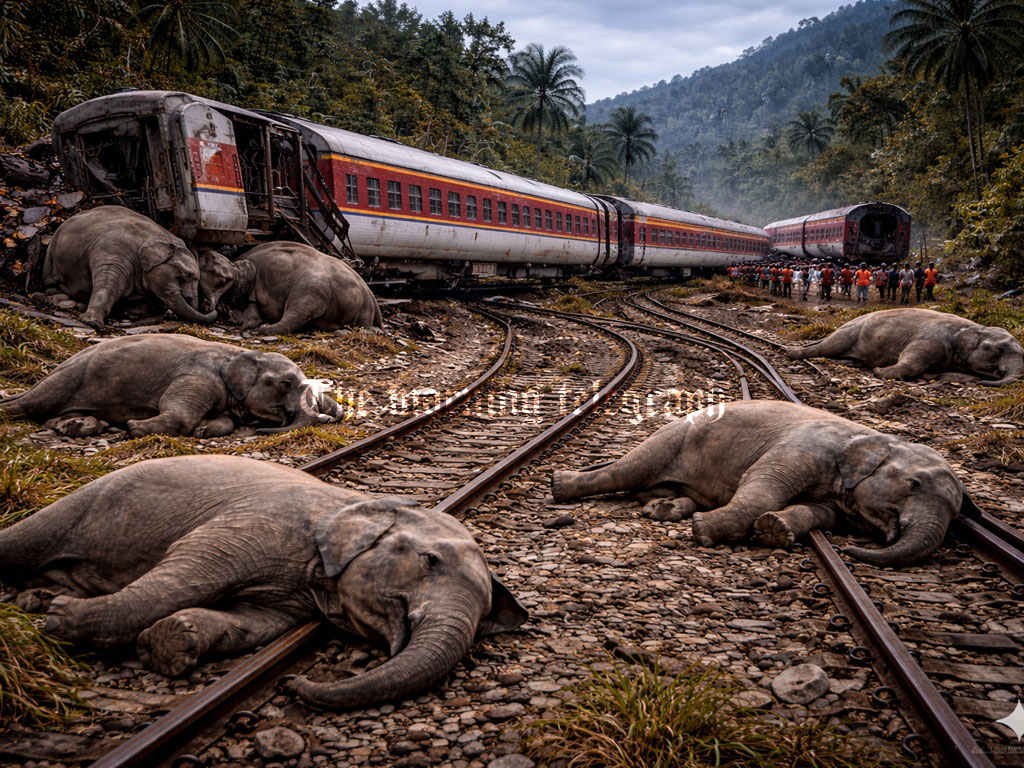
A devastating early-morning collision between a premium Rajdhani Express and a herd of elephants in Assam has once again exposed the deadly intersection of fast rail expansion, fragile ecosystems, and unresolved human-animal conflict in India’s Northeast.
At least seven elephants were killed and one calf was seriously injured after a herd collided with the Sairang–New Delhi Rajdhani Express in Assam’s Hojai district early Saturday morning, causing the locomotive and five coaches to derail and disrupting rail services across large parts of the Northeast.
Railway officials confirmed that the New Delhi-bound train struck the elephants at around 2.17 am. Despite the severity of the collision, no passengers were reported injured. The Sairang–New Delhi Rajdhani Express connects Sairang near Aizawl in Mizoram with Anand Vihar Terminal in the national capital, serving as a key long-distance route through forested terrain.

The accident site lies approximately 126 kilometres from Guwahati. Following the incident, accident relief trains, senior railway officials, and emergency personnel were rushed to the location to begin clearance and restoration work. Railway authorities issued helpline numbers from Guwahati Railway Station to assist concerned passengers and families seeking information.
Rail services to Upper Assam and other parts of the Northeast were significantly affected after the derailment. Officials said that elephant remains scattered across the tracks, along with damaged coaches, delayed restoration efforts. Passengers travelling in the derailed coaches were temporarily accommodated in vacant berths available in other coaches of the same train. Railway sources said that once the train reaches Guwahati, additional coaches will be attached to accommodate all passengers before resuming the onward journey.
According to preliminary findings, the collision occurred at a location that is not officially marked as an elephant corridor. The loco pilot reportedly noticed the herd on the tracks and applied emergency brakes. However, despite the braking attempt, the elephants ran into the train, leading to the fatal impact and subsequent derailment. Forest and railway authorities are jointly reviewing whether visibility conditions, train speed, or warning systems could have played a role.
This tragedy is not an isolated incident. Just last month, an adult elephant was killed and a calf injured after being struck by a train in Dhupguri in West Bengal’s Jalpaiguri district. Over the past five years, at least 79 elephants have died in train collisions across India, according to figures shared by the Environment Ministry in Parliament. These numbers are based on reports submitted by state governments and Union Territories between 2020–21 and 2024–25.
While India does not maintain consolidated data on deaths of other wildlife species on railway tracks, elephants remain among the most affected due to their movement patterns and the fragmentation of forest habitats. The Ministry has acknowledged that many collisions occur outside officially notified elephant corridors, complicating prevention efforts.
In response to the rising toll, the Environment Ministry and Indian Railways have jointly implemented several mitigation measures. These include speed restrictions in known elephant habitats, pilot projects using seismic sensors to detect elephant movement near tracks, and the construction of underpasses, ramps, and fencing at vulnerable locations. The Wildlife Institute of India has also issued detailed guidelines on eco-friendly infrastructure design to reduce human-animal conflict.
Despite these initiatives, conservationists warn that the Assam incident highlights the urgent need for faster implementation, continuous monitoring, and better coordination between wildlife and railway authorities. As rail traffic intensifies across biodiversity-rich regions, the balance between development and conservation remains fragile, with devastating consequences when it fails.