By: Roshan Jayasinghe
When I open my eyes, something happens so quickly that I forget how astonishing it is.
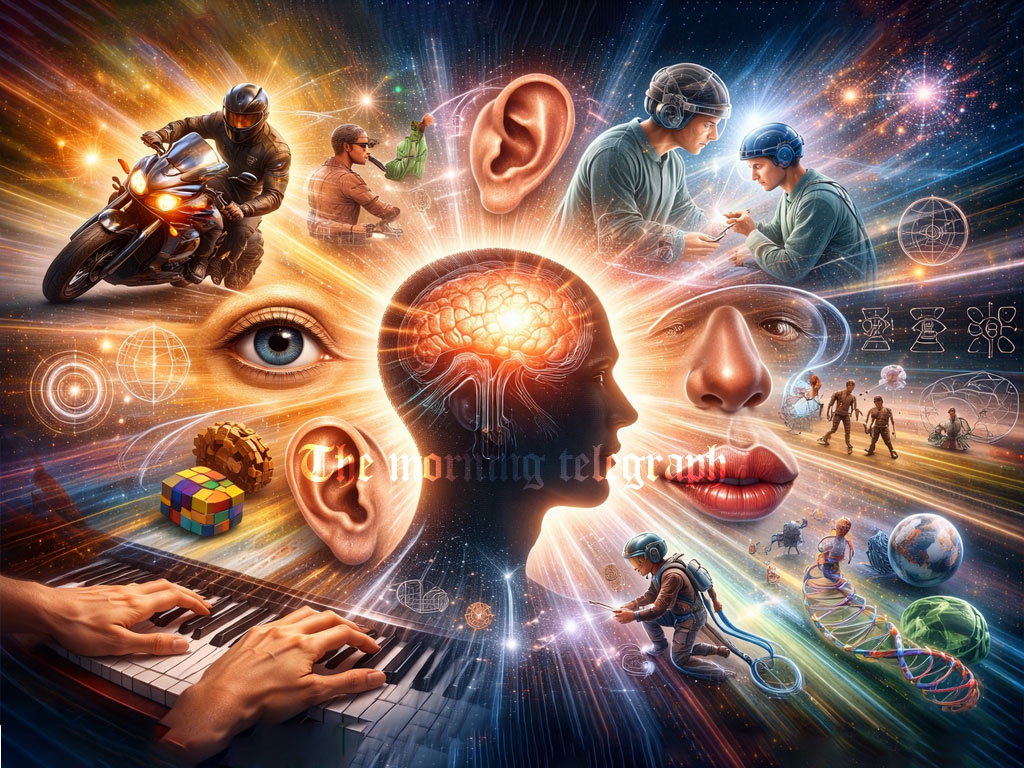
A word on a billboard becomes meaning. A sound becomes a car passing. A smell becomes coffee. A face becomes familiar or unfamiliar. A song becomes a memory. A surface becomes texture. In seconds, the world is assembled inside me through sight, sound, touch, taste, and smell.
Recognition happens faster than thought. It feels effortless, almost automatic. And when I pause long enough to notice it, I’m left with the same thought again and again: this alone is extraordinary.
But then a deeper observation arrives.
The human being doesn’t only recognize life. We can master life. We can take raw sensing and turn it into precision, learning, creativity, science, art, engineering, responsibility, and skill. We have a vast arsenal, and perhaps the most unique part of it is this: we can observe ourselves using it. We can analyze our own doing. We can watch the watcher. We can refine our attention.
This is the thread I want to follow. Because the question isn’t whether we have capacity. We clearly do. The question is why, in so many areas that matter most, we live as if we don’t.
The Arsenal of Instant Knowing
We often underestimate what’s happening in ordinary seconds.
We don’t just see. We interpret. We label. We connect. We predict. We remember. We imagine. We run simulations and call it thinking.
A child touches a hot kettle once and the body remembers forever.
A man hears one line of a song from decades ago and an entire year returns.
A woman walks into a room and senses tension without anyone saying a word.
We don’t merely detect reality. We translate it into meaning.
And this is where the human being becomes both magnificent and vulnerable.
Because the same gift that allows instant recognition can also become the trap. We can assemble a world so fast that we mistake our assembly for truth. We can mistake interpretation for reality. We can mistake a story for the moment itself.
The Arsenal in Motion: My Motorcycle Mirror
The cleanest place I see true human intelligence is when I’m on a motorcycle.
Street riding, adventure riding, off road, track, once I’m moving at speed, the whole system turns on like a perfect instrument. Eyes scanning. Ears reading the engine note. Hands receiving feedback through the bars. The body sensing traction through the pegs and seat.
Then comes the moment that reveals everything: a fast approach into a thrilling corner that is also a blind spot. I cannot fully see what’s around it. It might be clean pavement. There might be sand. It might be open road. There might be an oncoming car drifting wide.
So what happens?
I do not just slow down. I time the slowing down.
I choose an entry speed that respects what I cannot see.
I brake smooth, not violently, because smoothness keeps grip.
I set my line.
I position my body with intention.
I commit without becoming careless.
I look where I want to go, not where fear wants to stare.
I leave a margin for the unknown.
This is not theory. This is precision under uncertainty. Presence with consequences.
On a track, the unknown is reduced. The surface is more predictable. Corners become a study in flow. Timing becomes like music, early, late, perfect. You practice until the body learns cleanly.
But on the street, the blind corner teaches humility. It teaches that intelligence is not only speed. It is restraint. It is respect. It is the ability to slow down when you don’t fully know.
Off road teaches the same lesson in a different language. Loose gravel, ruts, rocks, sand, the bike moves under you. You don’t dominate the terrain. You read it. You cooperate. You stay light. You keep your eyes up. You stop fighting what is and start moving with it.
And then I step off the bike and realize something uncomfortable.
On the bike, I naturally use my senses the way they were meant to be used: direct contact, real time feedback, clear decision, immediate consequence.
But in daily life, I often forget.
I enter blind corners in relationships at full speed.
I enter conversations without margin.
I react before I see clearly.
I lean into story instead of facts.
The motorcycle becomes more than a machine. It becomes a mirror of what the human being is capable of when aligned, and how strange it is that we don’t live that way more often.
The Arsenal in the Body: Gym, Food, Recovery
Then I see the same intelligence in the gym.
Working out is not just pushing weight. It is understanding what the body can do and respecting its laws. Alignment. Breath. Tempo. Joint position. Form. Progression.
A person who trains well assigns the correct weight, not the ego weight. If it’s too heavy, form collapses. If it’s too light, the message to the muscle is weak. So we adjust. We refine. We respect time. The body responds to correct action repeated consistently.
And beside training sits the intelligence of eating.
Not complicated eating. Not fear based eating. Intelligent eating.
Knowing what fuels me and what fogs me. Knowing the difference between hunger and craving. Choosing nourishment over stimulation. Choosing food that supports strength, recovery, clarity, longevity.
Then there is sleep, the great teacher of surrender.
Sleep shows me that I cannot dominate everything. I can create conditions, but I cannot command rest the way I command effort. Recovery is not laziness. Recovery is intelligence. Life continues perfectly without my thinking. That fact alone is humbling.
Intelligence Isn’t Just in the Head
Sometimes we treat intelligence as if it lives only in the mind.
But much of our deepest intelligence is sensory and physical. It is timing. It is restraint. It is feedback. It is adaptation. It is the ability to learn through contact with reality.
And the same pattern, attention, repetition, correction, refinement, shows up in every human domain. Whether it’s a corner, a lift, a meal, a melody, a problem, or a decision, mastery always leaves the same footprint.
The Arsenal in Talent, Pattern, and Creation
Look at what human beings can do.
A racer doesn’t merely drive. They read traction like a language. They feel the limit before it arrives. Hundreds of micro decisions per minute, and it looks like one clean flow.
A person solving a Rubik’s Cube in seconds sees patterns and sequences where most people see confusion. They hold complexity without panic.
Sports belongs here too, because it shows the same human signature in another language. An athlete reads space, timing, and momentum the way a musician reads rhythm. A basketball player sees passing lanes that aren’t there yet. A boxer senses openings before they appear. A surfer reads the ocean like a living map. Training refines the nervous system through repetition, correction, and restraint. And in team sport, something else appears as well: shared intelligence, a group moving as one organism, anticipating each other without words.
Then there’s music. Singing. Dancing.
A singer shapes breath into emotion.
A musician turns timing into feeling.
A dancer turns gravity into rhythm.
These aren’t just skills. They are examples of what the human system can become through practice.
Then there is engineering, imagination anchored into function. Bridges that hold. Systems that work. Machines that serve.
And then mathematics.
Mathematics is the human ability to see pattern without needing an object in front of us. We can hold invisible structure in the mind and test it, refine it, prove it. We can describe the curve of a wave, the arc of a planet, the balance of forces, the logic of growth. Mathematics is a kind of seeing, a language of order.
Then art and design.
Artists and designers translate feeling into form. They shape space, light, proportion, rhythm, and contrast. And often our best design is nature recognized and respected: curves, spirals, honeycomb strength, flow patterns, symmetry, adaptation. What we call creativity is often a conversation with nature, not a rebellion against it.
And there are other arenas of the arsenal that are so normal we forget they’re miracles. Language, for example, the ability to shape a private inner world into words and send it into someone else’s mind. Storytelling, teaching, persuading, comforting, leading. Memory that can hold a lifetime, and imagination that can rehearse futures that don’t exist yet. Social intelligence, the ability to read a room, sense what isn’t said, repair conflict, raise a child, build trust. Moral intelligence too, the quiet power to restrain impulse, to choose integrity when nobody is watching, to do what is right rather than what is easy. And beyond tools and machines, the ability to build systems, invisible structures like education, medicine, laws, logistics, entire ways of organizing life. All of it is human capacity expressed, refined, and shared.
So yes, the arsenal is real. Vast. Repeatable. Humans are not fixed. We are trainable.
The Arsenal at the Highest Stakes: Surgery, Stars, Earth
Now take it to the highest stakes.
A surgeon performing surgery opens another human being and sees what is inside, knowing that everything in that person’s inner body is almost identical to what is inside his own. Same tissues. Same organs. Same vulnerability. And yet the surgeon remains steady. Calm hands. Deep knowledge. Responsibility in the presence of life. Consciousness fully engaged.
Then zoom out.
Astronomers look into the universe and understand it through physics, chemistry, mathematics, biology, reading light and motion and composition. They translate the invisible into knowledge. They take wonder and turn it into understanding without killing wonder.
Then look down again.
Geology reads earth through rock layers, pressure, time, movement. Weather science reads patterns in wind, water, heat, atmosphere. Everywhere, humans are doing the same thing: learning the language of reality.
We are not only living inside nature. We can understand nature.
And here is the most astonishing twist: we can also understand ourselves.
The Paradox: The Misuse of the Arsenal in a Dual World
So here is the central paradox I keep coming back to.
With all this capability, how do we end up living as if we have none of it inwardly?
How does a mind that can design bridges struggle to sit in silence for five minutes?
How does a being that can master music speak to itself with cruelty?
How does a species that can explore stars get trapped in small resentments and repeated arguments?
This is what I mean by the dual world.
The mind turns life into sides: good and bad, right and wrong, winning and losing, me and them, safe and unsafe. And our senses, meant for contact, become tools for confirming a story.
We look, but we judge.
We listen, but we defend.
We feel, but we resist or numb.
We can slow down perfectly for a blind corner on a motorcycle, yet we don’t slow down before speaking in anger.
We can assign the correct weight at the gym, yet we don’t assign the correct weight to our thoughts, we carry every worry like it is truth.
We can practice instruments and skills and careers, but we don’t practice presence.
We can study weather and storms, but we ignore our own emotional weather.
We upgrade machines and neglect the operator.
And then we wonder why life feels heavy.
The Real Frontier: Right Usage
So my observation becomes simple.
The human arsenal is not the problem. Direction is.
We already know what mastery looks like.
On a motorcycle, mastery means timing, line choice, margin, presence.
In the gym, mastery means form, progression, listening to the body.
In eating, mastery means nourishment, restraint, clarity.
In music and dance, mastery means rhythm, repetition, refinement.
In mathematics, mastery means pattern, proof, invisible order.
In design, mastery means harmony, proportion, nature understood.
In surgery, mastery means calm responsibility under pressure.
In astronomy and science, mastery means curiosity disciplined by truth.
In every arena, mastery has the same fingerprint:
Presence. Sensitivity. Correct perception. Right action.
So why would the inner world be exempt?
Mastery of attention.
Mastery of reaction.
Mastery of emotion without suppression.
Mastery of thought without being owned by thought.
Mastery of relationship without war.
The same presence that saves you in a blind corner can save you in a hard conversation. The same discipline that builds muscle can build character. The same curiosity that studies stars can study the self.
We already have what we need.
The invitation is to aim this arsenal inward with the same devotion we admire everywhere else, and use our senses for what they were meant for: contact with reality, not confirmation of story.
Author’s Note
I’m writing this as an observation, not as a finished teaching. I drift like everyone does. I get pulled into noise and urgency and story. But I keep seeing the pattern. The moments I feel most alive, riding, training, learning, listening, are the moments I’m most present.
And it makes me wonder if the simplest human mastery is not talent at all, but the willingness to meet life directly, with clear senses and an honest mind.
About the Author
Roshan Jayasinghe is a writer and observer of human systems. His work explores the gap between man made constructs and lived humanity, with a focus on how economics, trade and everyday choices intersect with questions of fairness, responsibility and inner alignment. Through essays for publications in The Morning Telegraph, he aims to remind readers that they are not passengers in a fixed machine, but active custodians of a shared world.