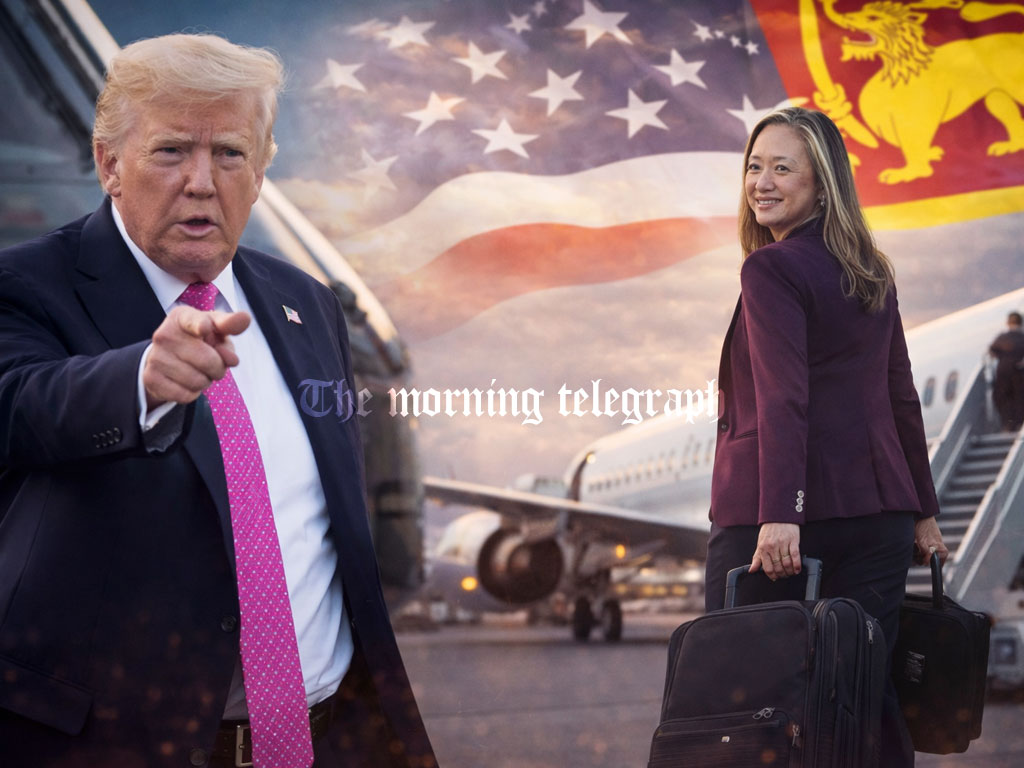
A sweeping diplomatic recall under Donald Trump puts Sri Lanka back at the center of a fierce debate over foreign influence, sovereignty, and Washington’s shifting priorities.
The Trump administration has begun recalling nearly 30 career diplomats from ambassadorships and senior embassy posts across the world, marking a decisive move to realign United States diplomacy with President Donald Trump’s “America First” agenda. The decision has sparked renewed attention in Sri Lanka, where the possible recall of US Ambassador Julie Chung has reopened long running arguments over Washington’s role in the island’s internal political affairs.

According to State Department officials, chiefs of mission in at least 29 countries were informed last week that their tenures would end in January. Most of the diplomats affected were appointed during the Biden administration and had initially remained in place after an earlier reshuffle that focused mainly on political appointees. That situation changed when formal notices began arriving from Washington, signalling a broader effort to ensure that senior diplomats are closely aligned with the current administration’s foreign policy priorities.
While ambassadors formally serve at the pleasure of the president, they are often retained for three to four years to preserve continuity in diplomatic relations. Officials have stressed that those being recalled are not being dismissed from the foreign service and may return to Washington for reassignment. The State Department has defended the move as routine, arguing that ambassadors are personal representatives of the president and must faithfully advance his policy agenda abroad.
Africa has been the region most heavily affected, with ambassadors in 13 countries set to be replaced. Asia, Europe, the Middle East, South and Central Asia, and the Western Hemisphere have also seen recalls. Sri Lanka is among the countries included, placing Ambassador Julie Chung’s future in Colombo under intense scrutiny.
Chung’s tenure in Sri Lanka has been one of the most openly contested of any US envoy in recent years. Critics across the local political spectrum have accused her of crossing diplomatic boundaries and interfering in domestic politics, particularly during the period of instability that followed the 2022 economic collapse. Her frequent public statements on governance, protests, corruption, and political reform were welcomed by some civil society groups but condemned by others as undue pressure on a sovereign state.
Opposition politicians and nationalist groups have alleged that Chung played an active behind the scenes role in shaping political outcomes. These claims include extensive engagement with protest leaders, opposition figures, and unelected actors during the mass demonstrations that ultimately led to the resignation of former President Gotabaya Rajapaksa. While the US embassy framed such engagements as support for democratic expression and stability, critics argued that they amounted to tacit endorsement of regime change.
The ambassador has also been accused by her detractors of exerting influence over constitutional and economic decision making through close coordination with international financial institutions and reform advocates, particularly during negotiations with the International Monetary Fund. Some lawmakers claimed that US backed reform narratives were used to marginalize alternative political voices and accelerate unpopular policy changes without clear electoral mandates.
Chung’s unusually active presence on social media further fuelled controversy. Her real time commentary on protests, arrests, and political developments was seen by supporters as transparency and engagement. Critics, however, viewed it as performative diplomacy designed to shape public opinion and apply pressure on Sri Lankan institutions, including the military and the judiciary.
Against this backdrop, Trump’s decision to recall diplomats appointed under the previous administration has been interpreted by some Sri Lankan observers as a tacit rebuke of what they see as overreach by US envoys. Trump has repeatedly criticised foreign policy approaches that, in his view, entangle Washington in other nations’ internal affairs under the banner of democracy promotion and human rights advocacy.
In the United States, lawmakers and the union representing American diplomats have expressed concern that the recalls could disrupt diplomatic continuity and weaken US influence overseas. Administration officials counter that the move is about discipline and alignment rather than punishment, insisting that ambassadors must execute the president’s vision instead of pursuing independent policy agendas.
In Sri Lanka, the potential recall of Julie Chung is being closely watched as a symbolic moment. For her critics, it represents accountability for what they describe as excessive foreign interference during a national crisis. For her supporters, it raises fears that US engagement on governance, reform, and human rights could diminish under an administration more focused on transactional diplomacy and strategic realignment.