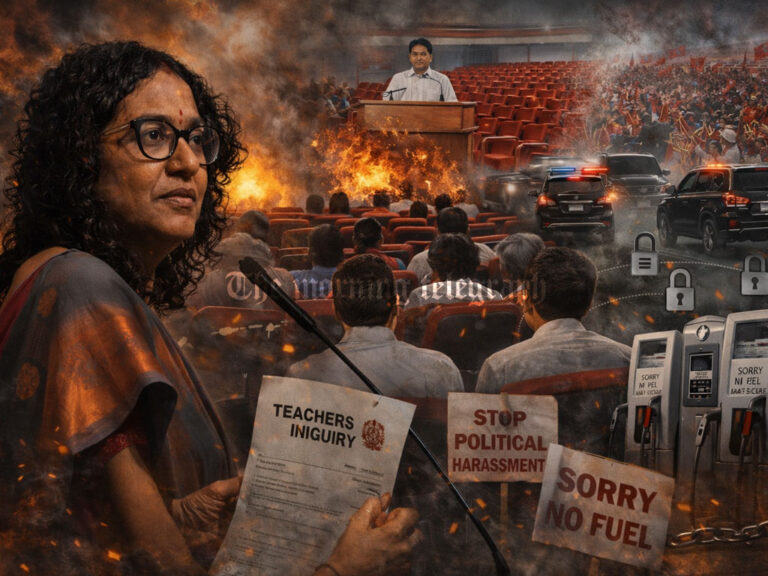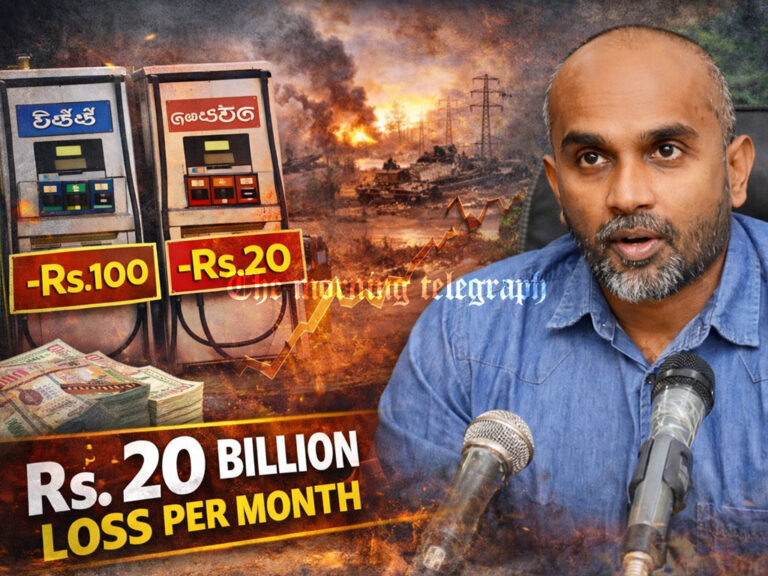
Namal Rajapaksa launches a scathing attack on the Inspector General of Police, accusing the government of political interference, intimidation of officers, and eroding the independence of law enforcement.
Namal Rajapaksa, the National Organizer of the Sri Lanka Podujana Peramuna, has questioned whether the current Inspector General of Police should feel ashamed to continue serving a government whose Members of Parliament allegedly attack police officers on the streets.
Speaking to the media, Namal Rajapaksa said that the present IGP is no longer acting as the IGP of the country, but rather as the “IGP of the compass,” implying political loyalty over institutional neutrality. His remarks were made in reference to an incident in which a National People’s Power Ratnapura District MP, Shantha Padmakumara, is alleged to have attacked a police officer.

According to Rajapaksa, such actions have created fear within the police force and discouraged officers from carrying out their duties independently. He said the conduct of certain government MPs has weakened discipline and respect for law enforcement, leading to a dangerous environment for officers attempting to uphold the law.
He further claimed that politicians who once accused the Rajapaksas of involvement in drugs have now reached a stage where cannabis cultivation is allegedly linked to figures within the current administration. Rajapaksa stated that police officers who raided a cannabis plantation connected to a Malima government MP were subjected to harassment, including transfers and direct attacks. One officer involved in the raid was transferred, while another was allegedly assaulted on the road by the MP concerned.
Rajapaksa also accused the government of suppressing investigations into a car accident involving former Speaker Ashoka Ranwala by transferring officers who conducted the inquiry, instead of allowing a proper investigation to proceed.
He concluded by stating that when police officers attempted to enforce the law against politically connected individuals, the response from the government and the IGP reflected political bias rather than institutional integrity.