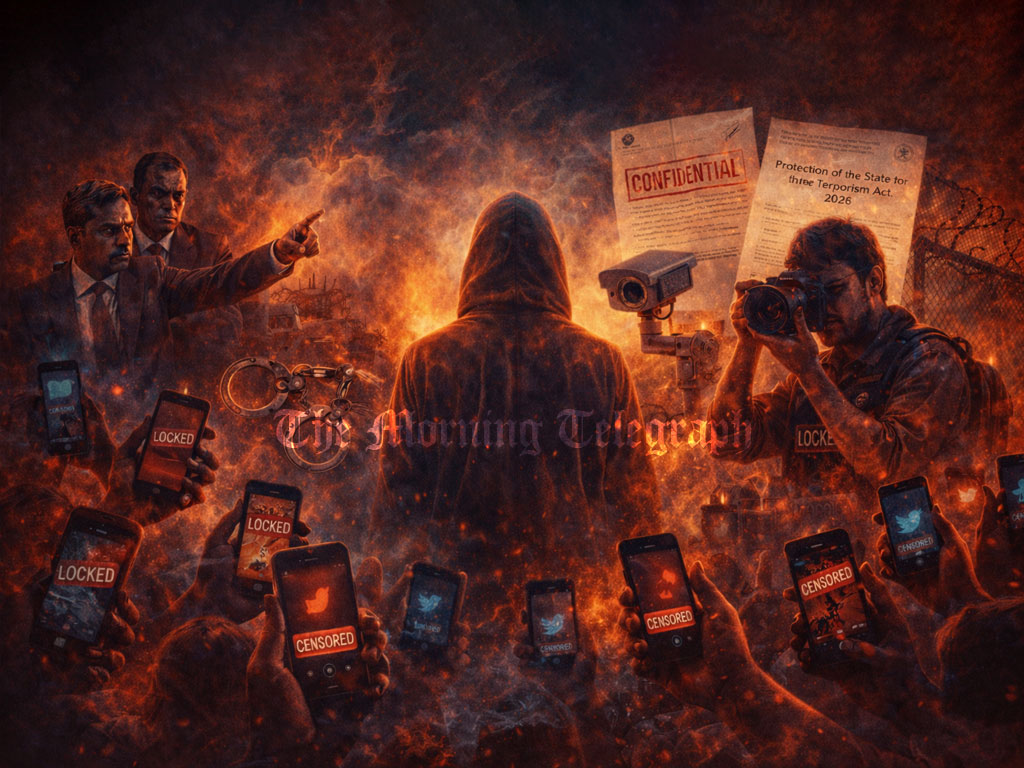
Warning that a proposed security law revives decades old repression, Sri Lanka’s social media publishers say the new bill risks criminalizing dissent, expanding executive power, and forcing journalists and citizens into silence.
The Collective for Social Media Publishing has issued a strong statement opposing the proposed Protection of the State from Terrorism Act, arguing that it poses a serious threat to free expression, civil liberties, and democratic space in Sri Lanka.
The statement, released by Sampath Samarakoon on behalf of the collective, states that although the bill is presented as a replacement for the Prevention of Terrorism Act, it retains the very features that generated resistance to the PTA for more than four decades.

“The Protection of the State from Terrorism Act, 2026, is presented as an improvement on the existing Prevention of Terrorism Act (PTA). Its basic structure, including administrative detention, military powers, prohibition regimes and broad speech offences, is concealed by the framework that recreates the essential features that led to opposition to the Prevention of Terrorism Act for over four decades.”
According to the collective, the bill recreates the foundation on which opposition to the PTA was built. Instead of relying on ordinary criminal law to address terrorism, with emergency powers used only when necessary, the proposed act establishes parallel criminal jurisdictions with reduced safeguards and expanded executive authority.
The statement highlights what it describes as an extraordinary arrest system. Powers of arrest and detention are preserved, while the Attorney General is granted mechanisms to authorize forced entry without trial. In addition, the President, senior police officers, and the Secretary of Defense are empowered to issue banning orders, restraining orders, curfews, and no go area declarations with limited judicial oversight.
The collective notes that the bill’s stated objective is to protect the state rather than civilians. As a result, public dissent, political disruption, and challenges to political authority risk being classified as terrorism. While the bill includes provisions referring to protests and industrial action, the group warns that these safeguards may conflict with other sections and prove ineffective in practice.
Particular concern is raised over Section 78, which defines confidential information in extremely broad terms. This could include social media posts, photographs of military checkpoints, images of deployments during protests, and even tweets mentioning the presence of intelligence officers at public events. Tamil civil society organizations documenting ongoing militarization in their communities face heightened exposure under these provisions.
The statement further criticizes Article 15, which makes failure to report information about terrorist offences punishable by up to seven years in prison. This provision, the collective says, criminalizes journalists, lawyers, doctors, and religious figures who adhere to professional ethics, effectively turning them into state informants.
Journalists, civil society activists, and ordinary social media users, the group warns, are particularly vulnerable. The predictable outcome, it says, is widespread self censorship driven by fear rather than genuine security needs. Extended detention provisions allowing remand without charge for up to two years are described as a repressive tool to silence dissent.
The collective urges the government to withdraw the bill, consult meaningfully with civil society and affected communities, and introduce legislation that addresses national security while complying with international human rights standards.