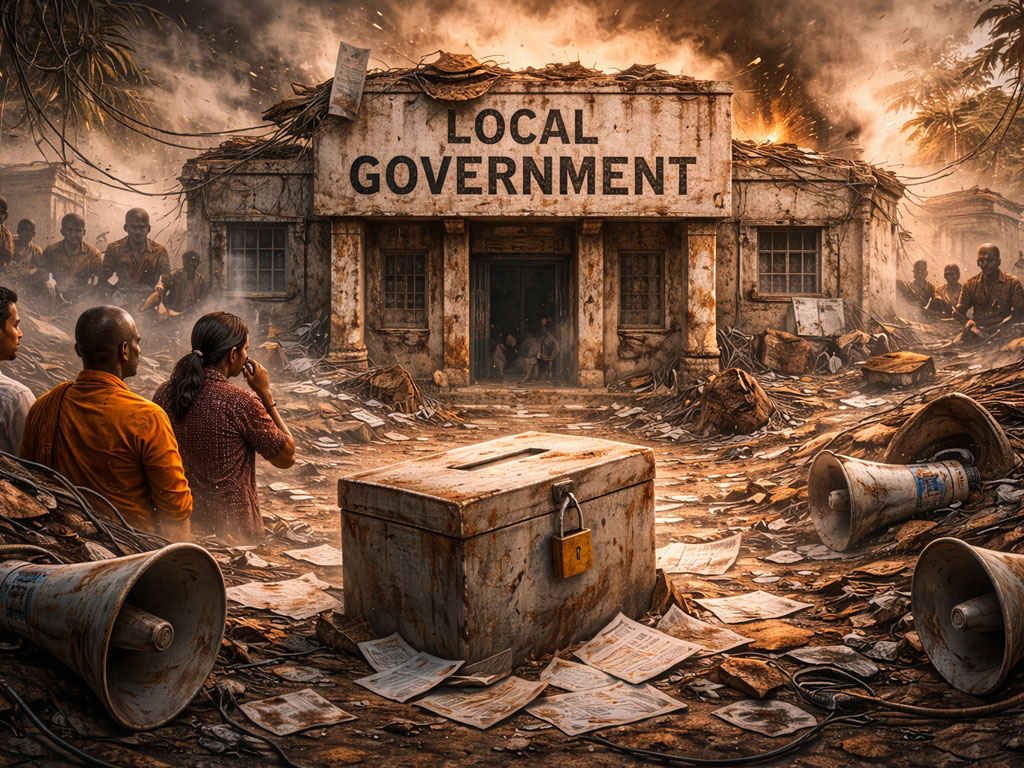
Sri Lanka’s local government system was meant to empower communities, but instead it has drifted into partisan theatre, leaving citizens unheard, democracy hollowed out, and public trust steadily eroded.
Local governance, at its core, is meant to be the most human face of government. It is about managing public affairs at the community level, where local authorities, citizens, and organisations work together to make and implement decisions on everyday services such as roads, sanitation, schools, parks, and public health. When it functions as intended, local government should be responsive, efficient, and representative, shaped by participatory processes like budgeting, planning, and service delivery. By decentralising power, it brings government closer to people, strengthens democracy, and addresses local development issues in practical and visible ways.

“When you are in local government, you are on the ground, and you are looking into the eyes and hearts of the people you are there to serve. It teaches you to listen; it teaches you to be expansive in the people with whom you talk to, and I think that engagement gives you political judgment.”
— Valerie Jarrett, Chief Executive Officer of the Obama Foundation
The central question, however, is whether local communities in Sri Lanka truly participate in, or have any meaningful say in, these processes. In practice, local government elections have increasingly become a referendum on the national government rather than a forum for discussing community priorities. They have turned into extensions of national political battles, with local councils often serving as proxy battlegrounds for party rivalry rather than engines of grassroots governance. While there may be a few councils genuinely attempting to engage their communities, the broader picture suggests a troubling lack of dialogue between elected representatives and the people they are meant to serve.
Across much of the country, there are few structured avenues for residents to meet their councillors, discuss local priorities, or monitor progress on agreed goals. Community participation in planning, budgeting, or oversight is minimal, if it exists at all. As a result, many citizens feel disconnected from local government, seeing it as distant and irrelevant despite its supposed proximity to their daily lives.
This disconnect raises serious questions about value for money. Local government elections are conducted at a significant cost to taxpayers, yet from many accounts, they have delivered little democratic return. If the purpose of these elections was to deepen democracy and stimulate discussion on local issues, they have largely failed. Instead, the focus has remained fixed on national partisan politics, leaving local concerns sidelined and communities disengaged.
As the Museum of Australian Democracy observes, democracy is fundamentally about discussion, often described as government by discussion. It relies on consultation, debate, and the free exchange of ideas among citizens to make informed decisions, manage differences, and ensure the collective good through peaceful and inclusive dialogue rather than force. This ongoing conversation, built on active listening and flexible thinking, sustains democratic life by allowing diverse viewpoints to be considered and integrated.
Sri Lanka’s overall governance model, whether at national, provincial, or local level, falls short of this ideal. Democratic practice is largely confined to periodic voting to elect representatives. Even then, there is typically very little direct engagement between candidates and voters beyond campaign slogans and party messaging. The deeper work of listening, deliberation, and consensus building is often absent.
The most recent local government elections vividly illustrated this problem. The way some councils were formed, and the subsequent political manoeuvring within them, stood in stark contrast to democratic ideals. In several cases, council budgets were defeated despite councils being formed with majority support, either through single parties or coalitions. Elections were fought almost entirely on national issues, and council formations that followed were driven by attempts to signal support for or opposition to national government policies. Service delivery and community welfare were secondary to power struggles.
Looking ahead, it is clear that incremental adjustments will not be enough. A genuine system change is required if democracy is to be meaningfully practised at all levels of governance. Many hope that a new Constitution, expected to be drafted through a consultative process and presented at a referendum, will address a critical missing element in Sri Lanka’s democracy. That missing element is the creation of mechanisms for sustained, meaningful discussion and debate between those seeking election and those voting, both during elections and long after ballots are cast.
At the local level, several key priorities deserve urgent attention. Local councils must shift their emphasis away from national political narratives and refocus on community issues, while still allowing space for residents to engage in discussions on national matters that affect them locally. Councils should concentrate on delivering essential services, including waste management, water and electricity coordination, road maintenance, preventive and primary healthcare, parks and recreational facilities, housing and zonal planning, sports infrastructure, and efficient library services.
Resource management and environmental protection should be central to local governance, with stronger enforcement of regulations and the promotion of green initiatives such as waste reduction and renewable energy. Councils also have a role in creating business friendly environments, supporting local entrepreneurs, and fostering green jobs that stimulate local economies and generate employment.
Citizen engagement must move beyond rhetoric. Regular constituency meetings, both online and offline, should be institutionalised. Surveys, digital platforms, and accessible public forums can ensure that all groups, including marginalised communities, are heard. Councils should act as a bridge between citizens and provincial and national governments, clearly articulating local perspectives and concerns.
Strategic planning is another missing pillar. Each local government entity should develop a five year strategic plan based on community consultation, with clearly defined goals, action plans, allocated funding, and monitoring mechanisms. Budgets should align with these plans through multi year estimates and annual allocations, giving communities confidence in the direction and continuity of local governance.
Ultimately, local governance must resist domination by partisan politics. Councillors should be elected for their individual capacity to serve, not merely as representatives of national party agendas. Sri Lanka’s deeply divisive political culture has repeatedly shown how damaging such partisanship can be, most starkly during moments of national crisis.
A well functioning local governance model that prioritises community interests, encourages participation, and supports inclusive policy making can form the foundation of a genuine bottom up democratic process. Sri Lanka has no shortage of knowledge, talent, or civic energy. What it lacks is a system that truly listens. Engaging citizens meaningfully in shaping local policy is not only democratic. It is essential for rebuilding trust and making governance work where it matters most.