
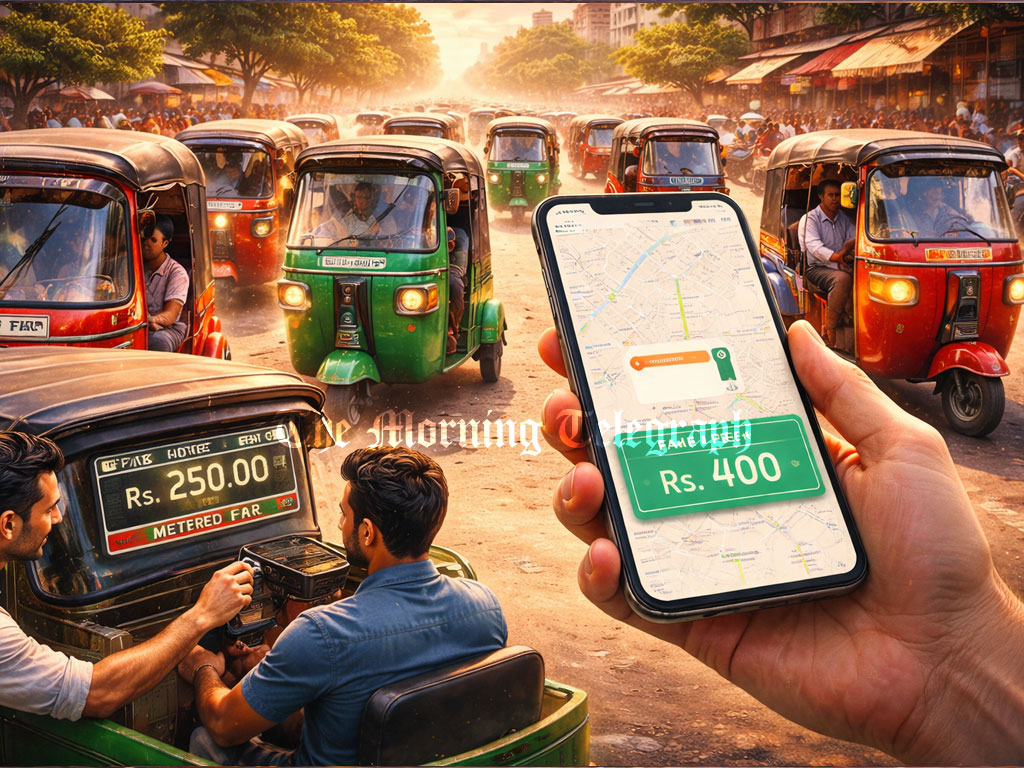
A long-awaited reform promises to end fare disputes, protect passengers, and restore dignity to three-wheeler drivers through a single transparent pricing system across Sri Lanka.
The government has turned its attention to reforming Sri Lanka’s three-wheeler transport sector following a growing crisis affecting services across the island. Authorities have now focused on formalizing the industry, with particular emphasis on eliminating long-standing irregularities in fare charging and introducing a standardized fare structure that is fair to both passengers and drivers.

At present, passengers often face uncertainty and disputes over three-wheeler fares, with prices varying widely depending on location, driver discretion, and circumstance. This lack of consistency has led to frequent complaints and public frustration. The proposed reforms aim to address these issues by introducing a transparent and predictable fare system.
In many developed countries, taxi and para-transit services operate under strict government or local authority supervision. These systems commonly rely on regulated meter fares or fixed fares determined in advance through mobile applications. As a result, passengers are informed of the cost before the journey begins, significantly reducing conflict and misunderstanding between drivers and passengers.
Sri Lanka’s proposed system seeks to follow a similar model. Under the new framework, both passengers and drivers will be able to know the distance and the fare before starting a journey. This is expected to bring clarity, trust, and accountability to three-wheeler transport services.
The decision has also been influenced by recent unrest between mobile app-based ride-hailing companies and independent three-wheeler drivers in several parts of the country. Policymakers believe that a unified fare structure will help ease tensions and create a level playing field.
Authorities are also considering the introduction of a common minimum and maximum fare limit applicable nationwide. In addition, the licensing system is set to be strengthened to improve service quality, ensure passenger safety, and uphold professional standards within the industry.
Although discussions on regulating the three-wheeler sector have taken place for many years, current conditions have made implementation unavoidable. Officials say the reforms are essential to prevent passenger exploitation while safeguarding the livelihood and dignity of three-wheeler drivers across Sri Lanka.




I welcome this decision with open arms. I have no problems with Uber or PickMe, except with the rare rogue exception.
This applies to the average Tuk Tuk driver as well. Most are decent folk.