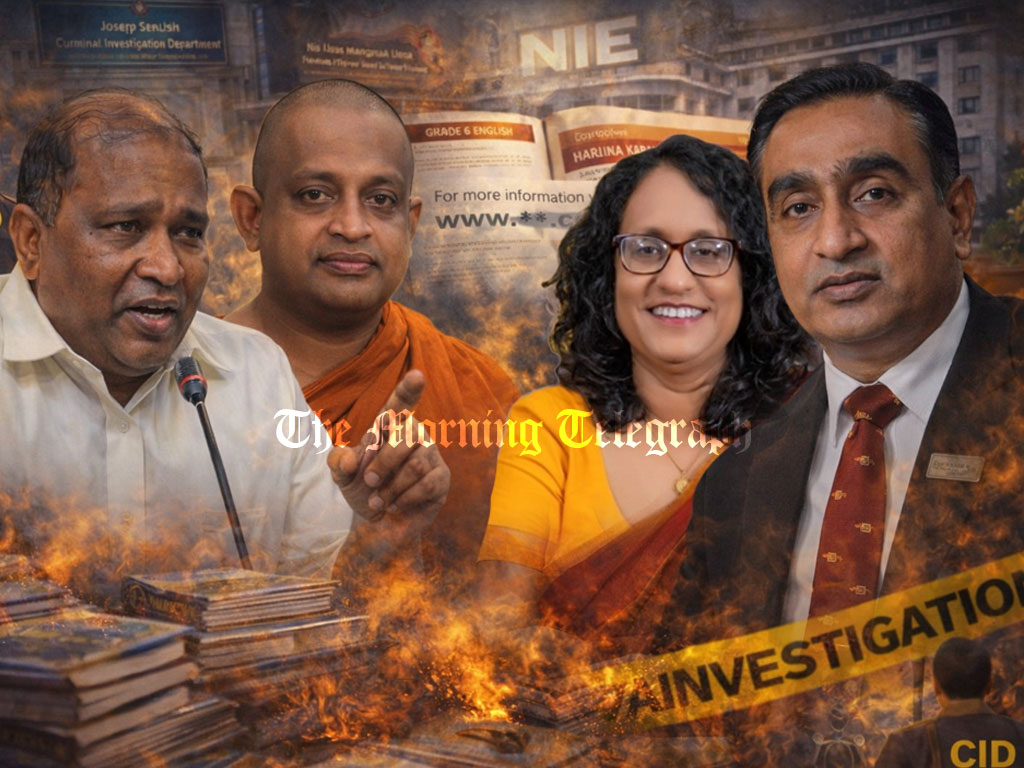
A single reference hidden inside a Grade 6 English textbook has snowballed into a nationwide controversy, shaking confidence in Sri Lanka’s education reforms and raising serious questions about accountability, intent, and the safeguarding of children.
Background to the controversy
The discovery of the name of a website associated with finding homosexual partners in the Grade 6 English Language First Term Module, prepared under the current government’s education reforms, has sparked widespread concern and public debate. The issue came to light after images of the module pages, including references to the website name and screenshots resembling the site, began circulating rapidly on social media.
The Ministry of Education responded on December 30 by announcing an immediate investigation and confirming that a complaint would be filed with the Criminal Investigation Department. The revelation intensified existing tensions between education authorities and teacher principal associations, who have already expressed reservations about the speed and quality of the reform process.

‘The module has already been trained’
The President of the Education Professionals Association, Venerable Ulapane Sumangala Thero, stated that the issue remained unnoticed until he brought it to public attention. He stressed that the impact of the mistake is far-reaching, as teachers across all education zones have already been trained to use the module.
“Teachers in all zones of Sri Lanka have been trained for this book. A lot of money has been spent on it, they have paid resource persons, they have spent on food and drink for the teachers, a lot of money has been spent on printing the book. There are nearly 500,000 children, so we do not know how much money it will cost to print such a book for 500,000.”
According to him, the problem cannot be dismissed as a minor editorial oversight because of the scale of training and distribution already undertaken. He emphasized that public funds have been used extensively for training programs and printing, raising serious concerns about waste and responsibility.
‘A conspiracy’
Venerable Ulapane Sumangala Thero went further, alleging that the incident represents a deliberate attempt to undermine the country and its future generation. He argued that the identities of those involved in preparing and approving the module are clearly listed in the publication itself and therefore accountability cannot be avoided.
“We are talking about a conspiracy against the country, a conspiracy to destroy the future nation. Those conspirators have been put in the front of the book. The book has the supervision, the mentorship, who the writers are, who reviewed it, everything is in the book. Then they should all be arrested.”
“No one else is doing a conspiracy, it is the ministry, the NIE, the book publishing, the heads of those are the conspirators,” he added.
His remarks intensified the debate, with supporters demanding arrests and critics cautioning against premature conclusions before investigations are completed.
A request to postpone the education reform work
The controversy has renewed calls to suspend the education reforms altogether. The Venerable Thero explained that teacher and principal associations had previously asked the Ministry of Education to review all modules linked to the reforms, but only the science module had been presented for discussion.
“Check all the modules. Check all the modules and postpone it for a year. From next year onwards, do a quality and optimal level of reform.”
He argued that rushing reforms without comprehensive review risks further mistakes that could damage children’s education and public trust in the system.
‘Those at the National Institute of Education should be held responsible’
The General Secretary of the Lanka Teachers’ Union, Posaf Stalin, placed responsibility squarely on officials at the National Institute of Education. He stated that both the Education Secretary and the Minister have the authority to act against those responsible.
“Those at the National Institute of Education should be held responsible for this. There is also the Department of Educational Publications, whose work is also taken over by the National Institute of Education. The National Education Commission is doing the reform work, and they have taken over that work too. We have shown the Education Minister on several occasions that they are not capable of it.”
He added that union representatives had previously warned higher authorities that the individuals tasked with implementing reforms were unsuitable, but those warnings were ignored.
Module printing cost Rs. 70 million
Posaf Stalin further revealed that approximately Rs. 70 million has been spent on printing the new modules. He alleged that the current government is implementing reforms originally designed during the Gotabaya Rajapaksa administration, reforms that were not executed even when the education minister at the time had the opportunity to do so.
“These people are carrying out the reforms brought by the Gotabaya Rajapaksa government, brought by the then State Secretary for Education, Dr. Upali Sedara. Susil Premajayantha, who was the State Minister for Education at the time, did not implement those reforms even after he became the Minister of Education. They are doing all this for this ADB loan. The government is doing everything for the IMF loan, they are doing this for the ADB loan. In fact, this is not something that is done with children in mind.”
His comments linked the controversy to broader concerns about donor driven policy decisions and questioned whether children’s welfare is being prioritized.
What does this indicate?
Senior Lecturer Charudatta Ilangasinghe, Secretary of the University Teachers’ Union, described the incident as evidence of careless policymaking. He emphasized that the National Institute of Education bears primary responsibility for curriculum revision and reform.
“What this suggests is how carelessly these reforms are being carried out. The National Institute of Education is fully responsible for this. The National Institute of Education is the institution responsible for the education sector in this country, especially for this curriculum revision and these reforms. In the past few years, the National Institute of Education has spent billions on educational reforms. But it is clear what has been done.”
He stressed that the issue cannot be treated lightly and called for the removal of those responsible, followed by a thorough investigation and appropriate punishment.
Why was the complaint filed with the CID?
Secretary to the Ministry of Education, Higher Education and Vocational Education, Nalaka Kaluwewa, filed a complaint with the Criminal Investigation Department on December 31 regarding the inclusion of the inappropriate website name. He stated that the complaint aims to determine whether the reference was deliberately inserted as part of a conspiracy.
“Over the past few days, various parties have been making baseless allegations about the education reform process. We have a reasonable suspicion that this situation, this inclusion, this inappropriate website, this word or introduction, is something that some party has done in a conspiratorial manner to substantiate the allegations made in favor of education reform.”
He confirmed that an internal investigation is also underway at the Ministry of Education.
‘No reprinting’
Addressing concerns about wastage and distribution, the Secretary clarified that the printed modules have not yet been distributed and that reprinting would not be necessary.
“We will not reprint the module. We will use the same one that we have after fixing the mistake in the module.”
This assurance was intended to calm public anger over the financial implications of the error.
Who is on the internal investigation board?
Nalaka Kaluwewa stated that the internal investigation is being conducted under the leadership of three additional secretaries. The board is chaired by Additional Secretary Devika Liyanage, with Deputy Commissioner General of Examinations Thilak Wattuhewa and Additional Secretary of Higher Education Apsara Kaldera also serving as members.
‘I think I should take that responsibility’
Professor Manjula Vidanapathirana, Director General of the National Institute of Education, acknowledged responsibility for the oversight.
“When we entered the name, we could say that as the NIE, we should have looked into the use of that name in that activity, I think I should take that responsibility.”
Her statement marked one of the first admissions of fault from within the institution responsible for preparing the module.
Comments posted on social media
The controversy has generated intense discussion on social media platforms. Many users questioned why non government websites, YouTube links, and QR codes were included in school textbooks at all. Others argued that the incident reflects deeper flaws in the reform process rather than a single isolated mistake.
As investigations continue, the incident has become a defining test for Sri Lanka’s education reforms, highlighting issues of governance, quality control, public trust, and the responsibility of institutions entrusted with shaping the next generation.
SOURCE :- BBC SINHALA