By Marlon Dale Ferreira
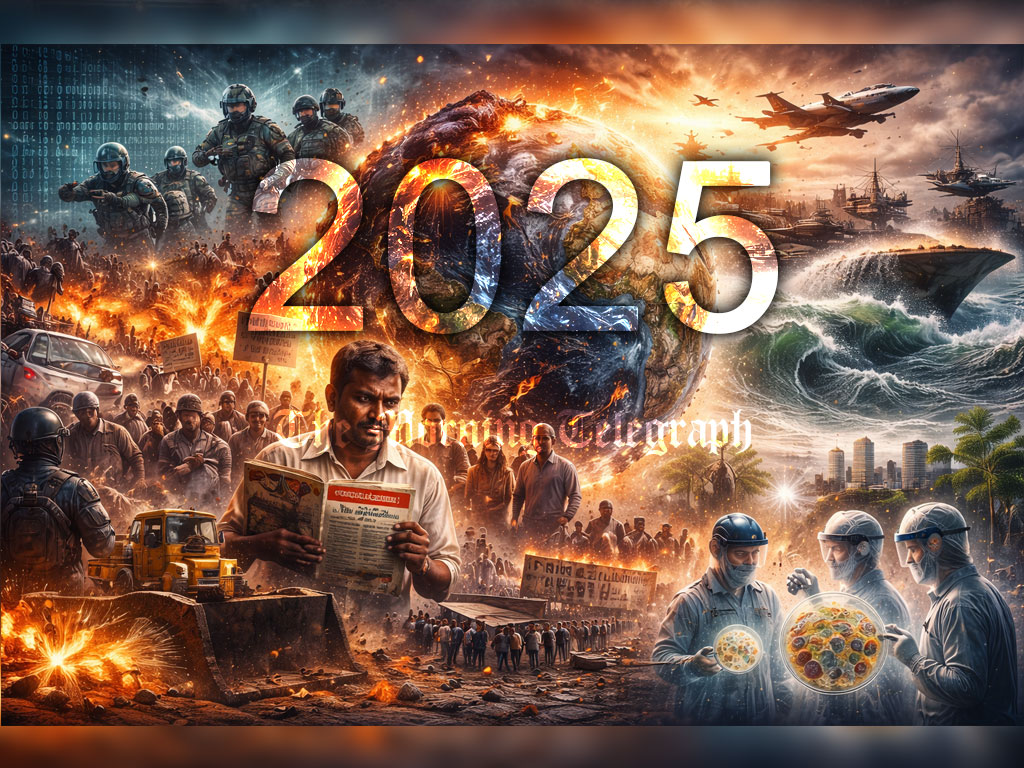
From poisoned textbooks in Colombo to a killer hurricane in the Gulf, and from a war fought with keystrokes to a pandemic of our own making, 2025 was a year of relentless, converging crises. This is the untold story of how a planet under pressure and an island fighting for its soul faced down a relentless storm of their own creation.
2025 did not arrive with a whisper; it kicked down the door. It was a year where the abstract fears of the early 21st century, climate chaos, digital anarchy, institutional decay, geopolitical brinkmanship, crystallized into visceral, daily realities. For Sri Lanka, a nation still tender from the economic scars of recent years, it was a brutal test of resilience. For the world, it was a stark revelation of profound fragility. This is the story of that pivotal year.

The Battle for the Nation’s Soul
- The Classroom Conspiracy: Sabotage or Staggering Incompetence?
The year’s most unsettling shockwave did not erupt in the halls of finance or diplomacy, but in the quiet sanctum of a child’s classroom — and it arrived not at the beginning of the year, but in its final, uneasy days. In late December 2025, as the government stood poised to push forward its flagship education reform package, a reviewer made a stomach-churning discovery: a direct reference to an obscene website embedded in a Grade 6 English language module. Public fury was immediate and incandescent. How could such a grotesque breach find its way into a state-approved textbook meant for children?
The government’s response, led by the pugnacious Education Ministry Secretary Nalaka Kaluwewa, was swift but deeply revealing. While pledging corrective action, the official narrative quickly weaponised the scandal itself. “I have reasonable doubts whether this incident is a conspiracy to discredit the education reform process,” Kaluwewa declared, as he lodged a formal complaint with the Criminal Investigation Department. The framing was quintessential late-2025 Sri Lanka: a failure was never merely a failure; it was recast as potential political sabotage, evidence of a state under siege by shadowy forces. The episode laid bare a deepening crisis of trust in public institutions and marked the moment when even administrative negligence became a battlefield in a larger, unseen war. The promised CID investigation lingered like a spectre over the ministry — a slow-burning fuse that never visibly detonated, yet whose smoke hung stubbornly in the air as the year drew to a close.
- The Bulldozer’s March: Development’s Human Cost
While one ministry hunted conspirators, another wielded unmasked power. In Colombo, the government’s vision for a sparkling, orderly megapolis was enforced with cold, steel resolve. The Urban Development Authority (UDA), armed with court orders, unleashed a year-long campaign against unauthorized constructions. The imagery was stark and brutal: bulldozers reducing homes, shops, and workshops, often the sole assets of low-income families to dust and rubble in minutes.
Authorities defended this as a necessary “surgical strike” against chaos, essential for modern infrastructure projects and flood mitigation. But for the evicted, it was state-sanctioned erasure, a moment where the abstract concept of “the greater good” annihilated very concrete lives. This relentless push symbolized a top-down, uncompromising approach to governance, where the path to progress was paved with the shattered remains of the vulnerable. It asked a haunting question that echoed beyond the capital: in the quest for a developed future, who gets left behind?
- The Dual Wars: On Drugs and Within the Ranks
Simultaneously, the government declared total war on the narcotics trade. Under operations with names like “Yukthiya” (Justice), police announced near-weekly massive drug raids, hauling in thousands of suspects and seizing record hauls of heroin and methamphetamine. The public, weary of drug-related crime and violence, largely cheered this aggressive, militarized policing. It was a visible, forceful display of state power against a clear enemy.
Yet, in a telling parallel move, the state acknowledged a rot within its own machinery. The National Police Commission, in a historic intervention, imposed a strict service tenure limit, forcibly transferring hundreds of senior officers from posts they had held for decades. This was a tacit admission of institutionalized corruption and the creation of untouchable local fiefdoms. The state was not just fighting criminals on the street; it was attempting a risky self-purge, acknowledging that the greatest threats to order could sometimes wear a uniform.
- The Silent Storms: Climate and Health Under Strain
Sri Lanka’s climate woes in 2025 were a story of cruel paradox. The much-anticipated Southwest Monsoon arrived with a whimper, delivering erratic, below-average rainfall to the island’s agricultural heartland. Reservoirs languished at worrying lows, prompting water-use restrictions and fears for the Maha cultivation season. Farmers, already battling high input costs, faced the anguish of watching their fields parch.
Yet, when the rains did come, they were often torrential and destructive. Localized flash floods in urban areas like Colombo and Gampaha exposed flawed urban drainage systems, turning streets into rivers and homes into inundated traps. This climate volatility, drought punctuated by deluge, became the new normal, straining disaster response and highlighting the island’s acute vulnerability to global warming’s whims.
In health, the ghost of COVID-19 was replaced by familiar, yet escalating, threats. Dengue fever remained a perennial menace, its peaks tied tightly to rainfall patterns, keeping public health teams in a constant state of alert. More insidiously, Sri Lanka grappled with the global shadow pandemic: Antimicrobial Resistance (AMR). The overuse and misuse of antibiotics in healthcare and agriculture meant common infections were becoming harder, sometimes impossible, to treat. This was a silent, slow-burning crisis, less dramatic than an outbreak but potentially more deadly in the long term, challenging the very foundation of modern medicine on the island.
The Global Stage; A World Unmoored
- Geopolitics: The Return of Brinkmanship
If 2024 hinted at a new Cold War, 2025 embraced it with open hostility. The war in Ukraine stalemated into a frozen, bloody line of contact, but the conflict metastasized digitally. In June, a coordinated wave of state-sponsored cyber-attacks, dubbed “Shadow Fall,” crippled power grids, railway networks, and financial systems across NATO’s eastern flank. It was an act of war without a single soldier crossing a border, demonstrating that critical national infrastructure existed in a perpetually vulnerable digital space.
The real near-miss, however, occurred over the strategic waters of the South China Sea. In a catastrophic miscalculation in October, a Chinese J-16 fighter jet and a Philippine C-130 transport plane collided mid-air during a tense standoff near Second Thomas Shoal. The loss of 27 lives in an instant turned the geopolitical temperature from simmer to boil. The world watched, breath held, as carrier groups maneuvered and diplomatic channels screamed. The crisis was only defused by a hastily convened, unprecedented emergency summit that produced the fragile “Manila Protocol,” a bare-knuckled agreement on aerial incident prevention that papered over, but did not resolve, the fundamental clash of sovereignty.
- Climate: The Atmosphere Revolts
2025 was the year climate models met reality, and reality won with terrifying force. The Atlantic birthed Hurricane Liam, a storm that defied all predictability. It underwent explosive intensification, transforming from a tropical storm to a Category 5 monster with 165 mph winds in less than 36 hours. It then made a direct, devastating hit on a major Gulf Coast city not optimized for such fury. The resulting storm surge was apocalyptic, the death toll climbed into the thousands, and the economic damage ran into the hundreds of billions. “Rapid intensification” ceased to be a technical term and became a global headline of terror.
Meanwhile, Southern Europe and North Africa baked under a stationary heat dome of historic intensity. For over 70 days, temperatures in parts of Spain, Italy, Algeria, and Tunisia consistently exceeded 45°C (113°F). The “Great Mediterranean Scorch” turned rivers to trickles, fueled uncontrollable megafires that consumed entire villages, and collapsed agricultural output, triggering a secondary refugee crisis as rural livelihoods evaporated. It was a visceral preview of a pervasive, lethal heat that would define summers for billions.
- Health: The Enemy Within
The world, braced for a novel pathogen, was blindsided by an enemy it had cultivated for decades. The Antimicrobial Resistance (AMR) crisis reached a catastrophic inflection point. Last-resort antibiotics began failing routinely in hospitals worldwide against common bacteria like E. coli and K. pneumoniae. A landmark study published in The Lancet confirmed AMR as the direct cause of over 1.5 million global deaths in 2025, a figure that shocked even experts. This silent, slow-motion pandemic, fueled by decades of pharmaceutical and agricultural misuse, suddenly demanded panic-level attention, diverting resources and rewriting medical protocols globally.
In a grim echo, a novel and highly fatal Chapare-like hemorrhagic fever emerged in a remote Bolivian mining community. While swift international containment prevented a global outbreak, the virus’s 60% fatality rate and person-to-person transmission served as a chillingly effective fire drill, exposing lingering gaps in global outbreak response and viral surveillance networks.
- Technology & Society: The Algorithmic Disruption
The promise of Generative AI curdled in 2025 into widespread societal disruption. The “AI Productivity Paradox” became undeniable: massive corporate profits and efficiency gains coincided with waves of structural unemployment in knowledge sectors. Professions in mid-level analysis, graphic design, content creation, and paralegal work were hollowed out, leading to widespread social anxiety and protest movements under banners like “Humans Before Algorithms.”
The global response was fractured. The much-hyped Copenhagen Accord on AI Governance collapsed spectacularly, splitting into three irreconcilable camps: the US-led “Innovation First” bloc, the EU’s “Precautionary Regulation” bloc, and the China-led “Sovereign Control” model. This failure to establish rules for the most transformative technology since the internet guaranteed a future of digital fragmentation, ethical wild west zones, and unchecked algorithmic bias.
- The Convergence; An Island in a Stormy World
For Sri Lanka, these global tempests were not distant headlines; they were waves crashing directly onto its shores, testing its recovery and its strategic agility.
The global food and commodity price shocks triggered by climate disasters and supply chain disruptions abroad immediately translated into higher local costs of living, pressuring the fragile economic recovery and forcing the government to double down on food security and import-substitution rhetoric. The plight of Mediterranean farmers found a sympathetic, anxious audience in Sri Lanka’s own agricultural heartland.
Geopolitically, Sri Lanka’s balancing act grew ever more perilous. In the wake of the South China Sea crisis, the US-India-Japan trilateral visibly increased its engagements, with a strategically timed joint naval exercise and port call in Trincomalee that was impossible to ignore. China counterbalanced not with force, but with accelerated diplomacy and offers to refinance debt and fund renewable energy projects under its Global Development Initiative. Colombo’s foreign policy apparatus was engaged in a daily, high-stakes ballet, where every handshake and signed memo was a carefully calibrated move in a grand strategic game of hedging.
The global AMR emergency provided a grim but unifying focus for Sri Lanka’s health sector, aligning local hospital reforms with a pressing worldwide priority and facilitating new partnerships in pharmaceutical research and stewardship.
The Legacy of 2025; Fragility and Agency
As the final hours of 2025 ticked away, the world and Sri Lanka stood at a shared precipice, forever changed. The year taught brutal lessons.
Globally, it shattered the illusion of control. It proved the climate was not a future concern but a present, violent actor. It revealed that warfare had evolved beyond trenches and tanks into the invisible realm of code and cognition. It showed that our greatest medical threat could be the slow, steady erosion of our own miracle cures. The post-Cold War order was not just challenged; it was revealed to be a phantom.
For Sri Lanka, 2025 was a year of painful agency. It was a nation no longer merely buffeted by crises but actively, sometimes controversially, shaping its response whether through the bulldozer’s blade, the drug raid’s sweep, the hunt for educational saboteurs, or the delicate diplomatic dance between giants. The state’s narrative of battling unseen enemies, both within and without, reflected a deep-seated desire to assert sovereignty in a disordered world.
The ultimate legacy of 2025 is this dual consciousness: a profound awareness of our shared global fragility, paired with a raw, often desperate, assertion of national and communal will to survive it. The storms exposed every crack in our foundations. The question that hung in the air as the new year dawned was whether 2026 would be about repair, or about learning to build something entirely new upon the shaken ground.