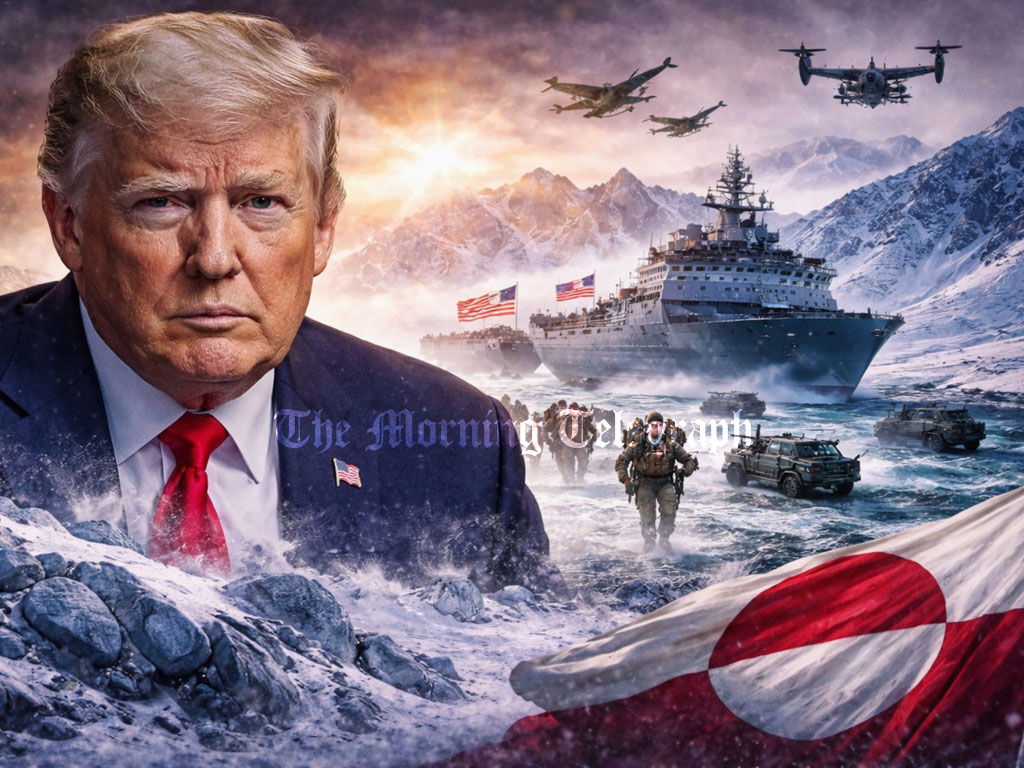
As global tensions rise in the Arctic, Donald Trump signals that Greenland is no longer just a diplomatic ambition but a strategic prize the United States is prepared to fight for.
The White House has confirmed that US President Donald Trump is actively discussing multiple options, including military action, to bring Greenland under American control. Officials have framed the acquisition of the semi-autonomous territory of Denmark as a major national security priority for the United States, elevating the issue to the top tier of US foreign policy concerns.

According to statements from Washington, the possibility of deploying US military power remains available under the president’s authority as commander-in-chief. While no immediate military operation has been announced, the White House has made it clear that force remains an option in pursuit of this objective.
The remarks have triggered sharp reactions across Europe. Several European leaders have publicly voiced strong support for Denmark, warning that any US attack on Greenland would have catastrophic consequences for the transatlantic alliance. Danish Prime Minister Mette Frederiksen cautioned that a military move by the United States would effectively signal the end of NATO as it currently exists.
In a coordinated response, leaders from Britain, France, Germany, Italy, Poland, and Spain released a joint statement emphasizing that Greenland belongs to its people and that its sovereignty and territorial integrity must be respected. While acknowledging shared concerns over Arctic security, they stressed that such issues must be addressed collectively through NATO, not unilaterally by one member state.
Greenland’s strategic importance has long drawn American attention. The island sits at a crucial crossroads in the Arctic, offering military positioning advantages and access to untapped rare mineral resources. As climate change accelerates ice melt, new shipping routes and economic opportunities are also emerging, further increasing the region’s global value.
The growing presence of Russia and China in the Arctic has heightened US anxiety. Both countries have expanded their economic and strategic activities in the region, prompting Washington to reassess its long-term security posture alongside its NATO partners.
Reports suggest that the United States is weighing several approaches, including purchasing Greenland outright or negotiating a free association agreement. US Secretary of State Marco Rubio stated that while there are no active plans to invade Greenland, discussions about buying the territory are ongoing. In contrast, Defense Secretary Pete Hegseth confirmed that the Pentagon has contingency plans to seize Greenland by force if required.
Within Greenland, public opposition to US annexation is overwhelming. The island’s population of approximately 57,000 has expressed deep fear and resentment at being treated as a geopolitical commodity. Greenland’s Prime Minister Jens-Fredrik Nielsen has insisted that any negotiations must fully respect international law and the island’s territorial rights.
President Trump has repeatedly argued that the United States “needs” Greenland for national security reasons. US officials now describe the issue as more than a land deal, portraying it as a strategic move tied to Arctic dominance, Western security, and America’s global influence.