
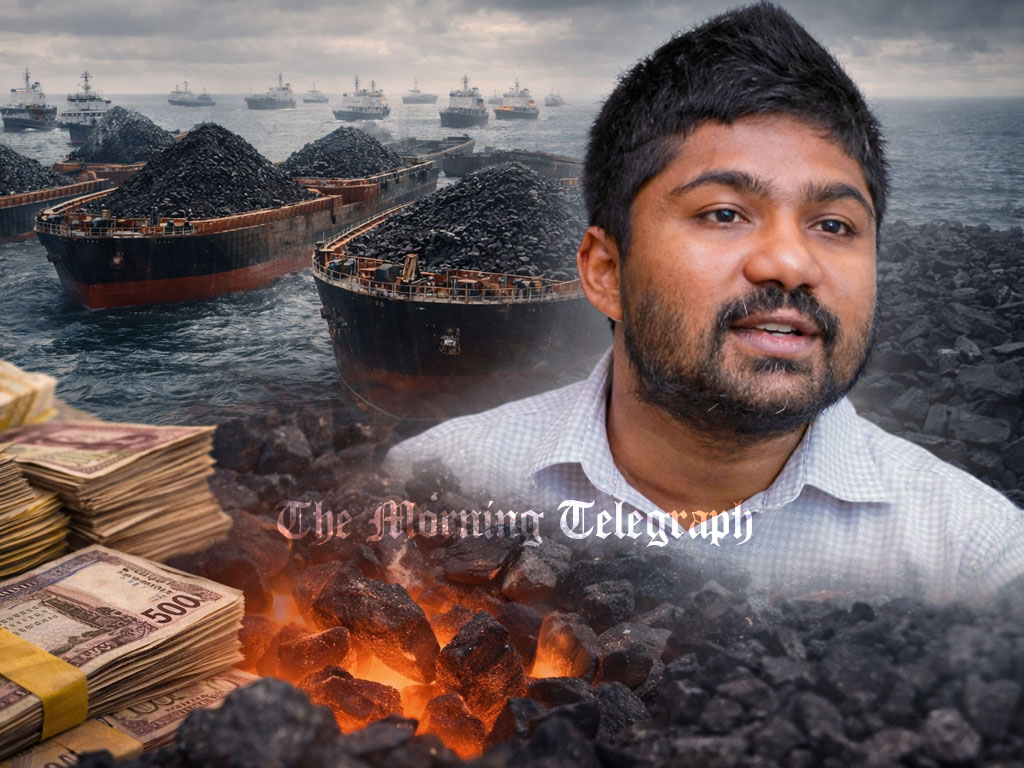
A senior MP has accused the government of engineering a massive coal procurement scam that has allegedly drained billions from public funds, warning that manipulated tenders and substandard imports are now forcing Sri Lanka to burn more coal, buy more ships, and pay a far higher price.
Raising serious allegations in Parliament, MP D. V. Chanaka claimed that corruption and fraud have marked the government’s actions from the very first week of its rule. He revealed details of what he described as a large scale coal scam that has caused losses amounting to crores of rupees by bypassing established procedures.

According to the MP, the coal tender that is normally called in April was deliberately postponed until September. He alleged that the delay was intended to allow two companies with no international experience to register and qualify for the tender process.
He further stated that the mandatory minimum period of six weeks, or 42 days, required for an international tender was reduced to just three weeks, or 21 days. Despite suppliers warning that the timeframe was insufficient, the tender was allegedly rushed to accommodate specific companies by providing them with favorable conditions.
Tests conducted by the Lakvijaya Power Plant confirmed that the Calorific Value of the first two coal shipments ranged between 5600 and 5800, falling short of the minimum required 5900 under tender guidelines. Due to this inferior coal quality, 120 tons are now needed to generate 300 megawatts instead of the usual 107 tons.
As a result, 936 tons of coal must be burned daily at a rate of 13 tons per boiler per hour. The MP stressed that this inefficiency means six additional coal ships must be imported annually, imposing massive extra costs on the country.
Although the coal was sourced from South Africa, laboratory reports were reportedly obtained from Indonesia, raising further concerns. He also accused the responsible minister of rejecting Lakvijaya Power Plant reports and targeting officials who exposed the issue.
The MP concluded by stating that a government elected on promises of clean governance is now allegedly involved in corruption spanning coal, fuel, rice, and salt.

Oh, my, my, my.
What is happening?