
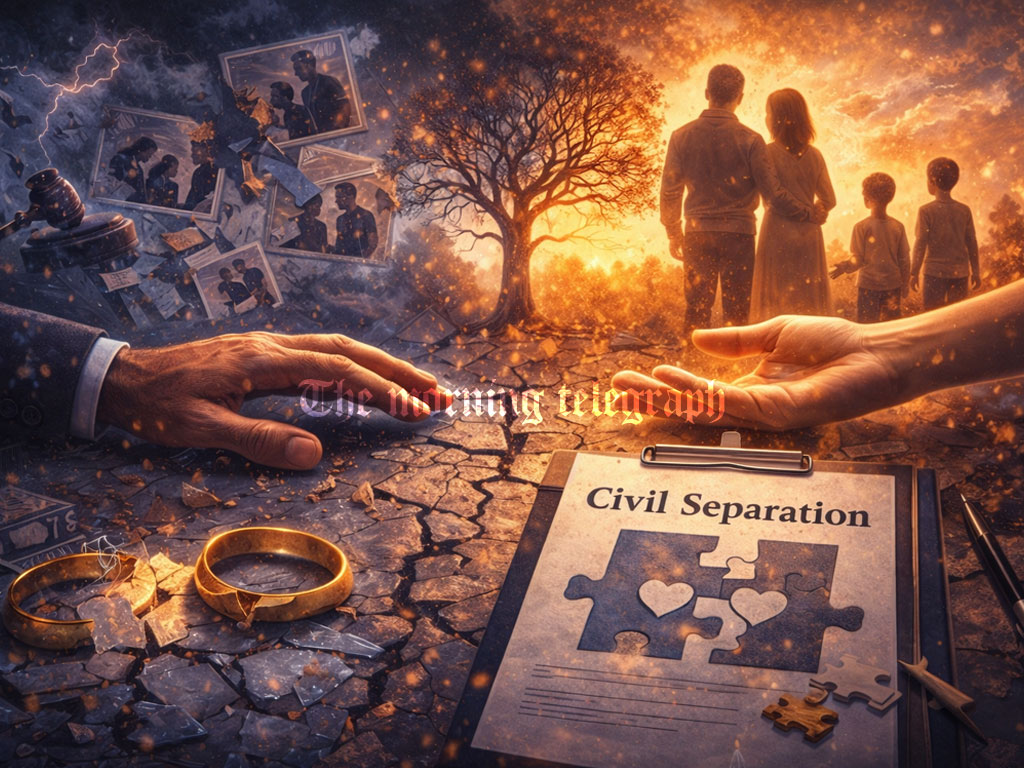
By Roshan Jayasinghe
Most marriages do not begin with a plan to hurt each other.
They begin with hope. Sometimes with romance. Sometimes with family influence, tradition, or an arranged structure that still carries a sincere intention. Two people step in believing that life will be better together than apart. They share a home, a table, a private world, and often children. They build history.
So when that relationship can no longer continue, something feels deeply wrong about how we end it.

We take a human moment that already carries grief and uncertainty, and we wrap it in a system that often turns the two people into opponents. The ending becomes a contest. The language becomes war. People start speaking like they are in court even when they are standing in their own kitchen. Friends and family get recruited. Children get pulled into the atmosphere. Dignity becomes optional.
I am not against law. I am not against fairness. I am not against accountability. There are situations where legal protection is necessary and safety must come first.
But what troubles me is how easily we accept cruelty as normal.
The end of a marriage should not require the end of humanity.
This is a proposal for a different standard. A more civilized one. Something people can read, reflect on, and choose as a guiding structure when a relationship changes form.
Because the real question is not only how we love.
It is how we part.
The deeper issue: we treat separation like moral failure
In many communities, separation carries a hidden accusation. Someone must be the villain. Someone must be the problem. Someone must lose.
But life is more complex than that.
Not every ending is betrayal.
Not every separation is abuse.
Not every marriage that ends was meaningless.
Sometimes two people simply cannot continue in the same form. Sometimes they grew in different directions. Sometimes the relationship became unhealthy. Sometimes the pain became repetitive and repair stopped happening. Whatever the reason, an ending can be sad and still be honest.
The suffering so many people experience is not only because the relationship ends.
It is because the ending becomes a place where dignity is abandoned.
And if children are involved, the damage spreads further than the couple. Children do not experience separation as paperwork. They experience it as atmosphere. Tone. Tension. Silence. Fear. Loyalty pressure. Confusion.
A society that claims to value family should care about this.
So here is the shift I am proposing.
Stop centering “divorce” as the main identity of the ending.
Start centering “civil separation” as the standard of how we behave.
Not as a legal term. As a human one.
A new structure: civil separation
Civil separation is not a denial of pain. It is not pretending everything is fine. It is not spiritual bypassing.
It is a choice to keep the ending human.
It means the partnership ends, but the person is not treated as an enemy.
It means the chapter closes, but the book is not burned.
It means fairness matters, but revenge is not allowed to dress up as fairness.
It is a simple idea, but it changes everything:
The goal of separation is not victory.
The goal is reducing harm and restoring stability.
There is a moment most people remember.
Not the moment the papers were signed. Not the moment the lawyers got involved. Not the moment family members heard the news.
The real moment is quieter than that.
It is the moment two people realize the life they built together is about to change shape. The house feels different even if nothing has moved. The air feels heavier. You can feel the end before you can explain it.
In that moment, no judge can choose for you.
You can turn the ending into punishment. You can collect evidence, recruit support, sharpen your words, and make sure the other person feels what you feel. You can try to win the ending.
Or you can do something harder, and far more courageous.
You can choose dignity.
You can say: this did not work, but I will not erase your humanity.
You can say: we are not together anymore, but we will not become cruel.
You can say: if we have children, they will not carry our pain for the next twenty years.
A civilized separation is not the absence of grief.
It is the refusal to turn grief into violence.
The Civil Separation Framework
This is the part I want people to hold on to. Not as a perfect formula, but as a guide. A structure that can reduce suffering and bring maturity back into the room.
1. Dignity is non negotiable
If the relationship ends, dignity does not end.
This means no humiliation campaigns.
No character assassination.
No threats as communication.
No turning private pain into public punishment.
If you once loved someone, or even simply shared a life with them, do not destroy them because the relationship could not continue.
2. The relationship ends, humanity continues
Ending a marriage should mean the romantic partnership stops. It should not mean respect stops.
You can set boundaries without becoming cruel.
You can say no without becoming a weapon.
When people treat each other like enemies, the ending becomes a lifelong wound. When they remain human, the ending becomes a hard lesson, not a permanent scar.
3. Fairness replaces victory
Many separations turn ugly because one side tries to win.
But separation is not war. It is restructuring.
Fair division is not punishment.
Support is not weakness.
Stability is not surrender.
A civilized ending leaves both people able to stand and rebuild.
4. Children are protected, always
If children exist, they are not part of adult conflict.
No loyalty tests.
No messenger duties.
No interrogations after visits.
No bad mouthing the other parent in their presence.
Children should never feel they must choose who to love in order to be safe.
The adult relationship may be ending. The child’s need for calm does not end.
5. Clarity is kindness
Confusion creates fear. Fear creates control. Control creates war.
A humane separation chooses clarity about real things:
Responsibilities. Finances. Parenting decisions. Boundaries. What stays private and what is shared.
When there is clarity, people breathe. When there is constant uncertainty, people become defensive. Many fights are not about love. They are about instability.
6. Communication has ethics
If communication becomes a courtroom, the ending becomes toxic.
A civil separation holds a simple ethic:
Speak to solve, not to punish.
Talk about the issue, not the identity of the person.
When emotions rise, pause instead of escalating.
When stuck, use neutral support instead of recruiting allies.
This is not about being polite. It is about preventing damage.
7. Repair remains a human skill
Even during separation, people will get triggered. People will say things they regret. Grief will speak loudly.
A mature culture makes room for repair:
Acknowledging impact. Apologizing when needed. Correcting behaviour. Returning to dignity.
We do not need perfect people. We need adults willing to repair.
A new vocabulary for a new standard
Language shapes behaviour. If we use war language, we will live war behaviour.
Consider shifting the words we use:
Marriage becomes a life partnership.
Divorce becomes civil separation.
Custody becomes child stewardship.
Settlement becomes a stability agreement.
This is not about being trendy. It is about keeping people out of the mindset of battle.
The Civil Separation Pledge
If this framework is to spread, it needs to be simple enough to repeat and share. Here is the heart of it.
We will end the partnership without humiliating each other.
We will not weaponize children, money, or reputation.
We will commit to fairness and transparency.
We will protect children from adult conflict.
We will speak to solve, not to punish.
We will seek neutral support before escalation.
We will remain human, even when it hurts.
This is not sentiment. It is a civic standard.
One necessary truth
There are situations where kindness must include strong boundaries.
If there is abuse, coercion, intimidation, serious addiction chaos, or ongoing deception, then legal protection may be necessary. Safety must come first.
So the proposal is not to remove law.
The proposal is to stop allowing law to replace human decency where decency is possible.
Closing
We celebrate weddings with music, flowers, gold, and community.
But we often handle endings with bitterness, threats, and power plays.
A society is not measured only by how it begins love.
It is measured by how it handles the moment love changes.
If we want a civil society with real respect for humanity, then we must raise the standard of how we separate. Not just for the couple, but for the children, for the families, and for the emotional culture we pass down.
Love may end.
But humanity does not have to.
Author’s Note
This article is not legal advice. I am not writing as a lawyer. I am writing as a human being who believes our culture can do better.
There are times when legal structures are necessary for safety and protection. I respect that reality. What I am challenging is the unnecessary cruelty we have normalized in ordinary separations, even when two people could have ended with decency.
If this framework resonates, share it. Speak about it. Try it on. Improve it. Civilisation is not only built through technology or policy. It is built through the standards we live by when life gets hard.
About the Author
Roshan Jayasinghe is a writer and observer of human systems. His work explores the gap between man made constructs and lived humanity, with a focus on how economics, trade and everyday choices intersect with questions of fairness, responsibility and inner alignment. Through essays for publications in The Morning Telegraph, he aims to remind readers that they are not passengers in a fixed machine, but active custodians of a shared world.




Sorry to say that I’m experiencing what you say here ….. how the small kids get affected (rather how they get brainwashed) and how confused they are as a result.
I’m told that new divorce laws are currently being discussed as to settle them as quick as possible. Do you have any idea?