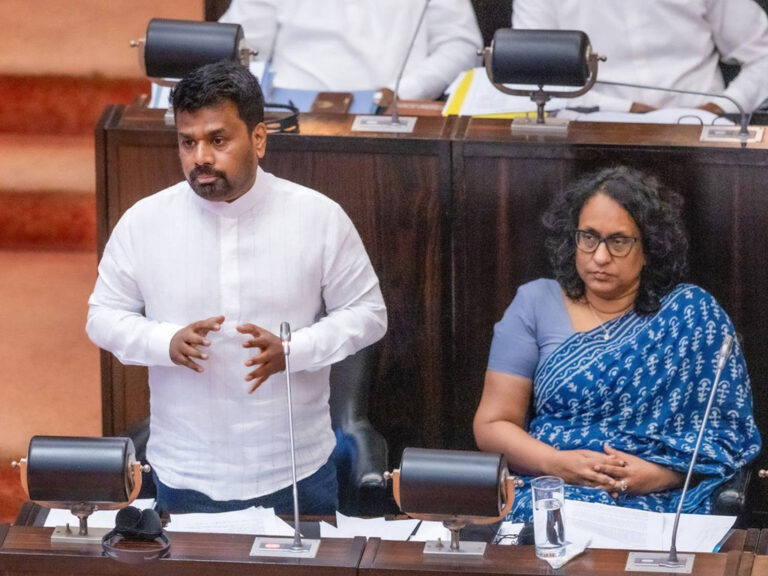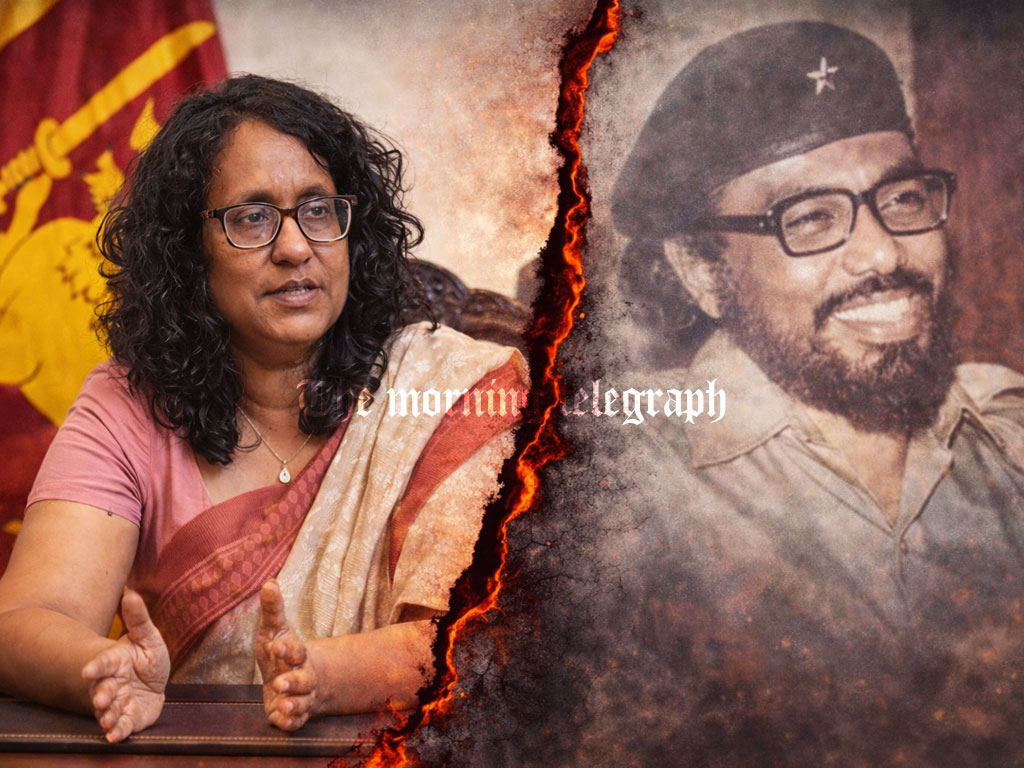
A rising political star now sits at the center of a growing storm, forcing the NPP to confront an uncomfortable question about leadership, ideology, and accountability.
During the 2024 presidential election campaign, a moment in Kandy quietly exposed deeper political fault lines. After Thalatha Athukorala left the Samagi Jana Balawegaya, veteran actress and SLPP parliamentarian Geetha Kumarasinghe appeared on Sajith Premadasa’s stage. Within hours, JVP presidential candidate Anura Kumara Dissanayake mocked the move, saying it was like “giving up Thalatha and taking Geetha instead.” Almost immediately, JVP-linked social media accounts launched a sustained smear campaign against Geetha.

She was not alone. Hirunika Premachandra, a prominent female figure in the SJB, and award-winning actress Damitha Abeyratne, who joined Sajith after emerging from the protest movement, were also targeted. When images circulated of Hirunika confronting police during a protest, JVP social media amplified vulgar and degrading commentary. The attacks revealed a pattern of political mudslinging aimed at women who challenged the JVP narrative.
What made these attacks striking was the contrast in stature. Geetha Kumarasinghe is one of Sri Lanka’s most celebrated actresses, having won awards for both popularity and performance. Damitha Abeyratne is internationally recognized for her work. Hirunika Premachandra was the woman who led the first female-led protest to the gates of Gotabaya Rajapaksa’s residence. Yet all were dismissed and demeaned online.
Against this backdrop stands Harini Amarasuriya. A university lecturer who entered Parliament through the JVP national list, Harini was largely absent during the frontline struggles of 2015 and the 2022 Aragalaya protests. While others were on the streets confronting power, her name rarely surfaced. It was only after the protests subsided, the Rajapaksas exited, and Ranil Wickremesinghe assumed the presidency that Harini emerged prominently through interviews with foreign media.
From there, her ascent was rapid. She became a favorite among NGOs, academia, and Colombo’s urban elite. The JVP placed her at the helm of its women’s front, “Women Together as One,” and her visibility soared. As Rohana Wijeweera’s ideological legacy faded within the party, the “Harini moment” began to dominate the National People’s Power narrative.
Among upper-middle-class political circles, a new refrain emerged: “Anura cannot win. If Harini contests, she will.” This perception reshaped the JVP’s internal balance. Anura’s poor showing in the 2019 presidential election reinforced the belief that the party’s resurgence was not driven by its traditional leadership but by Harini’s liberal appeal.
In recognizing this, the JVP quietly shifted course. Wijeweera’s hardline leftist ideology was softened, making space for Harini’s progressive liberalism. What the party failed to anticipate was that this shift would eventually place it in direct conflict with its own historical identity.
The controversy surrounding the new education module has now brought that conflict into the open. Critics argue that the reforms, particularly allegations involving inappropriate online content, have damaged both the government and the JVP. Comparisons have been drawn to past accountability moments in Sri Lankan politics. Keheliya Rambukwella resigned over the medicine scandal. Ravi Karunanayake stepped down during the bond scandal to protect the government. Even Ranwala, a lifelong JVP member, was asked to resign over qualification issues.
The question now being asked is simple and uncomfortable: if others were asked to step aside for the sake of governance, why is Harini treated differently?
Historically, the JVP treated education as sacred ground. When Rohana Wijeweera was released from prison, his first major democratic uprising targeted JR Jayewardene’s education White Paper. That struggle, rooted in universities and schools, was so powerful that JR instructed Ranil Wickremesinghe to withdraw the proposal publicly in Parliament.
From C.W.W. Kannangara’s free education, to JR’s free textbooks, to Ranasinghe Premadasa’s school uniforms and mid-day meals, education reforms once unified the nation. Critics now ask whether today’s reforms betray that legacy.
Calls are growing for Harini to apologize, withdraw the reforms, and initiate a new, inclusive process through a parliamentary select committee supported by experts. Failing that, many argue resignation is the only option to protect the government.
The JVP once rallied under the cry “Motherland or death.” Today, critics say, the party appears to have replaced ideology with personality, defending not principles but individuals.
In abandoning Wijeweera’s legacy and embracing Harini’s liberal front, the JVP may have gained short-term appeal. Whether that choice now threatens its long-term credibility is the question haunting the NPP.
SOURCE :- MAWRATANEWS.LK