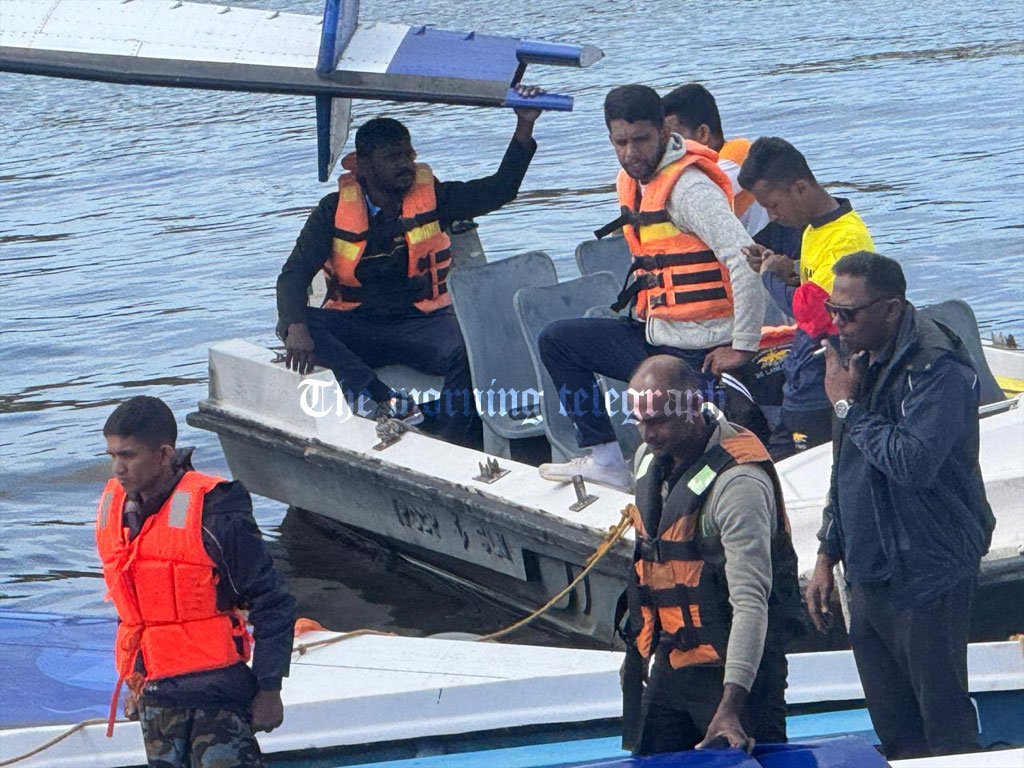
A shocking video from the crash site shows Indika Premadasa, Director of Flight & Ground Operations at Cinnamon Air, smoking a cigarette just feet away from the damaged aircraft at Lake Gregory, while recovery teams were actively engaged in hauling the aircraft from the water. Aviation safety experts say the conduct reflects a troubling and potentially criminally negligent disregard for ignition hazards in an active accident zone, potentially endangering recovery personnel and raising urgent questions about safety culture, regulatory oversight, and whether a far more serious disaster was avoided by sheer luck rather than effective risk control.
A shocking safety lapse captured on video at the crash site itself has now become the defining element of an aviation incident at Lake Gregory in Nuwara Eliya overshadowing the aircraft involved and triggering urgent questions about safety discipline, leadership conduct and regulatory oversight within Sri Lanka’s civil aviation sector.
The captured video footage shows behaviour at the scene that experts say should never occur at an active aircraft accident site, particularly one involving an amphibious aircraft where fuel-related risks are inherently elevated and often not immediately visible.

Incident Confirmed, But Attention Shifts to the Ground
The accident occurred earlier when an amphibious aircraft operated by Cinnamon Air experienced an issue during landing on the waters of Lake Gregory. The operator has confirmed that no passengers were on board at the time and that all crew members escaped without injury or casualties.
While the mechanical and operational aspects of the landing incident are now under assessment, attention has rapidly shifted away from the aircraft itself to the conduct observed at the incident site immediately after the event.
Director Seen Smoking at Active Accident Scene
Images and eyewitness accounts from the scene show Indika Premadasa, Director of Flight & Ground Operations at Cinnamon Air, engaging in conduct that aviation safety professionals have described as extraordinarily dangerous and professionally indefensible.
In the immediate aftermath of the accident, within what should have been treated as a controlled accident scene and ignition-restricted zone, Premadasa was seen smoking a cigarette in close proximity to the damaged aircraft and flicking ash and embers into the surrounding water.
Why This Matters: Fuel, Vapours, and Ignition Risk
In aviation accident response, the presence of residual fuel, volatile vapours, and unidentified leak points is presumed until conclusively ruled out. This precaution is even more critical for amphibious aircraft operating on water, where fuel dispersion and vapour behaviour are difficult to detect visually and risks may not be immediately apparent.
Introducing an open ignition source under such conditions is internationally classified as a critical safety breach, capable of escalating a controlled situation into a catastrophic fire or explosion within seconds; safety experts say the conduct observed at Lake Gregory represents a textbook example of converting a managed-risk environment into an active ignition hazard, effectively turning a survivable accident into a potential mass-casualty scenario.
“Disaster Was Narrowly Avoided”
Aviation professionals contacted by The Morning Telegraph described Premadasa’s behaviour as “deeply concerning” and “inexplicable.”
“That nothing happened does not mean the situation was safe,” said one senior aviation safety specialist, speaking on condition of anonymity. “It means a disaster was narrowly avoided.”
Observers note that the absence of fire or explosion appears to have been a matter of luck rather than safety management. In global aviation investigations, such near-misses are treated as warning signals, not successes, precisely because the next spark may not end without consequence.
Operator Response and Regulatory Role
Following the accident, Cinnamon Air’s parent company, Saffron Aviation, released a statement addressing the aircraft landing incident, confirming that:
- No passengers were on board
- All crew members are safe
- No injuries or casualties occurred
The company said it is cooperating with the Civil Aviation Authority of Sri Lanka, which is conducting an on-site assessment. It also noted that Cinnamon Air has operated since 2013, carried over 80,000 passengers, and has initiated an internal review.
However, the visual evidence emerging from the crash site has now complicated that narrative.
Leadership Conduct and Safety Culture Under Scrutiny
Safety experts stress that aviation culture is shaped not only by manuals, certifications, or historical safety records, but by how senior leaders behave during moments of risk. The conduct of Indika Premadasa the Cinnamon Air’s Director of Flight & Ground Operations at the accident site, they argue, sends a powerful signal to crews about what standards are genuinely enforced.
This episode has now placed renewed focus on the Civil Aviation Authority of Sri Lanka and what action they will take in this regard.
Regulatory Questions That Demand Answers
Did the act of smoking at the site constitute a breach of CAASL regulations, ICAO safety guidance, or the operator’s own Safety Management System (SMS) procedures? Were accident investigation officers or safety officials present at the scene at the time of the smoking incident, and if so, why was the behaviour not immediately stopped? Did the behaviour observed compromise the safety of recovery personnel, emergency responders, or investigators working in proximity to the aircraft? What corrective or disciplinary actions, if any, are mandated under CAASL regulations when senior operational personnel are observed violating fundamental safety controls?
In international aviation practice, investigators emphasize that outcomes matter less than behaviour. Safety systems exist to prevent worst-case scenarios, not to rationalize them after luck intervenes.
A Warning, Not a Footnote
What happened at Lake Gregory did not result in injury or loss of life, but for many watching closely, the video footage from the crash site has exposed deeper concerns about safety culture, leadership responsibility, and whether Sri Lanka’s aviation sector treats risk with the seriousness it demands. The real test now lies ahead: whether the smoking incident involving Indika Premadasa, Director of Flight & Ground Operations at Cinnamon Air, will be treated by the Civil Aviation Authority of Sri Lanka as a serious safety warning requiring firm action—or quietly dismissed as nothing more than good fortune, particularly given that the current Director General of Civil Aviation, Daminda Rambukwella, and Premadasa share prior Air Force backgrounds, raising questions about transparency, regulatory independence, and public confidence in the response.
In aviation, luck is not a safety strategy. Accountability is.