By Roshan Jayasinghe
A story for Journey People, our honored අමුත්තා (amuththā, guest) / விருந்தினர் (virundhinar, guest)
If you are reading this with a feeling to travel, let me offer you a Sri Lankan invitation.
Not an advertisement. Not a performance. Not a fantasy dressed up for a camera.
We would rather meet you as Journey People, human beings travelling across our shared Earth, coming to spend a small part of your life inside another home.
In our culture, a guest is an අමුත්තා (amuththā, guest) / விருந்தினர் (virundhinar, guest). A guest is received with respect, and often with a sense of divinity in the welcome itself. A guest is not a wallet. A guest is not a target market. A guest is a human being.
So if you arrive in Sri Lanka, we want to meet you first in that spirit, with civility, with warmth, and with dignity. And because respect must be real, not poetic, we also make this promise to those who visit us. We will speak truthfully about seasons, travel time, weather, standards, and realities, so your journey is built on clarity, not exaggeration.
Sri Lanka does not need to be sold as a miracle. It does not need to be dressed up as perfection. It is something more honest and more beautiful than that.
It is a living land on our treasure planet.

A welcome before anything else
If you arrive in Sri Lanka, you arrive the way all human beings arrive anywhere on Earth, carrying a body, a mind, a history, and a hope.
You might step off a plane tired. You might be excited. You might be unsure. You might have watched a hundred videos and still not know what is real until your feet touch the ground.
So let us begin properly.
When we speak of Journey People, we are speaking of those who travel with respect in their heart. People who come with curiosity, patience, and care. People who do not treat a country as a product, but as a living home on Earth. People who understand that when they enter another land, they are stepping into someone else’s daily life, not a stage built for entertainment.
If you come in that spirit, we want to meet you first as අමුත්තා (amuththā, guest) / விருந்தினர் (virundhinar, guest), an honored visitor, not as a transaction.
We do not begin with suspicion. We begin with civility, and we protect that civility through standards.
Respect first. Dignity first.
The land you are stepping onto
Sri Lanka is small enough to cross in hours, and layered enough to take a lifetime to understand.
In one journey, you may feel ocean salt in the morning and highland cool by afternoon. You may pass from rain fed green into dry land that teaches humility. You may watch waterfalls fall into fertile valleys, and later see ancient reservoirs and tanks holding life where the sun can be hard.
Beaches and mountains, yes. Also rivers, lagoons, forests, dry plains, tea hills, cultivated land, and the stubborn intelligence of nature that keeps returning.
If you come, come ready to meet more than scenery. Come ready to meet a living system.
The living tree, roots, trunk, branches, leaves
We are best understood not as a list, but as a whole, like a living tree.
Our roots are memory. Ancient water wisdom. Irrigation tanks and canals. Trade routes. Living faiths, temples, kovils, mosques, churches, still shaping ordinary days.
We also speak in many tongues. Sinhala and Tamil live here as native languages, and English moves through our daily life as a bridge language shaped by history and education. You will hear all three across the island, sometimes in the same conversation. This multilingual life is not only about communication. It is woven into our manners, our clothing, our food, and our way of carrying ourselves. It appears in how we greet elders, how we step into a home, how we dress when we enter sacred places, how we offer a cup of tea, how we share a meal without making it a performance.
It also lives in our religious beliefs and practices, in the folk stories told from one generation to the next, and in the festivals we celebrate, where the streets, the kitchens, the drums, the lights, and the prayers all remind us that culture is not an exhibit. Culture is life continuing.
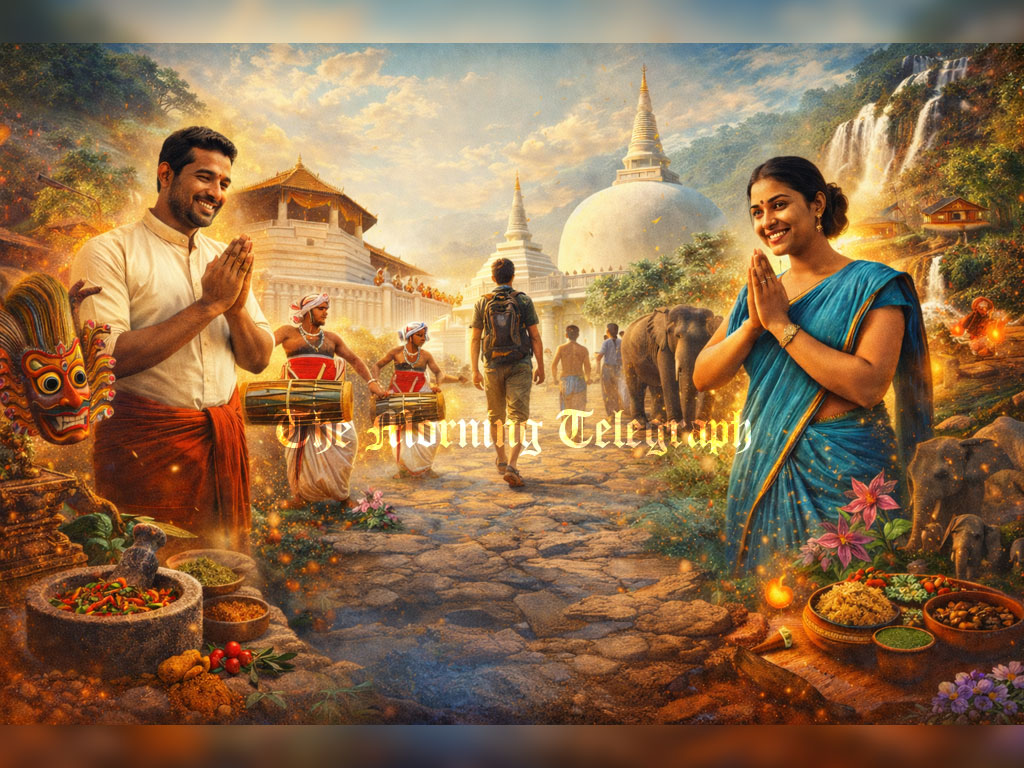
Our trunk is resilience. Soil and water. Agriculture and fishing. Work and daily life. The quiet dignity of people who keep going, the fisher at dawn, the farmer in heat, the tea worker in mist, the market vendor, the bus conductor, the home where the first act is still to offer you a seat.
Our branches are expression. Music. Traditional drumming. Traditional dancing. Mask traditions. Handcrafts. Architecture. Art. Also the modern culture of today, because we are alive now, not frozen in yesterday. Dancers whose footwork meets the drum like language. Craftspeople carving masks until wood becomes story. Weavers, potters, woodworkers, lacquer workers, batik artists, hands carrying lineages forward.
Our leaves are what you touch. Coast and mountain. Waterfall and dry land. Forest and lagoon. Birds and elephants. Rain on tin roofs. Temple bells. Market calls. The ocean keeping time.
To meet Sri Lanka properly, you do not collect attractions. You enter the whole tree.
There is a moment that happens when a person truly arrives.
Not when the passport is stamped. Not when the luggage is collected. Not even when the first photo is taken.
It happens when the nervous system softens.
When a cup of tea is placed in your hand without ceremony.
When a stranger points the right way without asking what you will pay.
When you hear a drum in the distance and realise it is not a performance for you, it is life continuing for itself.
When you smell rain on earth and remember you are not watching the planet, you are inside it.
This is why we call you Journey People.
Because the real journey is not sightseeing. The real journey is meeting Earth through another home.
The island you can taste, the living table
Food is one of the deepest ways to meet a land.
Sri Lanka is not a menu. Sri Lanka is a living table.
It begins in markets at dawn. It lives in street tea and short eats. In hands grating coconut. In spices tempered slowly. In clay pots and stone tools carrying old knowledge forward. In coastal fish hauled in before sunrise, and inland foods shaped by rivers and tanks. In hill country tea offered not as luxury, but as welcome.
Our cuisine carries many fingerprints, Sinhalese, Tamil, Muslim, Burgher, along with the memory of ocean routes that brought exchange and influence. It includes festival foods, sweets, bakery culture, daily cups, and the simple truth that the kitchen is not content. The kitchen is life.
If you come, do not only eat. Ask. Listen. Learn the story behind what you taste.
Music, dance, sport, the heartbeat of a real place
A land is not only seen. It is heard.
Music here is not decoration. It is memory and motion, ritual rhythm, folk song, drumming lineages, and the modern sounds of today too.
Traditional dancing must be spoken of properly because it is not invented for the camera. It is discipline and lineage. The costume holds meaning. The drum is not background. It is the spine of the moment. When you witness it with respect, you do not feel like you watched entertainment. You feel like you saw a culture breathe.
Sport lives here too, not as spectacle, but as belonging. Village cricket. School grounds. Beach games under salt wind. Laughter, teasing, shared snacks, community woven by play.
These are not extras. These are signs that a land is alive.
Dignified earning and conscious hosting
Now let us speak plainly about money, because money is part of travel.
The world is now visual and competitive. Travel platforms, operators, agencies, influencers, everyone is trying to earn. And yes, we must earn too. Drivers, guides, cooks, hotels, homestays, craftspeople, performers, restaurants, farmers, fishermen, transport workers. This is an ecosystem of livelihoods. A country must earn too.
But income is necessary, and dignity is non negotiable. We earn to stand, not to sell our soul.
When income becomes the only motive, hosting becomes extraction. The guest becomes a wallet. The land becomes a backdrop. Wildlife becomes a prop. Craft becomes cheap souvenir culture. Truth becomes negotiable. Corruption starts to look normal.
That is not civilized earning.
What we need is dignified earning. Fair pricing. Truthful descriptions. Clean standards. Ethical behavior. Pride in real service. A refusal of corrupt intent and disrespectful ways.
This is the conscious, correct way.
Journey styles, not human ranks
We also need to correct language that quietly divides human beings.
“Budget” and “premium” may sound harmless, but they can turn welcome into hierarchy. In our way, a guest is a guest, an අමුත්තා (amuththā, guest) / விருந்தினர் (virundhinar, guest).
Yes, people travel with different budgets. That is natural. But the welcome should never be priced.
So let us speak in journey styles, not human ranks. A simple journey. A comfort journey. A deeply guided journey. A family journey. A slow journey. An independent journey.
Different comforts, same dignity.
Our motto, in Sinhala, Tamil, and English
අමුත්තාව ගරු කරමු (Amuththāva garu karamu, Let us honor the guest) / விருந்தினரை மதிப்போம் (Virundhinarai mathippom, Let us honor the guest).
වෙනස් පහසුකම්, එකම ගෞරවය (Wenas pahasukam, ekama gaurawaya, Different comforts, the same dignity) / வசதிகள் வேறு, மரியாதை ஒன்று (Vasathigal veru, mariyadhai ondru, Different comforts, the same dignity).
A graceful invitation
So here is our invitation, plain and wholehearted.
Come as Journey People. Come not to collect attractions, but to meet a living land, roots, trunk, branches, leaves. Come for wet and dry, mountain and coast, waterfall and wide sky. Come for music, drumming, traditional dancing, masks, crafts, architecture, art. Come for sport and laughter and ordinary afternoons. Come for the living table. Come for the people.
And from the moment you arrive, for the days you stay, we will do our best to host you in the spirit of අමුත්තා (amuththā, guest) / விருந்தினர் (virundhinar, guest), as honored visitors, with respect to our land, and respect to our shared planet and all its glory.
ආයුබෝවන් (Ayubowan, May you live long, welcome) / வணக்கம் (Vanakkam, Greetings, welcome).
Welcome.
Author’s note
I wrote this as a reminder, not as a complaint.
Sri Lanka needs income. People need work. Those who provide service and accommodation do honorable labour. There is nothing wrong with earning. The problem begins when earning becomes the only motive and dignity is sacrificed.
My hope is simple. That we grow a culture of conscious hosting, where the guest is respected, the worker is respected, the land is respected, and truth is not negotiated. Truth includes the beauty, and it also includes the seasons, the pace, the standards, and the realities that allow a journey to be safe and clear.
In the end, this is not only about travel. It is about the kind of people we choose to be when the world is watching and when nobody is watching.
If we host with dignity, we do not only uplift Sri Lanka. We uplift the idea of travel itself as something civilized, human, and worthy of our living Earth.
With honor
About the Author
Roshan Jayasinghe is a writer and observer of human systems. His work explores the gap between man made constructs and lived humanity, with a focus on how economics, trade and everyday choices intersect with questions of fairness, responsibility and inner alignment. Through essays for publications in The Morning Telegraph, he aims to remind readers that they are not passengers in a fixed machine, but active custodians of a shared world.