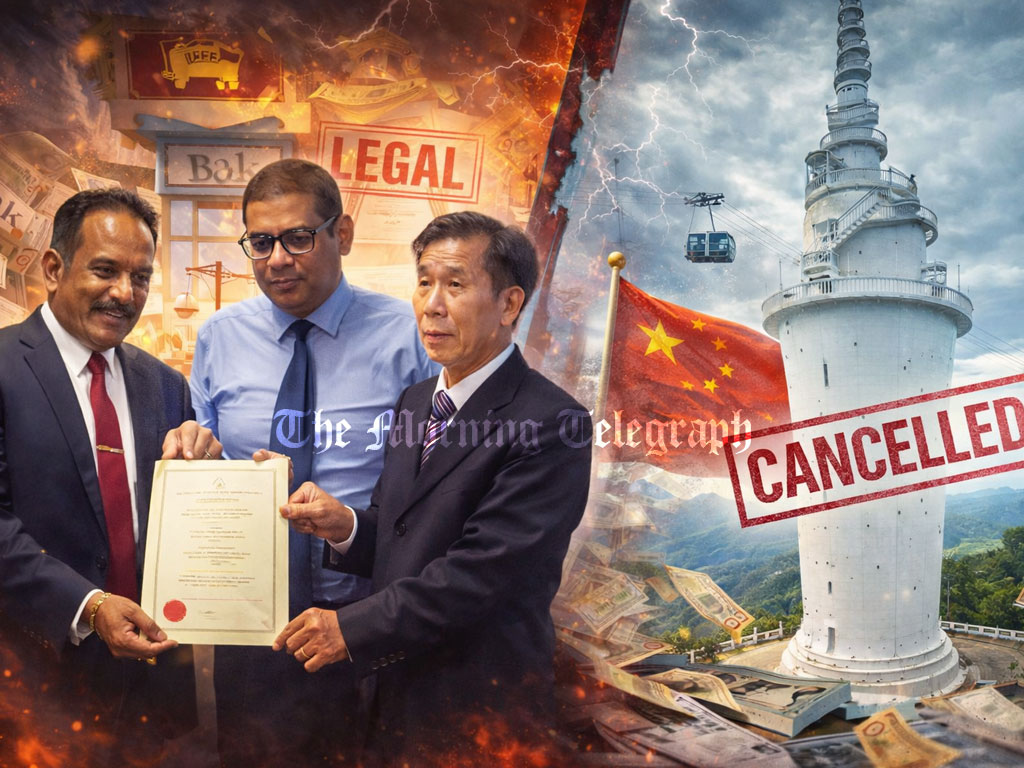
A high profile Chinese backed investment has exited Sri Lanka, citing regulatory paralysis, official obstruction, and investor insecurity, while warning of impending international legal action.
Chinese investor Amber Adventures Private Limited has decided to withdraw from the Ambuluwa Cable Car project, widely regarded as Sri Lanka’s first cable car development, delivering another setback to the country’s foreign investment landscape.

In a formal written notice sent to the Board of Investment of Sri Lanka on January 13, the company stated that persistent obstacles within Sri Lanka’s regulatory framework and what it described as arbitrary actions by government officials compelled it to abandon the project. The company emphasized that these conditions made continued participation commercially and operationally impossible.
Amber Adventures pointed specifically to the Central Environmental Authority’s decision to suspend construction activities, despite prior approvals granted by relevant technical institutions. According to the company, this suspension was triggered by complaints circulated on social media rather than by verified technical or environmental findings. The company said such actions undermined regulatory certainty and investor confidence.
The Ambuluwa Cable Car project was launched in 2022 during Sri Lanka’s economic crisis through a consortium involving investors from Sri Lanka, China, and the United States. The total investment value was estimated at US$12.75 million, with approximately US$3.5 million already invested, the company confirmed.
The project was structured on a build, operate and transfer model. Under the agreement, the cable car system, valued at over Rs. 5 billion, was to be handed over to the Sri Lankan government free of charge after an operational period of 13 years.
Amber Adventures noted that all required approvals had been obtained, including Cabinet clearance and authorizations from the Urban Development Authority, the Ministry of Defense, and the Central Environmental Authority. The company also rejected claims that the project posed a landslide risk, stating that inspections conducted by the National Building Research Organization following recent cyclone conditions had confirmed the stability of the site.
Citing repeated disruptions and regulatory uncertainty, the company said the project had become commercially unviable. It also revealed plans to pursue international legal action to recover losses, accusing the Board of Investment of failing to protect investors in an unpredictable policy environment.
Amber Adventures now joins a growing list of international companies that have exited Sri Lanka since 2022 amid economic instability and policy inconsistency. Previous departures include Japan’s Mitsubishi, France’s Decathlon, India’s Zomato, and the Adani Group, which withdrew from a disputed wind power project.
Economic analysts warn that this latest withdrawal sends a troubling signal to global investors about investment security and regulatory reliability in Sri Lanka.