A devastating UN brief exposes how wartime sexual violence remains unpunished, deeply entrenched, and continues to destroy lives long after Sri Lanka’s war officially ended.
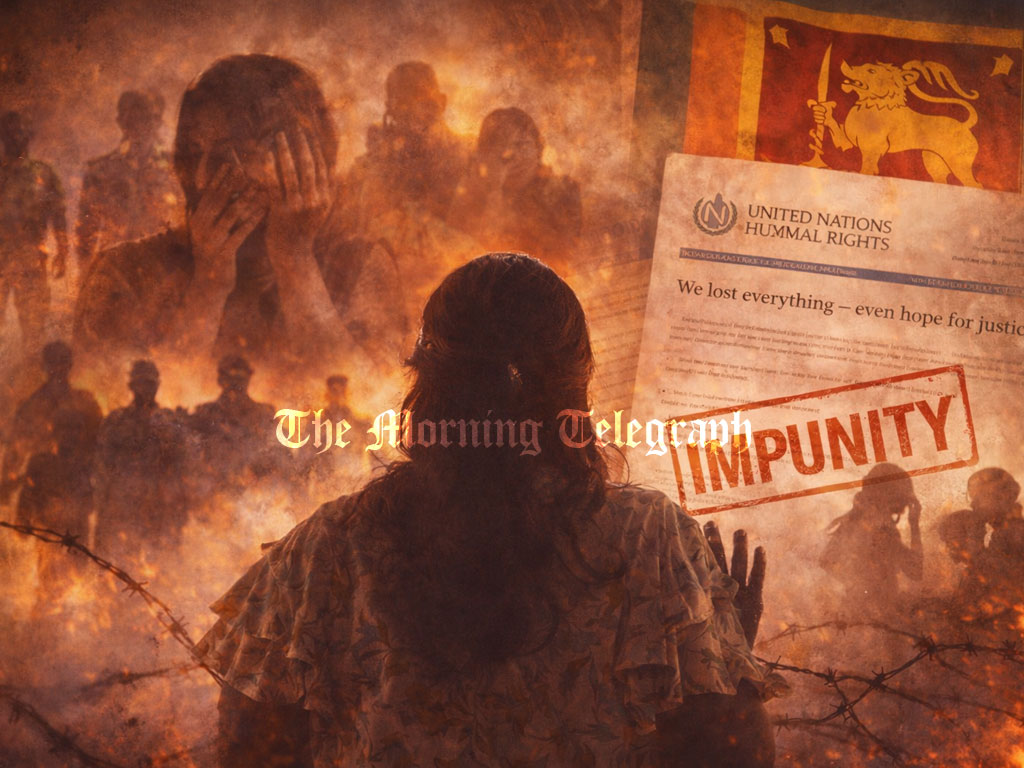
The United Nations Human Rights Office has issued one of its strongest and most unsettling warnings yet on Sri Lanka, concluding that conflict-related sexual violence remains endemic, systematically ignored, and buried beneath what it describes as a “legacy of impunity” that continues to devastate survivors more than fifteen years after the war officially ended. The findings, released under the stark title “We lost everything – even hope for justice,” make clear that this is not merely a historical account of wartime abuses, but a piercing indictment of the present. The report exposes how denial, inaction, intimidation, and institutional failure have ensured that sexual violence has never truly ended for those who endured it.

Drawing on more than a decade of monitoring and reporting by the UN Human Rights Office, alongside extensive consultations with survivors, gender-based violence specialists, medical professionals, and civil society groups, the Brief dismantles the widely promoted narrative that Sri Lanka has “moved on” from its civil war. Instead, it concludes that the absence of accountability, acknowledgment, and reparations for gross human rights violations has created an environment where trauma is prolonged, justice remains unreachable, and fear has become a permanent part of daily life. As the document states plainly, “the lack of accountability, acknowledgment and reparations for gross human rights violations and wartime crimes has created a legacy of impunity that continues to shape the lives of survivors today.”
Although the war ended in 2009 and is often presented by the Sri Lankan state as a closed chapter followed by peace and development, the UN findings reveal a very different reality. For many survivors of sexual violence, the end of hostilities did not mark the beginning of healing, but the start of a long and exhausting struggle with physical injury, psychological collapse, and social isolation. The report records that “many victims from the conflict which ended in 2009 continue to suffer chronic physical injuries, infertility, psychological breakdowns, and suicidal thoughts.” These are not abstract consequences or distant echoes of war. They are lived experiences that continue to unfold quietly, often behind closed doors, as survivors face stigma, disbelief, threats, and isolation within their own communities.
What makes the UN’s conclusions especially damning is its clear finding that sexual violence during the conflict was not an incidental by-product of war, but a deliberate and systematic tool of abuse, control, and humiliation. Survivors described acts of “rape, sexual mutilation, forced nudity and public degradation” that went far beyond physical assault. Many believed these crimes were “intended to cause lasting trauma and break down communities.” One survivor’s testimony, quoted directly in the report, strips away any illusion of closure or recovery: “Sexual violence is a torture that never stops.”
The Brief emphasizes that both women and men were subjected to these crimes, directly challenging deeply entrenched assumptions that sexual violence in conflict is exclusively a women’s issue. Male survivors, in particular, face extreme stigma and invisibility, compounded by cultural taboos that render their suffering unspeakable. The UN notes that survivors and their representatives consistently described “an enduring climate of surveillance, intimidation and harassment,” contributing to chronic under-reporting and what the paper calls “the near-absence of effective remedies.” In such an environment, speaking out is not merely emotionally risky, it can be physically dangerous.
Crucially, the report finds that this climate of fear has not faded with time. Instead, militarisation and emergency legal frameworks have sustained conditions in which gender-based violence continued to be reported even after the war. According to the Brief, “militarisation and emergency legal frameworks have created an environment in which gender-based violence, including sexual violence, continued to be reported after the conflict.” The implication is stark. The structures that enabled abuse were never dismantled, and in some cases were reinforced, allowing fear and silence to harden into long-term social conditions.
Perhaps most controversial is the UN’s assertion that Sri Lanka is not merely failing morally, but breaching its binding legal obligations under international law. The paper reminds readers that “sexual violence in conflict constitutes a serious violation of international law, which may amount to war crimes or crimes against humanity.” It further stresses that Sri Lanka is “legally obligated, under multiple international treaties and commitments, to prevent, investigate, and prosecute such violations and ensure reparation for survivors.” This is not framed as an appeal for goodwill or compassion, but as a demand for compliance with obligations the state has already accepted.
Despite these obligations, accountability remains virtually non-existent. Survivors interviewed by the UN described a justice system that is inaccessible at best and openly hostile at worst. Police complaints frequently lead nowhere, investigations stall for years, and prosecutions are vanishingly rare. In some cases, survivors reported being questioned in humiliating ways or warned against pursuing cases altogether. The result, as the Brief concludes, is a system that reinforces silence rather than truth, fear rather than healing, and impunity rather than justice.
The damage, the UN warns, does not stop with individual survivors. The report documents how stigma “extends to survivors’ families” and how “children born of rape have been labelled and discriminated against.” These children, who bear no responsibility for the crimes that led to their birth, are nonetheless marked by social exclusion, suspicion, and shame. Entire communities, the report finds, “remain fractured by silence, fear, and unresolved trauma.” In this sense, sexual violence has functioned not only as an attack on individual bodies, but as a long-term assault on social cohesion itself.
The UN’s intervention is particularly pointed in its insistence that reconciliation without truth and accountability is a hollow exercise. UN Human Rights Chief Volker Türk states that “recognition, truth, accountability and reparations are critical to restoring dignity to survivors, and advancing reconciliation and healing in Sri Lanka.” This directly challenges the Sri Lankan government’s long-standing preference for forward-looking narratives that avoid confronting state responsibility. Without acknowledgment, the paper suggests, reconciliation becomes a slogan rather than a lived reality for those who continue to suffer.
The Brief calls on the Government of Sri Lanka to take “immediate and concrete steps” that go far beyond symbolic gestures. Among its most significant demands is that the state must “publicly acknowledge past sexual violence committed by State forces and others, and issue a formal apology.” Such an apology would represent a seismic shift in official discourse, one that many survivors have waited decades to hear. The report also urges the government to implement “survivor-centred reforms across the security sector, judiciary and the legal framework,” to establish an independent prosecution office, and to ensure access to “psychological and social support.”
While these recommendations are not new, the urgency with which they are presented reflects a growing impatience within the UN system. The paper concludes that Sri Lanka has already made commitments to advance domestic accountability, but has repeatedly failed to follow through. Each delay, the UN warns, deepens the harm and entrenches distrust. Survivors are left with the bitter sense that justice is perpetually promised but never delivered.
The title of the Brief, “We lost everything – even hope for justice,” captures this exhaustion with brutal clarity. It is a statement not only of loss, but of abandonment. For many survivors, hope has been eroded not solely by the original violence, but by years of denial, deflection, and impunity. The UN’s warning is stark: without decisive action, this erosion will continue, with profound consequences for Sri Lanka’s social fabric, governance credibility, and international standing.
In exposing the ongoing reality of conflict-related sexual violence, the UN Human Rights Office has shattered the comfortable fiction that Sri Lanka’s war crimes belong solely to the past. The report forces an uncomfortable reckoning that peace built on silence is fragile, and that nations cannot outrun the crimes they refuse to confront. As long as survivors remain unheard and perpetrators remain unaccountable, sexual violence in Sri Lanka will not be a closed chapter, but an open wound that continues to bleed across generations.