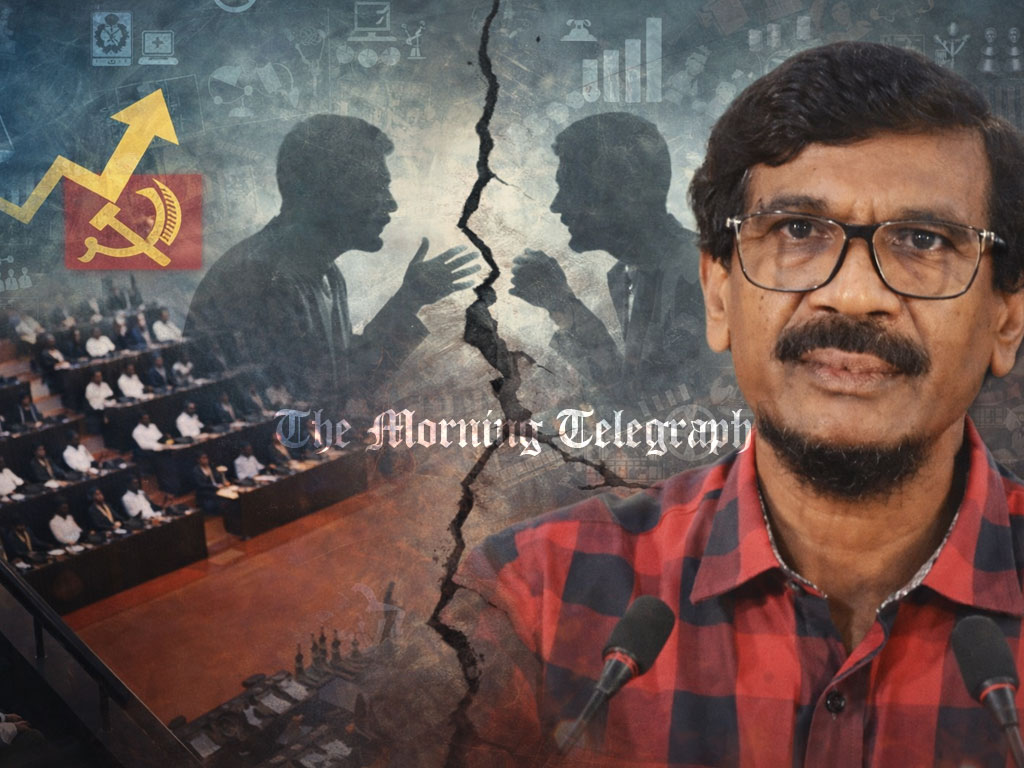
A fierce internal struggle within the JVP is pushing the party toward a historic break with tradition, as growing factional battles and global alignments fuel calls to bring Tilvin Silva into Parliament.
Former Provincial Councilor Waruna Rajapaksa says a heated political debate is unfolding over the possible entry of JVP General Secretary Tilvin Silva into Parliament, a move that would mark a major turning point in the party’s internal power structure. According to him, this discussion has gained momentum following a news item circulating on social media, which suggests that serious dialogue on the matter is taking place within the party itself.

Rajapaksa points out that since 1994, the JVP has followed a firm tradition in which the party’s General Secretary does not sit in Parliament. The reasoning behind this practice is that the General Secretary holds the most powerful position within the party, allowing him to manage party affairs independently and exercise authority outside the parliamentary framework. In that context, Tilvin Silva’s entry into Parliament would represent a decisive break from a long established organizational principle of the JVP.
He attributes this shift to deepening internal conflicts and the emergence of three distinct factions operating within the party. These internal divisions, he says, have altered the balance of power and created conditions for a possible restructuring of leadership roles.
Rajapaksa identifies the first group as the Kelaniya faction, led by President Anura Kumara Dissanayake, along with Vijitha Herath and Nalinda Jayatissa. This faction, he says, is focused on maintaining party unity and managing internal tensions in a controlled manner. The second group is the Pelawatte faction, which consists largely of senior and former JVP activists, including Tilvin Silva and Bimal Ratnayake. This faction is described as more assertive and ideologically rigid in its approach.
The third group is referred to as the Liberal Harini faction, which includes Prime Minister Harini Amarasuriya and Mr. Lalkantha. According to Rajapaksa, tensions between this faction and the Pelawatte faction have intensified in recent months. He claims that Mr. Lalkantha has been strongly defending the Prime Minister, making direct comparisons that even place President Anura Kumara Dissanayake under challenge.
Rajapaksa further argues that these internal divisions are not limited to domestic politics but have begun to carry geopolitical implications. He states that the group aligned with President Anura Kumara Dissanayake is perceived as maintaining close relations with the United States, while the Pelawatte faction led by Tilvin Silva is believed to favor a China friendly policy orientation.
He also refers to reports that during the recent surprise visit by the Chinese Foreign Minister to Sri Lanka, meetings were scheduled not only with government leaders but also separately with representatives of the Pelawatte faction. This, he suggests, reflects the growing international relevance of internal JVP dynamics.
Rajapaksa recalls that an earlier attempt by the Pelawatte faction to appoint Bimal Ratnayake as Prime Minister failed due to opposition from figures such as Mr. Lalkantha and Nalinda Jayatissa. In the aftermath of that setback, he says, the Pelawatte faction concluded that a powerful and unchallengeable figure was needed within Parliament.
It is against this background of factional rivalry, leadership struggles, and geopolitical alignment that the discussion to bring Tilvin Silva into Parliament has emerged, according to Waruna Rajapaksa’s analysis.