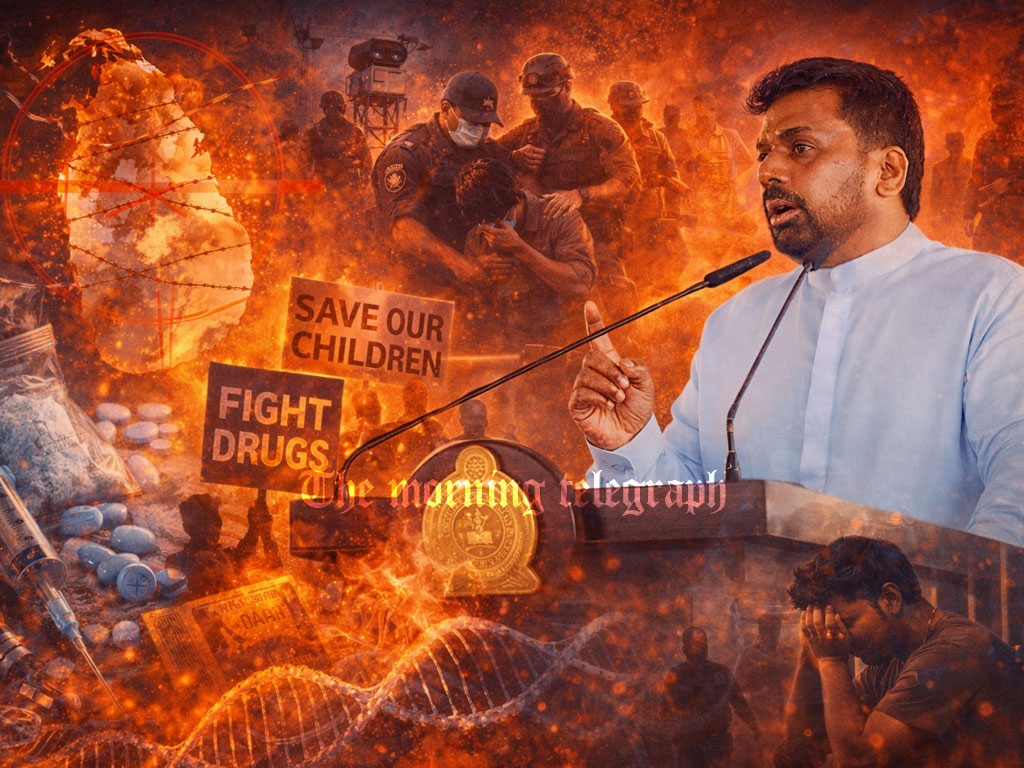
From war-torn fears to a new enemy poisoning youth, the President vows an irreversible national crackdown on drugs while calling on citizens to stand together as one defence network.
President Anura Kumara Dissanayake has warned that parents in Sri Lanka’s Northern Province, who once lived in fear of losing their children to war, are today forced to live in fear of losing them to drugs. Declaring that the national campaign to eradicate the drug menace will be carried out vigorously and without retreat, the President said the fight against drugs would cut across all divisions of class, ethnicity, region, and religion, and would not become a backward movement under any circumstances.

The President made these remarks while participating in the Northern Provincial programme of the Ratam Ekata National Campaign to Eliminate the Menace of Drugs, held this afternoon at the Jaffna College of Technology playground. He also presided over the presentation of awards to members of the tri forces and the police in the Northern Province who have made active contributions to recent raids targeting drug networks.
Speaking further, President Dissanayake said that the Ratam Ekata programme was not limited to eradicating drugs alone. He stressed that it was also a national effort to rehabilitate children who have fallen victim to drugs, provide them with vocational training, and transform them into productive citizens who can contribute meaningfully to their villages and to the country as a whole.
He emphasized that, for the first time, Sri Lanka now has a government that is acceptable to both the South and the North. While nationalist groups that have lost power are attempting to revive nationalism in isolated pockets, he made it clear that no such trend would be allowed to rise again. He also noted that Rs. 5,000 million had been allocated last year for the development of rural roads in the Northern Province, with a substantial allocation made again this year. He urged political authorities and state officials to ensure that these funds are properly utilized so that people receive the development benefits they deserve.
Addressing the gathering, the President said he had visited Jaffna on many occasions, but described this event as particularly significant because it marked a united effort to defeat the drug menace that is engulfing both youth and state institutions. He said Sri Lanka has aspirations to become a developed nation, build a strong economy, and establish unity, brotherhood, and trust among its people. However, he warned that all these aspirations are under threat from what he described as a poisonous drug scourge spreading without distinction between rich and poor, urban and rural, Sinhalese and Tamil.
He observed that parents across the country raise their children with hope, only to see those hopes shattered by drugs. According to the President, the vast wealth generated by drug trafficking has infiltrated parts of the state machinery. He said drug operations have even been conducted from within prisons, and acknowledged that while many police officers perform their duties efficiently, some have become victims of this illicit trade. Weaknesses within Customs, Motor Traffic, and Immigration and Emigration departments have also been exploited, with several public officials arrested in connection with drug-related activities.
“If children have become victims, and if the public service has become a victim, we must ask where we are heading as a country,” the President said, stressing that this movement must be defeated decisively. He recalled how drug traffickers once enjoyed political protection, with some politicians even adopting drug-related nicknames. Giving a firm assurance, he said the people have now built a government under which drug dealers will never again receive political protection.
He warned officials involved in drug-related corruption that they have only two options: abandon such dealings or resign from their duties. He pledged that drug dealers would have no space to operate alongside the underworld, and that the state machinery would be strengthened and cleansed to support effective drug raids. At the same time, he called on ordinary citizens to play their part, emphasizing that criminals should fear the people, not the other way around.
Reflecting on the Northern Province, the President said that youth here were once destroyed by war, leaving parents in constant fear. In the years following the end of the conflict, these same areas are now becoming victims of drugs. He said parents are pleading with the government to save their children, and assured them that the political leadership is firmly determined to defeat this menace, with the full support of the people.
He acknowledged collective responsibility, stating that society has failed to protect its children. He argued that it is meaningless to arrest only young users while leaving those at the top of the drug networks untouched. These networks, he said, must be dismantled entirely. Rehabilitation, he emphasized, is a central pillar of the programme. Rehabilitation centres are being established across the country, and parents are encouraged to hand over drug-addicted children, with the promise that they will be trained in professions and returned as productive citizens.
The President reaffirmed his commitment to eliminating armed criminal gangs and drug syndicates without yielding to intimidation. He reiterated the vision of a country where Sinhalese, Tamils, and Muslims live in brotherhood, noting that decades of hatred and anger have yielded nothing but disaster. He rejected any resurgence of racism, stating that the nation must move forward with trust, compassion, and unity.
He concluded by assuring the people that the trust they have placed in this government will not be broken. For the first time, he said, Sri Lanka has a people’s government, respected across the North, South, and East. He invited all citizens to work together to build a good country, using allocated development funds effectively to uplift villages and improve lives swiftly.
The event was attended by ministers, provincial leaders, senior officials, security force commanders, religious leaders, and members of the public, reflecting broad institutional and community support for the anti drug campaign in the Northern Province.