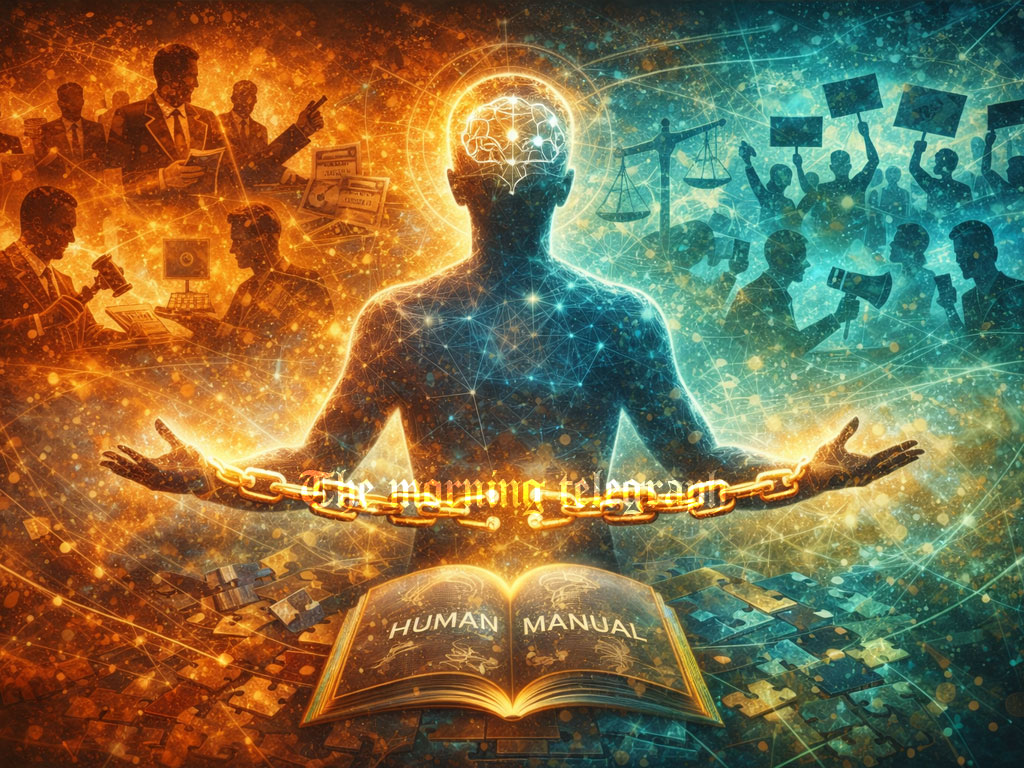
The Human Manual as the True Foundation of Law, Order, Power, and a Livable World
by Roshan Jayasinghe
There is a moment in every era when the world reveals itself.
Not through a war or a disaster, but through something quieter, something that should be ordinary, yet somehow exposes the whole structure beneath our lives.
A headline.
A donation.
A policy fight.
A small public story that points to a much larger private truth.
We call these moments politics. We call them economics. We call them “the news.”
But what they really are is a mirror.
A mirror showing us what we have become willing to accept.
Because what is happening in the world today is not a mystery of complexity. It is a mystery of consciousness. It is the gradual forgetting of something so basic that it feels almost embarrassing to say it out loud:
Human life cannot remain dignified when the systems governing it are not governed by humanity.
We keep reaching for stronger law, stronger order, stronger control, stronger leaders, hoping something external will repair what is breaking.
But what is breaking is not only policy.
What is breaking is the human operating code.
And when the human being is not guided by an inner manual, by restraint, empathy, fairness, and truth, then any system, no matter how intelligent on paper, becomes an instrument for appetite.

That is what this is about.
Not a future prediction.
A present moment recognition.
I saw the headline and something in me refused to blink.
A billionaire placing serious money behind the effort to defeat a tax aimed at billionaires. Not a gift to life, but a defense of accumulation. A protective wall built around a pile.
And in that moment I understood something many of us keep postponing as if it belongs to the future.
This is not about the future.
This is about the present moment. Every present moment.
Because the system that hollows out human dignity does not arrive like an invasion. It arrives like an update. Quietly. Legally. Professionally. With clean fonts and confident language.
And the real danger is not only what powerful people do.
The real danger is what ordinary people learn to tolerate… and then call normal.
If we are waiting for a someday to wake up, we are already asleep.
We Keep Debating the Wrong Starting Point
We keep arguing about law and order.
We keep arguing about power.
We keep arguing about government control, rights, freedoms, markets, taxes, crime, borders, endless debate, endless noise.
And all the while, we are ignoring the one thing that makes every one of those arguments either meaningful or meaningless:
The human being.
Because law without a human manual is force with paperwork.
Government without a human manual is management of bodies.
Power without a human manual is appetite with authority.
The world is not suffering from a lack of policies.
The world is suffering from a lack of human operating knowledge.
That is the missing link.
All Constructs Are Human Knowledge Made Visible
Here is the point we miss while we fight about systems:
Money, markets, corporations, profit models, interest, debt, lobbying, campaign funding, tax codes, even the way we define “success,” none of these are laws of nature.
They are arrangements.
Human agreements.
Human interpretations repeated until they become structures.
Which means the real battlefield is not only “out there.”
It is the human mind.
And I believe the most important thing we have blindly failed to see is this:
The capacity of the human mind is the freest force that exists in present life.
Not free in the sense of careless,
free in the sense of creative, corrective, and endlessly capable of recognizing what is true.
When the mind is clear, it can hold a society together without needing heavy control.
When the mind is captured, society fragments into parts that can be managed, marketed to, and manipulated.
The Soft Theft We Call Normal
There is a kind of theft that doesn’t need to kick down your door.
It waits until you are tired. Busy. Distracted. Trying to keep your life together.
Then it steps in politely and says: “This is just how it works.”
It does not always begin with money.
It begins with something deeper:
The conversion of human life into a resource.
The conversion of attention into a commodity.
The conversion of dignity into a transaction.
The conversion of need into leverage.
And once that conversion happens, everything else becomes easier to justify.
This is why so many constructs now feel “broken apart,” each one with its own origins and logic, each one defended as necessary, each one operating like a silo.
But the fragmentation is not neutral.
Fragmentation is the method.
A fragmented mind cannot see the whole.
And if the whole is not seen, the whole cannot be corrected.
How Unchecked Profit Became a Permission Slip
This is where profit enters, not as a villain, but as a test.
Profit in itself is not the enemy. Value should be rewarded. Effort should be compensated. Risk should be honored.
But here is the line we stopped drawing:
When profit becomes unlimited while human life remains finite, the relationship becomes immoral.
A living person cannot be an endless resource.
And once a society quietly accepts the idea that profit has no ceiling, something subtle happens:
need becomes a marketplace.
necessity becomes leverage.
and dignity becomes negotiable.
That is when profit stops being profit.
It becomes extraction.
And when a system allows limitless extraction from essential needs, it is no longer a market.
It is a toll booth on existence.
Governance Was Never Meant to Protect the Pile
Authority was not granted so the pile can grow without restraint.
Authority was given by people, for people, to keep life workable, fair, and dignified. To protect the commons. To prevent predation from becoming policy.
And here is the simplest truth we have allowed to become controversial:
If something is essential to living, the profit on it must have limits.
Not because success is evil.
Not because ambition should be punished.
But because essentials are not hunting grounds.
Food. Water. Shelter. Healthcare. Education. Energy. Mobility. Communication. Basic dignity.
A society that turns essentials into unlimited profit opportunities is not advanced.
It is organized predation.
The Mirror We Avoid
We should not pretend this lives only in boardrooms.
Because the machine does not survive on billionaires alone.
It survives on ordinary consent.
We participate when we admire predation as brilliance.
We participate when we worship wealth as proof of worth.
We participate when we defend the pile because we secretly hope to sit on a pile one day.
We participate when we call exploitation strategy.
We participate when we normalize cruelty as strength.
The system’s greatest trick is making people protect the structure that diminishes them, by dangling a fantasy:
One day you might be the winner, so defend the rules now.
Greed is not only at the top.
Greed is a human blind spot.
And blindness doesn’t announce itself as blindness.
It announces itself as realism.
The Moment We Must Return To
This is where we tend to lose the thread.
We start blaming politics. Then we blame business. Then we blame “the other side.” Then we blame history. Then we blame the future.
But the only place the world can be corrected is here.
Now.
The present moment is not a passing second.
It is the workshop of human life.
We are not watching life from a distance.
We are in total involvement, every present moment.
Every time we speak, we shape it.
Every time we buy, we shape it.
Every time we accept or tolerate, we shape it.
Every time we stay silent, we shape it.
Every time we call something normal, we shape it.
So the work is not to dream about a better future while repeating unconscious patterns in the present.
The work is to return to the present moment and ask:
What is happening now?
What is true now?
What is being normalized now?
What is harming human dignity now?
What needs to be improved now?
And then to act, not dramatically, but consistently, so the present moment becomes cleaner than the one before it.
This is not a one-time fix.
This is an everlasting practice of human correction.
The Questions We Must Start Asking
If we are serious about restoring balance, we have to stop treating today’s structures as if they descended from the sky.
They were built.
By humans.
With motives.
Under pressures.
Inside certain time periods.
For certain outcomes.
So one of the most important acts of clear seeing is this:
We must question the constructs.
Not with paranoia.
With maturity.
Not with cynicism.
With responsibility.
Because every construct that governs human life, money, profit models, corporations, lobbying, campaign funding, tax systems, insurance, credit, rent, interest, debt, growth, even the definition of success, was imagined by someone, negotiated by someone, enforced by someone, and normalized by everyone else.
Which means it can be reimagined.
But only if we ask the questions we’ve avoided:
Who created this construct?
Who benefits most from it?
What human weakness does it feed on?
Does it serve life, or does life serve it?
What does it turn humans into, citizens or customers, souls or numbers?
How does it flow into the present moment?
Even if it began with good intentions, what has it become now?
What happens if we keep it unchanged for another generation?
These are not academic questions.
These are survival questions.
The Manual Must Evolve, But Not Drift
Yes, the human manual must be ever evolving.
But evolving does not mean drifting.
Evolving means correcting.
Correctness is recognized through practice.
If a principle produces more dignity, more sanity, more fairness, more harmony, it belongs in the manual.
If it produces humiliation, division, desperation, and predation, it fails the human test, no matter how legal, efficient, or profitable it appears.
So the manual must be refined continually by a standard most people can feel immediately:
Does this reduce human-made suffering?
Does this protect the weak from the strong?
Does this prevent the conversion of life into extraction?
Does this strengthen human dignity in the present moment?
This is how we evolve without losing the soul.
The Human Code We Already Recognize
There is a moral code most human beings recognize without being taught.
This is our shared inheritance.
Call it conscience.
Call it decency.
Call it the inner law.
The human manual, at its core, is simple:
Do not profit from suffering.
Do not exploit what you did not build alone.
Do not trap people with what they cannot refuse.
Do not confuse legality with morality.
Do not confuse wealth with worth.
Do not monetize vulnerability.
Do not glamorize greed.
Do not normalize cruelty.
Do not trade your conscience for convenience.
Do not participate in harm and then pretend innocence.
If we govern society by this, we need fewer laws.
If we forget this, we will need endless laws and still break.
Because law can restrain behavior, but it cannot create virtue.
Power Is an Amplifier
We keep handing power to structures and expecting those structures to save us from human weakness.
But power is not self-purifying.
Power is an amplifier.
Give power to a conscious person, and you get service.
Give power to an unconscious person, and you get exploitation.
Give power to a fearful person, and you get oppression.
Give power to a greedy person, and you get extraction.
This is why we swing like a pendulum, from freedom to control, from softness to hardness, from one ideology to another, hoping a new structure will fix what the human being will not face.
But the system isn’t the root.
The human operating state is the root.
Action Is Not Violence. Action Is Refusal.
When people ask why don’t we retaliate, they often imagine violence.
But the most powerful action is not violence.
It is refusal.
Refusal to normalize the worship of unlimited profit.
Refusal to admire predation as intelligence.
Refusal to defend a system that violates what the majority of human beings recognize as moral.
Refusal to sell your conscience for convenience.
Refusal begins internally, and then becomes collective.
And in practical terms, refusal becomes demands:
Cap profiteering on essentials.
Enforce anti-monopoly rules.
Block political bribery disguised as donations.
Mandate transparency where people cannot refuse.
Reclaim windfall profits created through crisis and captivity.
Limits are not oppression.
Limits are civilization.
This Is an Everlasting Practice
The human manual is not a finished document. It cannot be.
Because human life is not a finished event.
It is a living unfolding.
So this process of seeing, correcting, refining, and improving will be everlasting. It will continue as long as we are in human form.
Not as a burden.
As a responsibility.
As the price and privilege of being conscious.
We don’t need perfection.
We need continuous correction.
A society that corrects itself stays alive.
A society that defends its mistakes becomes a prison.
Author’s Note
This piece was sparked by a headline, but it is not about a single person.
It is about a pattern that has become ordinary: the protection of the pile, and the conditioning of the people to accept it.
I am not writing this to argue ideology. I am writing this to return us to first principles.
The great missing link is not another policy, another leader, another invention, or another argument.
It is the remembering of what a human being is meant to be governed by:
Empathy. Restraint. Fairness. Courage. Truth.
If we restore the human manual, law becomes lighter, order becomes natural, government becomes service, business becomes value, and life becomes breathable again.
If we do not restore it, law and order will continue to become more forceful, more expensive, more invasive, and less effective.
Because you cannot build a peaceful society out of humans who have forgotten how to be human.
So yes, talk about government. Talk about law. Talk about power. Talk about markets.
But place them where they belong:
Downstream of the human manual.
Because the human being is the source.
And the human manual is the missing link.
About the Author
Roshan Jayasinghe is a writer and observer of human systems. His work explores the gap between man made constructs and lived humanity, with a focus on how economics, trade and everyday choices intersect with questions of fairness, responsibility and inner alignment. Through essays for publications in The Morning Telegraph, he aims to remind readers that they are not passengers in a fixed machine, but active custodians of a shared world.