Sri Lanka has lost valuable economic ground by failing to act on time, and unless the country modernizes while protecting its culture, religion, and social identity, the next generation will inherit a nation left behind in a fiercely competitive global economy.
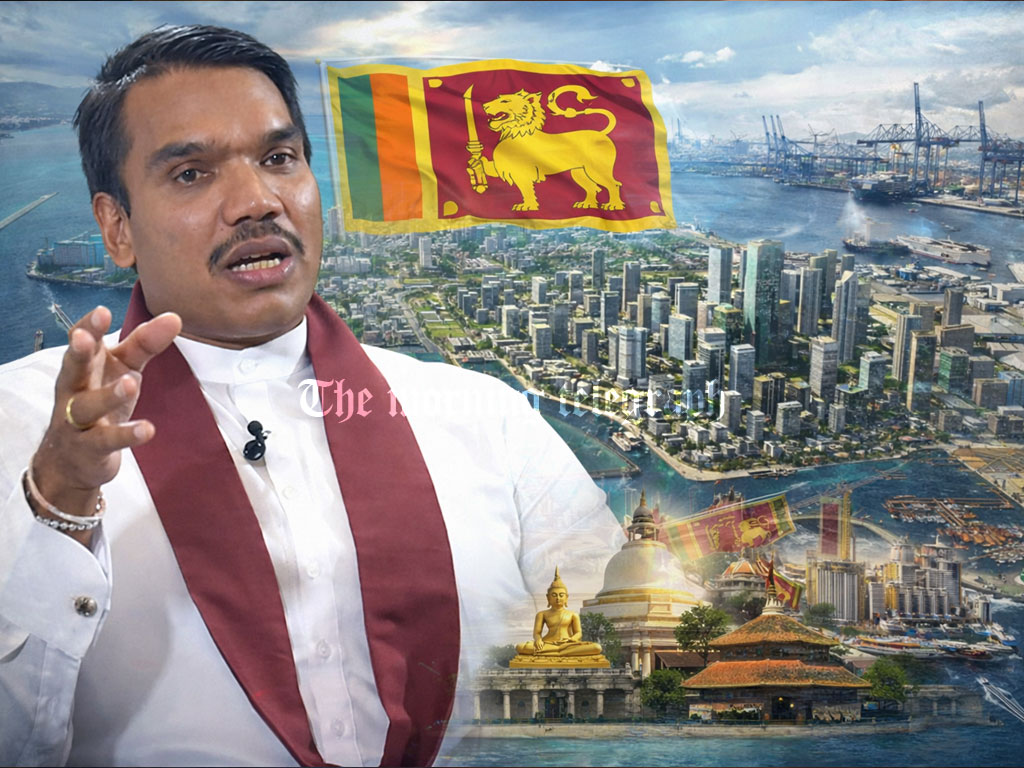
While Sri Lanka’s ports were delayed, other countries in the region moved ahead and built multiple ports, causing the country to lose valuable opportunities, said Namal Rajapaksa, National Organizer of the Sri Lanka Podujana Peramuna. He stressed that modernization must come through strengthening the economy in harmony with culture, religion, and society, not by discarding or undermining them.

Rajapaksa made these remarks while participating in the opening ceremony of the Youth Conference organized by the Youth Organization of the Sri Lanka Podujana Peramuna. Addressing a large gathering of young party members, he emphasized that economic development is not about symbolic arguments or personal criticism, but about preparing young people to be competitive in a rapidly changing world. He remarked that strengthening the economy is about equipping youth for global competition, not about trivial debates such as the size of clothes or personal appearances.
Speaking further, Namal Rajapaksa said the following.
“There are several things that we believe in as a political force. Mainly, we need to build ourselves as a country. If we build ourselves as a country, we need to protect our identity. We need to protect our identity. Modernizing a country does not mean that the culture and religion of that country are obsolete. We need to move towards modernity while protecting our identity. That is why we believe as a party that we must move towards that modernity. We must be modern. Similarly, we must move forward while protecting our culture, religion, and the religion and culture that we believe in. Throughout history, every party has built youth organizations and youth movements politically. That is the reality. Also, in our history, every struggle and every battle has been led by youth. It could be LTTE terrorism, it could be defeating that terrorism and uniting the country, it could be 88, 89, it could be 83. It is possible. It may be 2021/2022.”
He said that in all these events, youth issues were at the center of the struggle. According to Rajapaksa, this is not unique to Sri Lanka but is a common reality across the world. Whether in Bangladesh, Nepal, Indonesia, or in recent history in countries such as Iran, as well as in the Middle East and America, political and social movements have been driven largely by youth.
“Similarly, if the outcome of every struggle bears any fruit, if a country, society, or economy collapses, we should not forget that the youth of that country will have to bear the brunt of the economy of that country. That is a common factor everywhere in the world. Therefore, we believe that the youth of this country should be prepared for the next generation. We are not leading the youth, but rather, the political parties should plan for the future. We have made the biggest contribution in history. The mistake is that we have a government for five years and every government thinks about how to spend that five year period. That is why a theory was formed that dogs and cats cannot cross the road when building expressways.”
Rajapaksa said the unfortunate reality is that although many people continue to criticize large scale development projects, they have failed to seriously study how to utilize the benefits of such investments. Referring to the Colombo Port City, he said it was built as a financial city, but successive governments have not yet fully understood that fact or positioned Sri Lanka correctly in relation to other countries.
“The challenge for Colombo Port City is not the Colombo Investment Promotion Board. The challenge for Colombo Port City is not the Biyagama Trade Zone, nor the Katunayake Trade Zone. Nor is the Hambantota Economic Zone. But the challenge for Colombo Port City is how we position ourselves regionally with the financial cities in our region. So the challenge for Colombo Port City is that the port city is competing with Singapore, Dubai, and China. Then India’s new financial city has been built. We need to position ourselves. How will we position Sri Lanka in the next twenty to thirty years with those cities?”
He said it is no longer relevant to claim that Sri Lanka performed better than previous governments if global competitors have moved far ahead. What matters is understanding where the world stands today and who Sri Lanka is competing against. Without that perspective, past achievements will not remain relevant in the future.
Rajapaksa emphasized that moving with modern global trends does not mean abandoning culture or religion. He said countries around the world are advancing economically while preserving their identities. The real challenge is understanding changes in the global economic structure, navigating regional relationships, entering into effective bilateral and multilateral trade agreements, and generating sustainable employment.
He warned that new jobs will not be created under excessive tax burdens and that investors will not come to a country weighed down by unnecessary regulations and policy instability. According to him, this reality has been clearly demonstrated over the past five to ten years.
Referring to the period of President Mahinda Rajapaksa, he said that many investments brought to the country at that time were strongly criticized. As a result of that criticism, attempts were made to introduce laws to prevent similar investments. The long term consequence, he said, is that investors have stayed away from Sri Lanka until today.
Rajapaksa criticized what he described as a distorted public narrative.
“The person who built the port is blamed. But the person who could not manage the port has become good and the person who built it has become wrong. The person who built the airport is wrong and the person who stored the paddy has become right. The person who built the highway is wrong and the person who struggled for ten years to build the next thirty seven kilometers of the highway has become good. The person who built two hundred and fifty kilometers is wrong, and the governments of the country that could not build thirty seven have become good governments.”
He said there is a deliberate attempt by some groups to change public perception. Within global geopolitical politics, he said, certain countries cannot tolerate Sri Lanka’s development. When Sri Lanka attempts to assert itself as a regional country, it faces pressure at international platforms such as the United Nations, the Human Rights Council, and the SAARC Summit. These geopolitical challenges, he said, must be faced realistically.
Addressing the youth directly, Rajapaksa said they must build the country they aspire to live in. He urged them to focus on what suits Sri Lanka and what is right for the nation, stressing that what needs to be done today cannot be postponed to tomorrow.
He reiterated that digital transformation must be carried out immediately. The technology of today, he said, will not be the same in a few years, or even in a few months. The world is moving rapidly toward a creative economy, and Sri Lanka must adapt without delay.
“How do we create a young generation that generates income within this space? How do we create entrepreneurs within that space? How do we make the entrepreneur of the country a businessman? How do we make the child in school an entrepreneur? These are the things we need to do today.”
Rajapaksa said political instability and attempts to overthrow governments through chaos are no longer viable, not because society has changed morally, but because the world moves too fast. If Sri Lanka fails to act now, other countries will seize its markets and opportunities.
“When our port was late, other countries in the region have started port cities similar to the ones we have today. So the investments that would have come to the Colombo Port City, the companies that would have come to the Port City, the entrepreneurs today have other opportunities in addition to the Colombo Port City.”
He said Sri Lanka is now operating in a highly competitive global environment, not merely competing with its neighbors. Personal attacks, lifestyle debates, and symbolic criticisms, he said, are irrelevant distractions from the real challenges ahead.
Rajapaksa stressed the need for education reform and educational transformation, saying Sri Lanka’s cultural identity remains a strength, particularly in tourism, but economic positioning must align with global technological revolutions.
Concluding his remarks, he said Sri Lanka needs a modern political force that understands the aspirations of the younger generation. Youth organizations, he said, should not exist merely for posters or social media commentary, but to create thinkers, innovators, and leaders. True transformation, he emphasized, must be built on honesty, national pride, compassion, and a clear vision for Sri Lanka’s future.