Namal Rajapaksa unleashes a sweeping political broadside, accusing the government of intimidating the Attorney General, undermining the judiciary, distorting education reforms, and weaponizing institutions to push a collapsing political agenda.
Sri Lanka Podujana Peramuna National Organizer and Member of Parliament Namal Rajapaksa says the government is now attempting to intimidate the Attorney General’s Department and the judicial system in order to force outcomes that suit its political interests. Speaking to journalists at Nelum Mawatha yesterday, Rajapaksa warned that such actions threaten the foundations of the rule of law and democratic governance in Sri Lanka.

He expressed confidence that the Attorney General’s Department and the judiciary would not submit to pressure from the government. He described the current administration as one that has “passed the fifth grade but failed the sixth grade,” arguing that superficial achievements cannot compensate for deeper governance failures.
Responding to questions on national politics, Rajapaksa accused the President of promoting division as a political strategy. He said that under the President’s system, people can no longer freely travel between regions for religious and cultural observances, citing Nagadeepa and Pongal celebrations as examples. According to him, this approach reflects a broader political theory based on spreading hatred and targeting institutions, political parties, officials, and community leaders.
He urged the President to recognize that this brand of politics has lost relevance and warned that empty rhetoric would not resonate with the people. If the President has no meaningful message for the North, Rajapaksa said, he should at least develop a program to protect Tamil culture and allow communities to move forward with dignity.
Rajapaksa rejected accusations of racism against Rajapaksa-era politics and the Sri Lanka Podujana Peramuna. He said their stance was always about defending what was right, regardless of whether it involved Buddhist temples, Hindu kovils, Catholic churches, or Islamic places of worship. He recalled that when the LTTE removed the statue of Madhu Maniya, it was the Rajapaksa government that ended the war and restored religious freedom by enabling the Madhu Maniya festival and ensuring access to religious sites across the country, including Mullaitivu.
He claimed that certain political actors now resort to accusations to conceal real issues. Referring to recent events involving Buddhist monks, Rajapaksa questioned inconsistencies in law enforcement. He noted that monks were arrested and remanded, while later the Buddha statue was brought again under police supervision, raising questions about unequal application of the law. He asked who authorized the second procession involving the statue and why different standards appear to apply to police officers and monks.
Rajapaksa also raised concerns about alleged environmental violations in the Kurunegala district, questioning whether complaints had been filed with relevant authorities regarding forest clearing. He suggested that political connections may be shielding those responsible, warning that if ordinary individuals were involved, officials would already have been suspended or transferred.
According to Rajapaksa, the government is pursuing a deliberate agenda to weaken cultural and religious foundations in the country. He claimed that Buddhist, Catholic, Islamic, and Hindu religious leaders are being targeted through public criticism to distance people from religion. He alleged that this aligns with a broader ideological objective to marginalize religion altogether.
He said Sri Lanka’s culture and identity must be protected and that any government incapable of doing so is failing its core responsibility. He accused the administration of insulting the Maha Sangha on one hand, criticizing religious leaders on another, and enforcing laws that do not exist, resulting in monks being placed in remand custody.
Rajapaksa also addressed infrastructure projects initiated under former President Mahinda Rajapaksa, noting that several were launched between 2012 and 2013 but were delayed by subsequent governments, the Covid pandemic, and the economic crisis. He said projects stalled for over a decade are now being completed, and while he welcomes their completion, he pointed out the irony of those who once criticized these projects now inaugurating them.
He said he finds it ironic that critics who once opposed such initiatives are now approving and opening them. Despite this, he said he is pleased that development work has finally progressed, regardless of who cuts the ribbon.
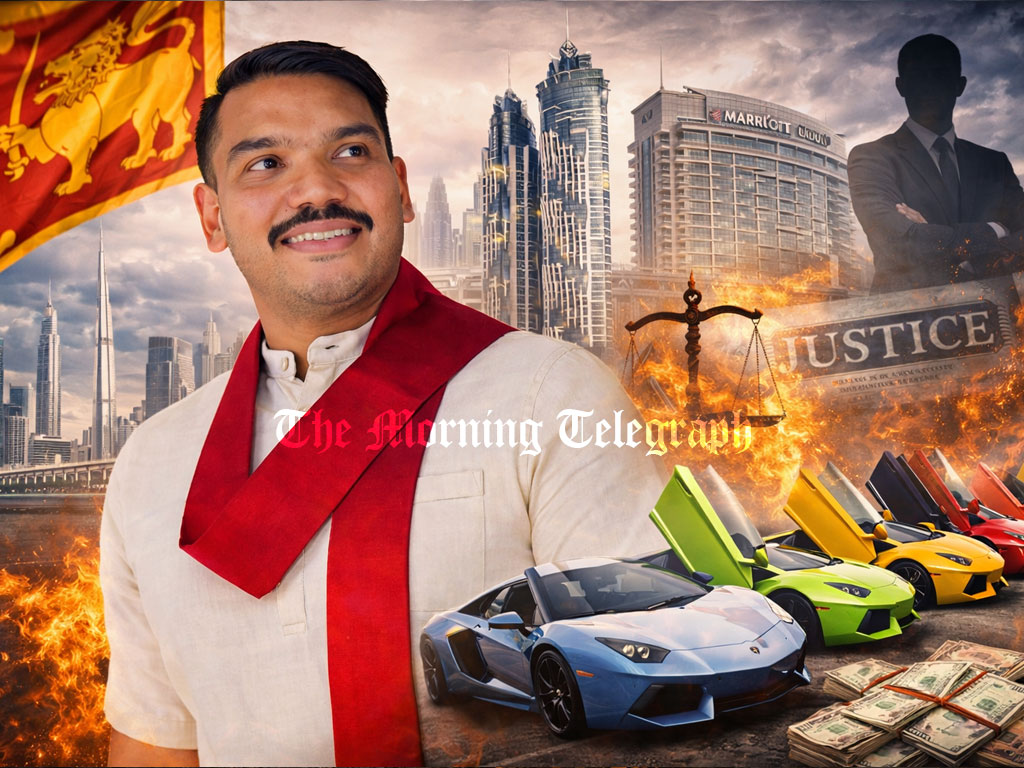
Turning to corruption allegations, Rajapaksa mocked repeated claims that billions of dollars were hidden abroad. He said, “I am still waiting for the eighteen billion dollars from Uganda, the Marriott Hotel in Dubai, and the Lamborghini to arrive,” accusing the government of spreading falsehoods. He questioned who led past anti-corruption efforts, who heads the police ministry now, and how figures associated with previous administrations continue to hold power.
He raised serious questions about accountability for the Easter Sunday attacks, asking who concealed responsibility and why political appointments continue to shape investigations. He alleged that false evidence has been fabricated and presented to the Attorney General in an attempt to validate narratives constructed on political platforms.
Rajapaksa emphasized that regardless of how much false information is presented, the Attorney General and the judiciary must act strictly according to existing laws. He warned that failure to do so would deepen politicization, recalling past instances involving judicial transfers and institutional interference.
He said the government’s pattern is clear. First politicians were intimidated, then officials, and now the Attorney General’s Department and judiciary are being targeted. He reiterated his belief that these institutions would not yield to pressure.
Using an education analogy, Rajapaksa said passing the fifth grade means nothing if one fails the sixth grade. He urged the government to verify facts before publishing educational content and to take responsibility when mistakes are made. He called for reforms that genuinely improve education rather than cosmetic changes.
On governance failures, he pointed to controversies in coal procurement, substandard medicine, education, and law enforcement. He said officials are consistently blamed while politicians escape accountability. He cited cases where police officers were punished for accidents or drug seizures, while political actors remained untouched.
Rajapaksa argued that the government operates with a mindset that only a select few are right while everyone else is wrong. He accused the administration of failing to honor promises made to the people and ignoring losses caused by mismanagement, including issues related to tenders, military supply contracts, and public funds.
He concluded by saying that Sri Lanka urgently needs education reform suited to modern realities but warned that modernization should not corrupt the minds of young children. He urged journalists and parents to ask the right questions about curriculum content rather than accepting vague reform narratives. He stressed that while education must evolve, it must also respect cultural values and parental responsibility.