As international pressure mounts on Sri Lanka over wartime accountability, India’s sudden glorification of the IPKF revives uncomfortable questions about intervention, destabilisation, and selective human rights narratives that the world prefers to forget.
A day after the United Nations once again reiterated allegations that sexual violence had been part of a deliberate, widespread, and systemic pattern of violations by the Sri Lankan military, which it claimed may amount to war crimes and crimes against humanity, India chose to publicly commend its own military operations in Sri Lanka carried out between 1987 and 1990 under the banner of the Indian Peacekeeping Force.

The timing was striking. As Sri Lanka faced renewed scrutiny, India praised the conduct and sacrifices of the IPKF, a force whose legacy remains deeply controversial among Sri Lankans across ethnic and political lines. Almost immediately, as if in echo, Human Rights Watch issued a statement dated January 15, 2026, from Geneva, citing its Deputy Asia Director Meenakshi Ganguly.
While referring to alleged abuses by Sri Lankan forces, Ganguly stated: “While the appalling rape and murder of Tamil women by Sri Lankan soldiers at the war’s end has long been known, the UN report shows that systematic sexual abuse was ignored, concealed, and even justified by Sri Lankan government’s unwillingness to punish those responsible.”
She went on to assert that Sri Lanka’s international partners needed to intensify efforts to promote accountability for war crimes in Sri Lanka. The framing was familiar, placing Sri Lanka once again at the centre of global condemnation while leaving other actors untouched by scrutiny.
To point fingers at Sri Lanka, or at any weak state, is not a moral high ground that Human Rights Watch can occupy without question. In 2012, HRW accepted a donation of 470,000 dollars from Saudi billionaire Mohamed Bin Issa Al Jaber, with the explicit condition that the funds not be used for its work on LGBT rights in the Middle East and North Africa. The donation was kept internal until an internal leak exposed the transaction in 2020 through reporting by The Intercept. Executive Director Kenneth Roth was implicated in the scandal, and the funds were refunded only after public exposure.
The United Nations, too, carries its own burden of selective morality. Its continued silence, or deliberate blindness, toward the ongoing mass suffering of Palestinians and other victims of Western-backed military campaigns in West Asia raises serious questions about consistency and credibility.
Human Rights Watch titled its statement “Sri Lanka: UN Finds Systemic Sexual Violence During Civil War,” with the strap line “Impunity Prevails for Abuses Against Women, Men; Survivors Suffer for Years.” Yet nowhere in the statement was there any reference to atrocities committed during the Indian Army’s deployment in Sri Lanka.
The Island newspaper sought responses from Meenakshi Ganguly on this glaring omission. Specific questions were raised regarding allegations from the period between July 1987 and March 1990, when the Indian Army controlled the Northern and Eastern Provinces under the Indo Lanka Accord while the Sri Lankan military remained confined to camps. Queries also included whether HRW had urged the Indian government to act against its personnel for violations in Sri Lanka and whether complaints had been received from foreign citizens of Sri Lankan origin.
Ganguly’s response was cautious and noncommittal. She stated that HRW could not speak about UN methodology and suggested directing such questions to the Office of the High Commissioner for Human Rights. She reiterated HRW’s hope that Sri Lankan authorities would take UN findings seriously regardless of the perpetrator, support survivors, and ensure accountability.
Mantri on IPKF
India’s official statement issued on January 14, 2026, regarding the role of its Army in Sri Lanka carries particular significance at a time when international pressure on Sri Lanka is intensifying. Addressing approximately 2,500 veterans at the Manekshaw Centre in New Delhi, Indian Defence Minister Raksha Mantri spoke at length about the IPKF deployment, notably without referencing other conflicts involving Indian forces.
India lost around 1,300 personnel during its Sri Lanka mission, which at its peak involved nearly 100,000 troops. According to India’s national portal, Raksha Mantri recalled the bravery of soldiers involved in Operation Pawan, describing it as a peacekeeping mission and lamenting that their sacrifices had not received due recognition.
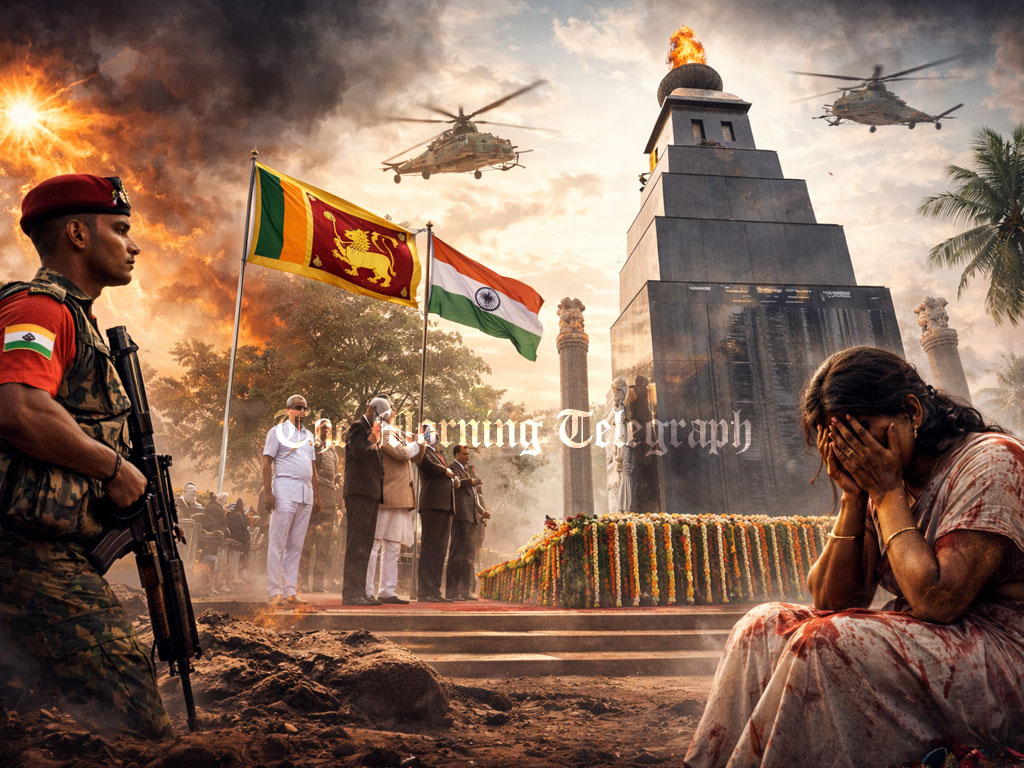
He stated that under Prime Minister Modi’s leadership, the government was now openly acknowledging the contributions of IPKF soldiers. He noted that during Modi’s 2015 visit to Sri Lanka, the Prime Minister paid respects at the IPKF Memorial and that India was now recognizing IPKF contributions at the National War Memorial in New Delhi.
Raksha Mantri, a former president of the Bharatiya Janata Party and a former Home Minister, has held the defence portfolio since 2019. Notably, no similar public emphasis on the IPKF had been made by any defence minister appointed by Modi since 2014.
The attempt to portray Operation Pawan as a peacekeeping mission is deeply misleading. The Indian Army’s presence in Sri Lanka cannot be separated from the destabilisation project initiated by India in the early 1980s. Operation Pawan was not launched to keep peace but emerged from a failed attempt to disarm militant groups that India itself had trained and supported.
Once the disarming process collapsed in August 1987 and the LTTE orchestrated the mass suicide of detained cadres at Palaly airbase, the so-called peacekeeping mission transformed into a full-scale military campaign. The Indian Army soon found itself fighting the very militants it had earlier nurtured.
Raksha Mantri also referred to the Indian Army memorial in Battaramulla, apparently unaware of the earlier monument erected at Palaly in memory of 33 Indian commandos of the 10 Para Commando unit, including Lieutenant Colonel Arun Kumar Chhabra, who died during the ill-fated raid on Jaffna University at the start of Operation Pawan.
BJP politics
The announcement that IPKF soldiers are now recognized at the National War Memorial raises important political questions. If this decision had been taken earlier, it would have been announced earlier. Prime Minister Modi, who has won three consecutive terms in 2014, 2019, and 2024, did not prioritize this recognition during his first two terms.
The original National War Memorial built after the 1971 Indo Pakistan war was inaugurated in 1972. Modi later commissioned a new memorial near India Gate, completing it during his first term. Yet the IPKF was excluded until now.
Honouring fallen soldiers is not in itself objectionable. What cannot be ignored is that the IPKF deployment was part of a broader destabilisation effort that inflicted immense suffering on Sri Lanka. India cannot absolve itself of responsibility for the consequences of decisions taken by Indira Gandhi and later executed by Rajiv Gandhi.
India’s intervention empowered terrorism as a strategic tool to compel Sri Lanka to accept the Indo Lanka Accord under duress. The forced air drop over Jaffna in June 1987 halted Operation Liberation, which was close to defeating the LTTE. Sri Lanka was pressured into enacting the 13th Amendment, temporarily merging the Northern and Eastern Provinces, fulfilling a long-standing separatist demand.
The Indian Army’s role in installing an administration loyal to New Delhi in the merged province further exposed the true intent behind the intervention. The establishment of the EPRLF-led North Eastern Provincial Council and the creation of the so-called Tamil National Army underscored India’s direct involvement in Sri Lanka’s internal political engineering.
Indian intervention also triggered a violent backlash in the South. The Janatha Vimukthi Peramuna launched an insurgency, targeting Indian interests and symbols, including economic goods associated with India. This period saw widespread violence and instability, further deepening Sri Lanka’s trauma.
The North Eastern Provincial Council elections of 1988 reflected the artificial political order imposed under Indian supervision. The EPRLF dominated the council, supported by groups closely aligned with Indian intelligence, including the ENDLF, an organization formed in India by defectors from other militant groups and accused of serious abuses.
These groups withdrew alongside the IPKF in 1990, fully aware that their survival depended on Indian protection. Their departure marked the collapse of India’s political experiment in Sri Lanka.
Dixit on India move
J N Dixit, India’s High Commissioner to Sri Lanka from 1985 to 1989, later provided candid insights in his memoir Makers of India’s Foreign Policy. He acknowledged that the decision to intervene militarily in Sri Lanka was taken by Indira Gandhi during her second tenure as Prime Minister.
Dixit admitted that this decision, which ultimately contributed to widespread death, destruction, and the assassination of Rajiv Gandhi, was driven by India’s strategic calculations. He described the intervention as unavoidable from India’s perspective, citing Sri Lanka’s alleged discrimination against Tamils and its developing security ties with the United States, Pakistan, and Israel.
What Dixit did not acknowledge was that Sri Lanka had no need to expand its military until India armed and trained militant groups. The LTTE’s ability to carry out the Thinnaveli ambush in July 1983, killing 13 soldiers, including an officer, was made possible through Indian training. That incident marked the beginning of a conflict that lasted nearly three decades.
Anti India project
Dixit also referred to alleged Chinese involvement and broader geopolitical rivalries involving Pakistan and the United States. Yet he ignored the reality that Sri Lanka never sought to militarize until terrorism, nurtured from Indian soil, overwhelmed its security apparatus. Tamil Nadu served as a sanctuary for militants, while wounded fighters received treatment in Indian hospitals.
In the concluding section of his chapter, Dixit criticized Indira Gandhi’s Sri Lanka policy as one of her major foreign policy miscalculations. He acknowledged that her support for Sri Lankan Tamil militants was a grave error, even if driven by India’s perceived national interests.
Dixit justified her actions by arguing that India could not afford Tamil separatism spilling into its own territory. He described Tamil aspirations in Sri Lanka as legitimate, citing decades of discrimination. This narrative continues to dominate international discourse, often without acknowledging the immense harm caused by external interference.
The author of this analysis encountered Dixit’s memoir during a visit organized by India’s External Affairs Ministry in 2006, at the start of Eelam War IV. It is doubtful that New Delhi anticipated Sri Lanka’s decisive military victory within less than three years.
Despite numerous violations committed by all sides during decades of conflict, sexual violence was never state policy in Sri Lanka. The latest UN report on accountability for conflict related sexual violence is part of a long series of post-war initiatives targeting Sri Lanka’s military.
The damage was compounded when the Sirisena Wickremesinghe government endorsed the Geneva accountability resolution in October 2015, legitimizing external pressure and undermining national sovereignty. That decision continues to fuel an anti Sri Lanka campaign that ignores historical context, external culpability, and the complex realities of war.
As India now seeks to rehabilitate the IPKF’s image, the selective memory of international actors stands exposed. Accountability cannot be selective. History cannot be rewritten without confronting uncomfortable truths.