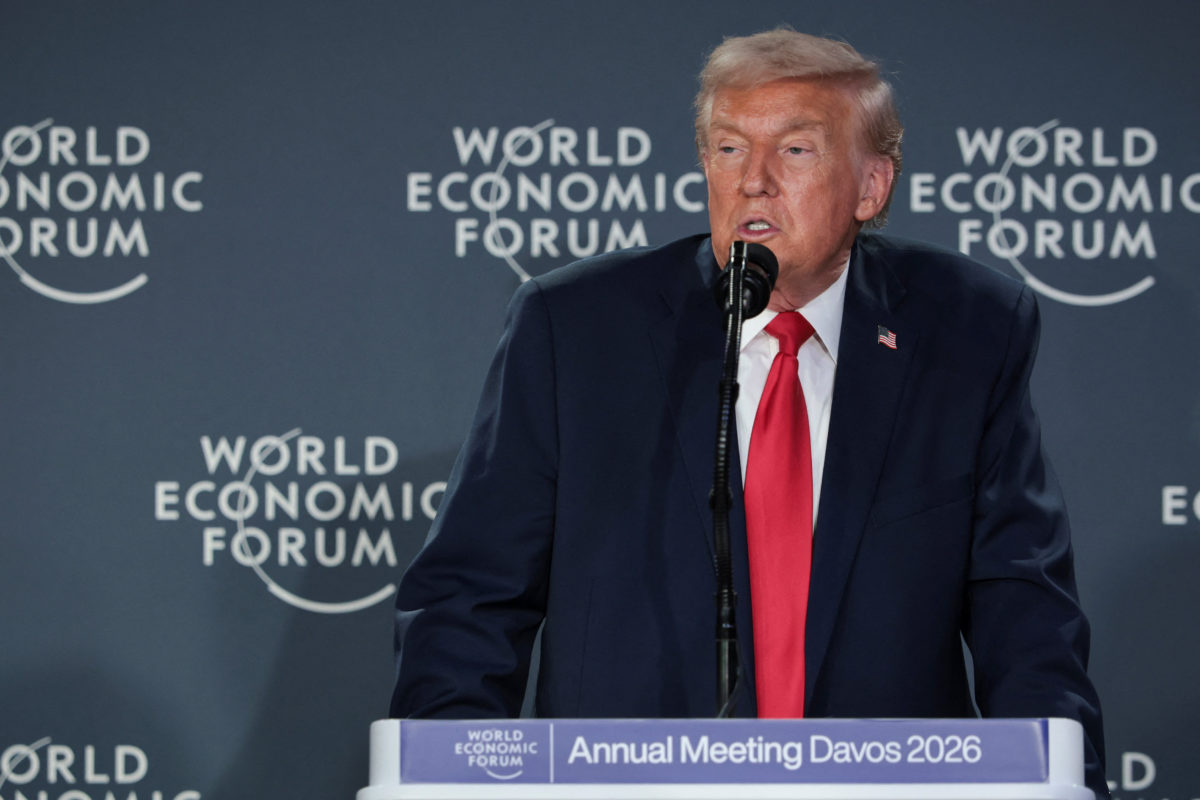
U.S. President Donald Trump speaks during a reception with business leaders, at the 56th annual World Economic Forum (WEF), in Davos, Switzerland, January 21, 2026. REUTERS/Jonathan Ernst
By Jonathan Ferreira
President Donald Trump said the United States had discussed a framework for a future agreement involving Greenland after talks with Nato leaders, while stepping back from earlier threats to impose tariffs on European allies. Speaking after meetings at the World Economic Forum in Davos, Trump said discussions had been very productive and suggested a potential deal could address American security interests in the Arctic. However, there was no indication that any agreement would include US ownership of Greenland, despite Trump repeating his long held desire for control of the territory.
Trump said the proposed framework could involve cooperation on security and access to Greenland’s mineral resources, which include rare earth elements vital for modern technologies. He added that negotiations would continue under the oversight of Secretary of State Marco Rubio and envoy Steve Witkoff. Danish officials responded cautiously, saying they were open to dialogue on security and economic issues but firm that Denmark’s sovereignty over Greenland was not negotiable. Nato officials also said that discussions did not include the issue of Danish control, while Greenlandic representatives stressed that decisions about the island must involve its people directly.
The US president also confirmed he would not proceed with planned tariffs against several European countries after his meeting with Nato Secretary General Mark Rutte. Trump had previously threatened to impose sweeping import taxes unless progress was made on Greenland, a move that alarmed European leaders. In Davos, he ruled out using military force to achieve his goals but continued to pressure allies to support negotiations. European leaders including France’s Emmanuel Macron criticised Trump’s earlier tariff threats as unacceptable, while Trump responded with sharp remarks aimed at several counterparts. Despite the rhetoric, officials said talks would continue, with a focus on Arctic security, investment and long term cooperation rather than immediate territorial change.