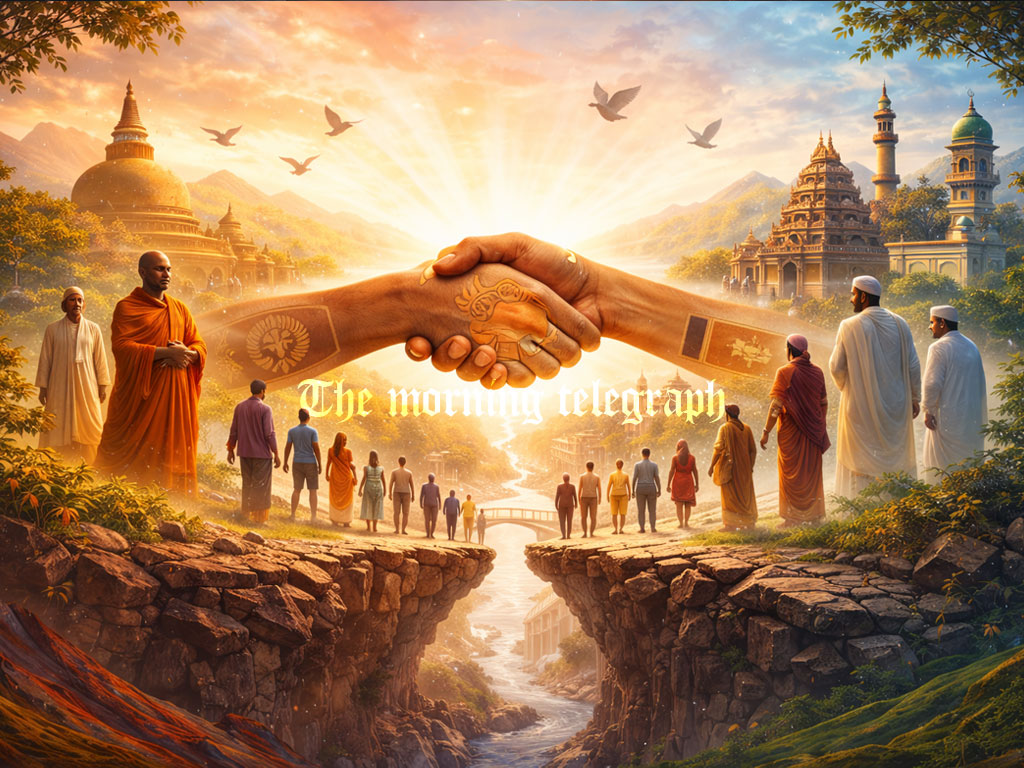
Racism thrives not because people are born hateful, but because they are kept apart. Sri Lanka’s tragedy was never race alone, but the politics of separation disguised as justice.
Racism, friends, is the narrow minded attitude of acting with prejudice, hatred, or discrimination toward other races, rooted in the belief that one’s own race is superior. It is easy to name it. It is harder to understand why it grows.

In countries where people of different ethnicities, religions, and languages live together, racist sentiment does not arise naturally. It grows when communities live apart in separate territories, when people do not meet, work together, eat together, or share daily life. Distance creates imagination, and imagination breeds fear.
The real struggle faced by both the North and the South of Sri Lanka was not racism. It was socio economic pressure tied to poverty, unemployment, and survival. Almost all daily hardships experienced by ordinary people had little to do with race. Yet racist leaders in both regions chose to sell a different story. They framed poverty as racial oppression, and suffering as ethnic persecution, because division brought them political advantage.
This thinking shaped the main strategy of the LTTE, which sought to remove Sinhalese people entirely from the North. In parallel, rulers in the South used fear and silence as tools to relieve pressure from Tamil communities living among them. The result was tragedy layered upon tragedy.
In a dark month of July, the LTTE murdered hundreds of pilgrims who had come to worship at the Sri Maha Bodhi in Anuradhapura. The message was clear. This is the furthest boundary Buddhism could reach. Hatred spoke in bullets.
On May 18, 2009, that violent chapter ended. On that day, a Tamil mother who had escaped after being used as a human shield spoke through tears. “Tell the king to save all our people.” At that moment, the king was the legally elected president of Sri Lanka. That plea cut deeper than ideology. It was the greatest blow casteism and racial madness had ever received.
After the war, rebuilding had to be human, not symbolic. The Yal Devi train to the North mattered. The Northern Expressway mattered. Movement mattered. People from the South went North. People from the North came South. They worked, traded, settled, married. Children were born to Sinhalese fathers and Tamil mothers, children who did not know which label they belonged to.
Languages crossed. Temples rose in the North. Kovils appeared in the South. This was the beginning of a human journey, not a political slogan.
Racism will never disappear if Buddhists stay only in the South, temples only in the North, mosques only in the East, and churches only in Negombo. Reconciliation comes when Tamils worship in southern temples and Sinhalese prepare their food. When Sinhalese worship in the North and Tamil hands serve them.
Federalism, land powers, and police powers deepen separation. Unity is built through shared religious, cultural, and linguistic space. When Buddhists go beyond Anuradhapura, it must be with compassion, not conquest. Hatred must not be planted in the minds of Northern people.
Imagine saying, “You give us a temple when we come South. We will give you one when you come to Kataragama.” That is unity.
Professor Sunil Ariyaratne and Nanda Malini sang it best. Sihala, Dravidian, Muslim friends. Buddhist, Christian, Hindu, Islamic brothers. Born together, fought together, died together.
Do not call this racism. Ask instead who truly profits from keeping us apart.