
A sweeping US-backed vision promises a glittering coastal Gaza of towers, ports, and industry, but critics warn the plan risks deepening political, humanitarian, and security fault lines rather than healing them.
The United States has unveiled an ambitious and highly controversial blueprint for a “new Gaza,” outlining a dramatic reconstruction of the war-ravaged Palestinian territory into a modern urban and economic hub along the Mediterranean coast. The proposal, presented through detailed slides, shows skyscrapers, large-scale housing developments, agricultural and industrial zones, and infrastructure designed for a population of approximately 2.1 million people.

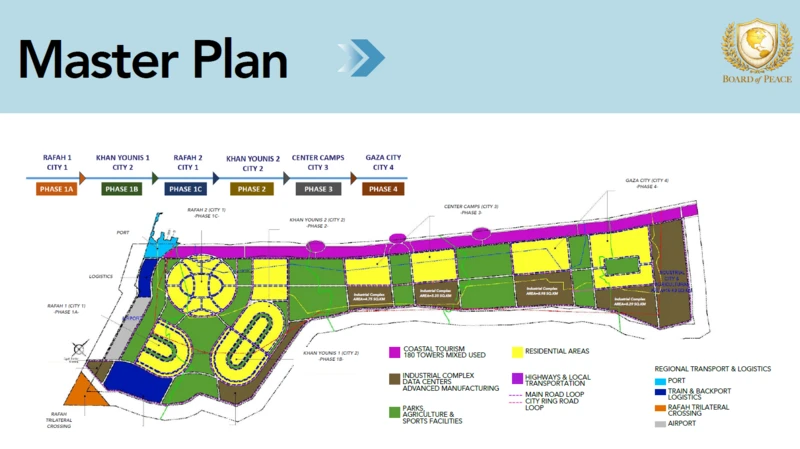
The plan was formally introduced at the World Economic Forum in Davos during a signing ceremony for President Donald Trump’s newly formed peace council, tasked with ending the two-year Israel–Hamas war and overseeing Gaza’s reconstruction. The presentation included visual maps depicting a transformed coastline lined with high-rise towers, new residential districts in Rafah, and phased development stretching northward toward Gaza City.
“We’re going to be very successful in Gaza. That’s going to be great,” Trump said at the event. Framing the proposal through a real estate lens, he added, “I’m a real estate developer at heart, and it’s all about the location. I say, ‘Look at this sea. Look at this beautiful property. Think about what this is going to be like for people.’”
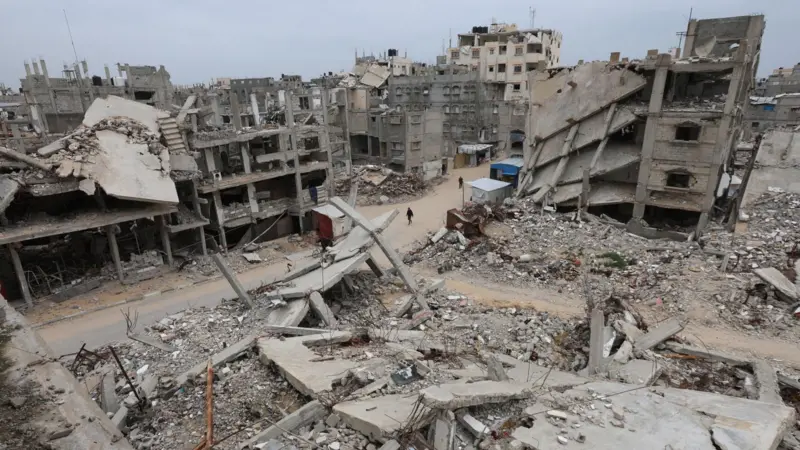
Trump’s son-in-law Jared Kushner, who played a central role in brokering the ceasefire that took effect in October, emphasized the scale of destruction driving the plan. He stated that around 90,000 tons of bombs had been dropped on Gaza, leaving behind nearly 60 million tons of debris that must be cleared before rebuilding can begin.
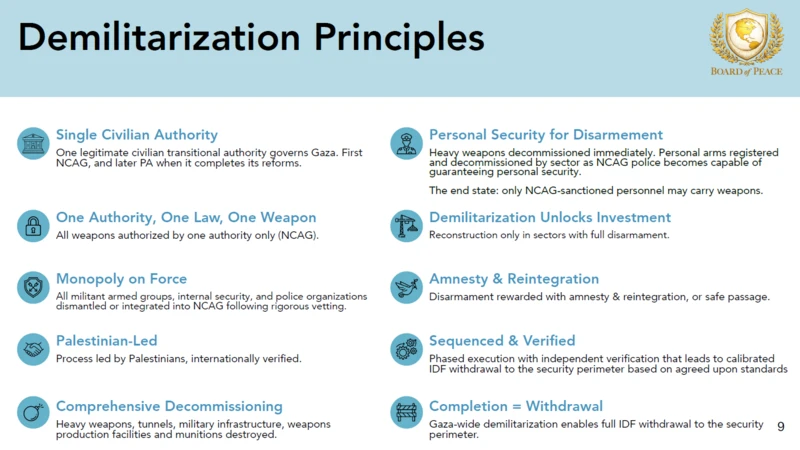
“Initially, we were like, ‘Let’s create a free zone, and then we’ll have a Hamas zone.’ Then we said, ‘You know what, we’re planning for a huge success,’” Kushner said. “We signed an agreement to demilitarize Hamas, and that’s what we’re going to do. People ask us what our Plan B is. We don’t have a Plan B.”
According to the master plan, Gaza would be divided into functional zones including coastal tourism areas with 180 skyscrapers, residential neighborhoods, industrial complexes, data centers, advanced manufacturing hubs, and green spaces for parks, agriculture, and sports facilities. The blueprint also includes a new port and airport near the Egyptian border, as well as a “trilateral crossing” at the junction of Egyptian and Israeli borders.
The redevelopment is structured in four phases, beginning in Rafah and gradually expanding north. A designated strip of empty land along Gaza’s borders with Egypt and Israel is marked as a “security zone,” where Israeli forces would remain “until the Gaza Strip is properly secured,” according to Trump’s broader 20-point peace plan.
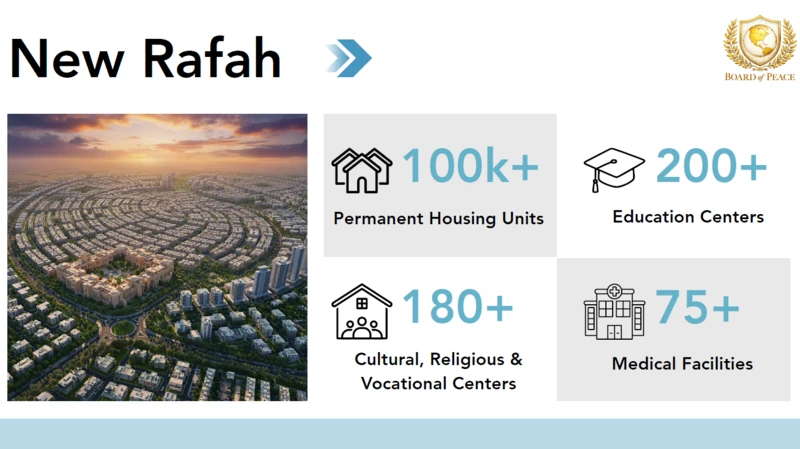
Another slide highlighted plans for “New Rafah,” featuring more than 100,000 permanent housing units, 200 educational institutions, and 75 medical facilities. Rafah, once home to about 280,000 residents, was largely flattened during Israeli military operations and currently lies under Israeli control.
Kushner said construction could be completed within two to three years. “We’ve already started clearing the rubble and demolishing some of the buildings. Then the new Gaza Strip will be built. It could be a hope, it could be a destination, it could have a lot of industry,” he said. He added that international contributions would be announced at a Washington conference in the coming weeks, pointing to “amazing investment opportunities” for the private sector.
The plan has revived global controversy following Trump’s earlier remarks suggesting Palestinians could be permanently relocated to neighboring countries, with Gaza transformed into a “Middle Eastern Riviera.” Kushner reinforced the security-first approach, stating, “Nobody will invest without security,” and confirming that demilitarization efforts “are starting now.”
He said the National Committee for the Administration of Gaza, described as the new Palestinian governing body in the territory, would work with Hamas to implement demilitarization. Hamas has historically rejected disarmament without the establishment of an independent Palestinian state.
Trump issued a blunt warning: “They have to lay down their arms. If they don’t, that will be the end of them.” He also demanded the return of the body of the last Israeli hostage killed in Gaza, insisting it should have been handed over before the second phase of the peace plan.
The ceasefire remains fragile. At least 477 Palestinians have been killed in Israeli strikes over the past three months, according to Gaza’s Health Ministry, while Israel reports the deaths of three soldiers in attacks by Palestinian armed groups. On Thursday alone, five people were reportedly killed in Israeli shelling across Gaza.
The United Nations warns that humanitarian conditions remain dire, with nearly one million people lacking adequate shelter and 1.6 million facing acute food insecurity. Hamas has accused Israel of undermining ceasefire efforts, while Israeli President Isaac Herzog praised Trump’s leadership but stressed that “the real test is Hamas’ withdrawal from Gaza.”
Palestinian Authority President Mahmoud Abbas called for full implementation of the peace plan, including Israeli withdrawal and a central administrative role for the PA. Meanwhile, NCAG head Ali Shaath announced the reopening of the Rafah crossing next week, calling it a signal that “the Gaza Strip is no longer closed to the future and to war.”
The conflict began with Hamas’ October 7, 2023 attack on southern Israel, killing about 1,200 people and taking 251 hostages. Israel’s subsequent military campaign has killed more than 71,560 people in Gaza, according to local health authorities, leaving behind a shattered territory now at the center of one of the most ambitious and disputed reconstruction visions in modern conflict history.
SOURCE:- BBC SINHALA